


Yes, but a sinus lift is usually needed to ensure proper bone support.
It’s a familiar story: either you’ve been told or you’ve just figured it out yourself that your jawbone “isn’t enough” for dental implants. It really hurts inside. You want your smile back, but it seems like your facial anatomy is against you. Most times the reason is sinus prolapse, or medically termed as sinus pneumatization.
The most concise and direct response is definitely yes. You can have dental implants even if your sinus floor has dropped.
However, that doesn’t mean it is as straightforward as just drilling a post into place. When the sinus expansion encroaches on the area where your tooth roots were, that is the space we have to reclaim. At Lema Dental Clinic in Istanbul, Turkey, we don’t see this as a dead-end; it’s a regular architectural problem we solve.
How to Visualize a “Dropped Sinus”
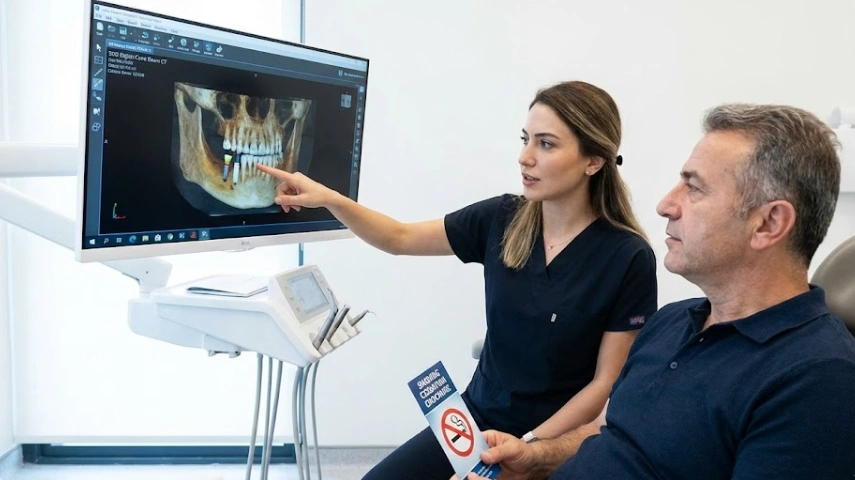
Once you lose your teeth, your body goes “Well, I don’t really need this bone, do I?” and starts resorbing it. At the same time, the air-filled sinus above pushes down, similar to a heavy tent that collapses because its poles were removed. That is what sinus prolapse is.
The consequence?
So you’re left with a very thin bone layer, just like a piece of tissue paper, which not only can’t hold the weight of the implant, but if you decide to, the implant will very likely poke into your sinus cavity—something we always avoid.
How It Works: The Sinus Lift
A skyscraper needs a really solid foundation. If the ground is not deep enough, you bring in more soil to build it up. That is what a Sinus Lift (Sinus Augmentation) is all about.
After a number of cases, we at Lema Dental Clinic view this as a highly reliable procedure in contemporary dentistry. Our method includes raising the sinus membrane a little, then placing the bone graft’s volume underneath.
One of the leading maxillofacial surgeons in Turkey Professor Doctor Coşkun Yıldız always highlights that the success of an implant in this particular scenario depends 90% on the gentle touch of that membrane. It’s the surgeon’s skill and steadiness of hand that are needed, not just the dentist’s drill.
Treatments We Offer in Turkey
We choose the way based on how much bone you have left:
- Internal (Closed) Lift: If the extra height you need is just 2-3mm, we can do this through the same tiny hole made for the implant. It’s less invasive and gets healed bit quicker.
- External (Lateral Window) Lift: When the bone is almost gone (less than 4-5mm), we make a small window on the side of the gum to place a larger volume of a bone graft.
The Team that Works for You: From Surgery to Smile
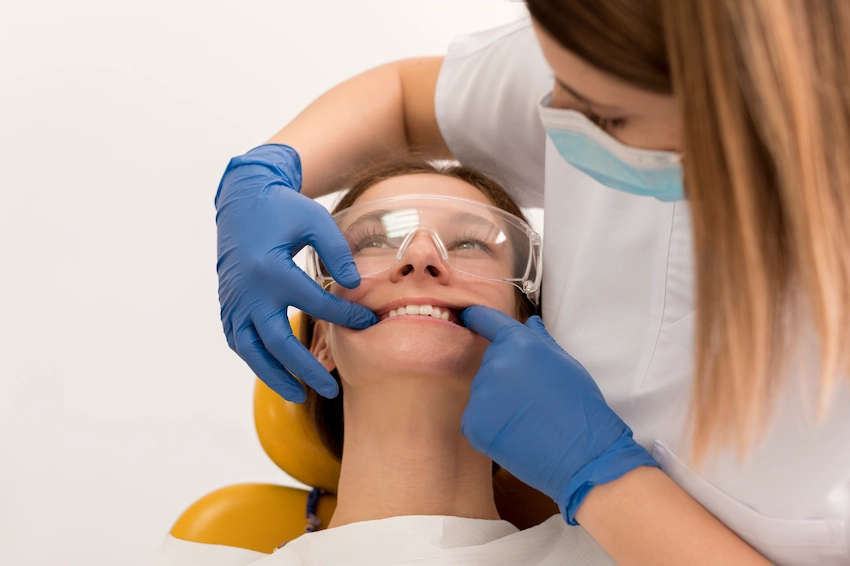
Though the surgery itself appears quite vigorous, the healing is more than often very easy and quick. Most of our patients in Istanbul go back to sightseeing in one or two days, if not sooner, and they take painkillers only occasionally and at very mild doses.
With the stage set, the real creative work starts. Dentist Polen Akkılıç and her staff join the play, and to the extent they can, Dt. Akkılıç’s great artistic talent is at their disposal to shape the visible part of the tooth.
Comparing Your Options
Many patients wonder whether they can do away with surgery and progress with a bridge or a shorter implant. Here, we compare the offsets.
| Feature | Standard Implant (No Lift) | Implant with Sinus Lift | Short/Mini Implants |
| Suitability | Only for patients with thick vertical bone | Best for patients with sinus prolapse or bone loss | For patients who cannot undergo major surgery |
| Stability | High | Very High (after graft consolidation) | Moderate to Low (less surface area) |
| Longevity | 20+ years / Lifetime | 20+ years / Lifetime | Variable (higher failure risk in soft bone) |
| Treatment Time | 3–6 months | 6–9 months (includes graft healing) | 3–4 months |
| Cost | Standard | Higher (surgery + graft material) | Lower initially, potentially higher if failure occurs |
Most Common Questions
No, it won’t. Everything is done inside. The graft placement is inside the jawbone socket. Actually, we often see a reversal of the aging effect because a major facial feature collapse is associated with bone loss which we are preventing by restoring the jawbone.
Typically, we advise the patient not to travel by plane for at least 48 to 72 hours. It is somewhat uncomfortable and painful for the sinuses to deal with changes in the cabin pressure immediately after surgery. But after this short time, it’s totally safe.
You will not be able to feel the surgery. Local anesthesia will be used and sedation is also available if you are anxious. After the surgery, there might be some stuffiness, like a mild head cold and some swelling, but it’s quite rare for the pain to be severe.
Anything good is worth waiting for. If the bone is reasonably sound, Dr. Coşkun Yıldız might implant at the same time with the lift. If the bone is so fragile as paper-thin we take the conservative approach: we lay the graft, let it transform (i.e. we let the donor material become new host bone) for 4-6 months, then put the implant in. That creativity renders the result flawless.
It is all about quantity as well as proficiency level. A general dentist in Europe might be lucky to see one sinus lift in a whole month. The surgeons of Lema Dental Clinic perform these procedures every day. We combine high-end biological materials with costs that are significantly lower than the UK or US without compromising on the sterility or skill.
- Testori, T., et al. (2019). Maxillary Sinus Surgery and Alternatives in Treatment. Quintessence Publishing.
- Esposito, M., et al. (2010). Effectiveness of sinus lift procedures for dental implant rehabilitation: a Cochrane systematic review. European Journal of Oral Implantology, 3(1), 7-26.
- Pjetursson, B. E., & Lang, N. P. (2014). Sinus floor elevation utilizing the transalveolar approach. Periodontology 2000, 66(1), 59-71.
- Wallace, S. S., & Froum, S. J. (2003). Effect of maxillary sinus augmentation on the survival of endosseous dental implants. A systematic review. Annals of Periodontology, 8(1), 328-343.
- Boyne, P. J., & James, R. A. (1980). Grafting of the maxillary sinus floor with autogenous marrow and bone. Journal of Oral Surgery, 38(8), 613-616.

