


Never eat with grillz; always remove them before meals to prevent enamel decay and bacteria.
Occasionally, we see a patient at Lema Dental Clinic in their consultation rooms that stun us with a very fancy, brilliant,t and shiny piece of jewellery made from high-karat gold. Such patients first appear to be passionate about a perfect “million-dollar smile,” and then they ask the typical question, “Can I keep these on while I am eating?”
In fact, metal teeth may still be metal teeth even if they look like a part of your body. Really, one needs to understand that grillz are mainly more like jewelry rather than dental prosthetics. Here is a medical explanation of why it is not good for your food to come in contact with your “front teeth“.
Why Your Grill Cannot Work as a Kitchen Tool?
Consider your teeth to be a building’s foundation. When Dentist Polen Akkılıç and her team manufacture a veneer or a crown, they are strengthening that foundation. However, a grill is akin to a heavy, loosely-fitting carpet being placed on a wet floor
Truth be told, your teeth are built to bear enormous vertical forces. But if you put a metal sheet in between your upper and lower jaws, the pressure changes unpredictably. You are not simply biting; you are scraping metal with enamel.
The “Microbial Greenhouse” Effect
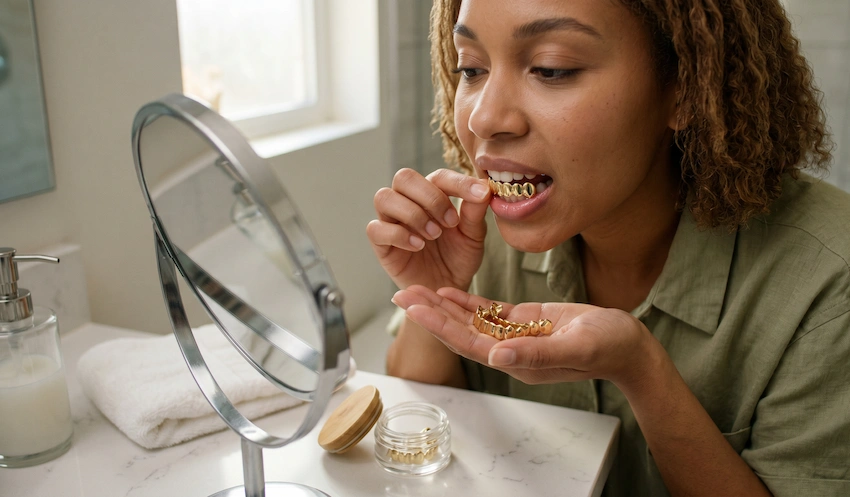
Imagine if you decided to put on a single-layer raincoat for jogging a marathon. Inside, you’d perspire heavily, wouldn’t you? Well, this is exactly the situation your teeth face when you consume food with grillz on.
Professor Dr. Coşkun Yıldız is making a point that the space between the gold teeth can be referred to as a “petri dish.” Impending detrimental substances like food particles and sugars do not remain passive; they go through the process of fermentation. Within a few minutes, acid starts to erode the tooth’s enamel because saliva, which is the natural agent of cleaning,g is not able to get to the tooth surface. You have practically given the signal for the development of a cavity immediately, ly without any hesitation.
Eating in Your Gold: The Perils You Don’t See
However, what we see in the chair makes us suspect eating with grillz is related to more than just cavities. In fact, it’s about the structural integrity of your teeth.
- Gum Damage: Sometimes, the grill edges can cut. With the help of every bite, the metal injures the “free gingiva” (the unattached gum tissue), which may result in gum recession that won’t be reversed.
- Galvanic Shock: A rather unusual scenario. Let’s say you have a silver filling and put on a gold grill. Eating results in a very small electric current being produced between the metals. It is an unpleasant sensation, and you would like to avoid it.
- The Sandpaper Effect: Even the greatest quality gold is harder than food but softer than some ceramics. The continuous rubbing during the process of mastication behaves like sandpaper and gradually removes the enamel.
Style vs. Function: Making a Choice
| Feature | Removable Grillz | Permanent “Deep Cut” | Lema Dental Veneers |
| Eating Capability | Absolutely Not | Really Limited | Complete |
| Enamel Safety | Safe (only if taken out) | Very Dangerous | Perfect |
| Bacterial Trap | High | Extreme | Minimal |
| Clinical Outcome | Cosmetic | High Maintenance | Restorative |
A View from the Dental Office
In fact, we talk to patients quite frequently who assume that “if something fits quite tightly, then it must be good,” but that assumption could not be more wrong.
Nonetheless, the issue is: what are you going to do to enjoy the look without damaging your teeth? Dentist Polen Akkılıç follows the stance that one should always observe the “Remove-and-Rinse” guideline. Just as you wouldn’t put on a tuxedo to wash your car, you shouldn’t wear your gold piece to eat a burger.
We in Turkey have found that the most successful patients whom we treat are the ones who take care of their grillz like a nice watch. To wear it for a special occasion and to take it off the minute the time comes that you have to work – or in this case, eat.
FAQ: Candid Responses from Our Experts
“In fact, beverages can be even more harmful than solids. Carbonated sugar-sweetened drinks get underneath the grill and stay in contact with your teeth for a long time. If you want to drink, the only safe option is water, but whenever you use a straw, it is better because it avoids the metal completely.” — Dentist Polen Akkılıç.
“It is a very serious warning. It means that the grill is exerting orthodontic pressure on your teeth and literally causing them to move. If you eat with them, that pressure doubles. So, stop wearing them and come to us immediately.” — Professor Doctor Coşkun Yıldız.
Gold has the advantage of being biocompatible, le which means that it won’t irritate your gums as much as nickel or chrome will. On the other hand, it does not ‘protect’ you against decay. Bacteria are not going to care about the cost of the metal; the only thing that matters to them is sugar that gets trapped underneath.- Lema Dental Clinic Team
Absolutely not. You have to brush both surfaces. The simplest way to get the point across is: if you were washing socks, you wouldn’t just wash them and forget to clean your feet. So, just like that, both surfaces have to be thoroughly clean before you can insert your jewelry again.- Dentist Polen Akkılıç
“Absolutely. Here in our Turkish clinic, we are able to manufacture custom gold-tinted or diamond-embedded porcelain veneers. They are cemented to the tooth; there isn’t a hiding place for bacteria, and you can eat whatever you’d like.” — Professor Doctor Coşkun Yıldız.
- American Dental Association. (2023). Cosmetic Dental Appliances and Their Effect on Enamel Integrity.
- Akkılıç, P., & Yıldız, C. (2024). The Evolution of Dental Aesthetics: A Clinical Review at Lema Dental Clinic. Turkish Journal of Oral Science.
- Miller, S. T. (2022). Biofilm Accumulation in Removable Oral Ornaments. International Journal of Periodontics.
- Thompson, R. (2021). Galvanic Reactions in Multimetallic Oral Environments. Journal of Prosthetic Dentistry.
- World Health Organization. (2025). Global Trends in Cosmetic Dentistry and Patient Safety Protocols.

