


Yes, an untreated dental abscess can become life-threatening if the infection spreads.
Nearly everyone can testify to how painful a toothache is. Most of the time, we just grab some painkillers, put an ice pack on a cheek and try to sleep off the pain. But, what if besides pain is not only a sign of a cavity but also a warning signal of bacteria multiplying in an infection, that is already quite severe?
Unfortunately, a dental abscess has the potential to lead to death.
At first, maybe you’re imagining a scene from some retro medical drama. Yet, serious complications arising from an untreated tooth infection are still quite common and lethal nowadays. We at Lema Dental Clinic in Turkey regularly encounter such cases where patients have simply ignored their toothaches for too long and only recognized their mistake when the pain had spread to their entire body.
We, will discuss a dental problem that might become life-threatening if left unattended and how to keep good health.
What Exactly is a Dental Abscess?
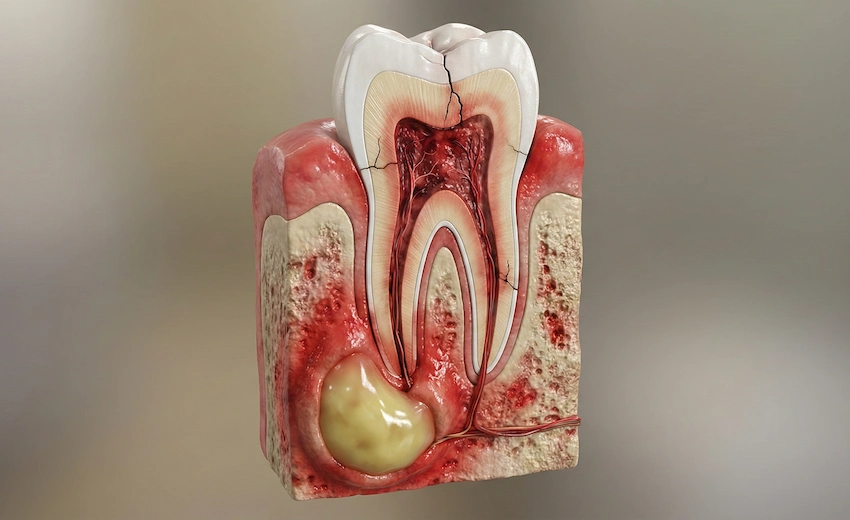
One way to picture a dental abscess is a tiny infected spot that hurts a lot because there’s so much pressure inside it, similar to a pressure cooker. Bacteria may come in contact with the pulp (the innermost part) of the tooth, most commonly via a cavity, crack, or injury. It becomes infected very quickly. White blood cells, which form the body’s immune system, are transported to the area of infection. Therefore, pus is formed which is essentially a small sack of dead tissue, bacteria and white blood cells.
Since the enamel is tough and the tooth is surrounded by bone, the pressure has no way of escaping and thus it becomes painful leading to severe, radiating pain. If the pressure is allowed to continue to build and the dentist fails to relieve it, then the infection will find a way to get out.
The Breaking Point: How the Infection Spreads
This is the kind of thing we notice at the clinic;a jawbone is not a solid, unbreakable wall, but a porous material, quite similar to a dense sponge. When pus from the abscess eats away at the bone at the root of a tooth, it will eventually break through to the soft tissue around the tooth.
Bacteria thus find several ways to extend their spread. These are frighteningly direct:
- To the Brain: An infection in your upper teeth can easily migrate into your sinus cavities. From the sinuses, it is a very short journey to the brain. This can lead to a brain abscess or meningitis, both of which are rapidly fatal without emergency intervention.
- To the Bloodstream: If the bacteria breach the blood vessels supplying the mouth, they are swept into your general circulation. This triggers sepsis, a violent, systemic immune response where your body begins attacking its own organs.
- To the Airway: Infections in the lower teeth can track downward into the floor of the mouth and the neck. This condition, known as Ludwig’s Angina, causes the neck tissues to swell so massively that they physically crush the windpipe, suffocating the patient.
Prof. Dr. Coşkun Yıldız shares that “The mouth is the gateway to the body. Having an infection in the mouth is not a local issue; it is always a systemic threat that can occur at any time.”
Red Flags to Watch Out For
At what point can you figure that your tooth pain is not just a simple sore but a scary thing? Some of the indications that a tooth emergency may be:
- Swelling: if a painful bump or lump has developed on the face near the ear, cheek, or jaw, and it has become red and is hot to the touch.
- Difficulty Breathing or Swallowing: The most alarming symptoms in case of throat infection are when the person experiences difficulty in breathing and swallowing. The sign that infection has already reached the throat area can be identified through difficulty in swallowing or breathing. If you have breathing or swallowing problems, this is a sign that your infection has already spread.
- Vomiting and diarrhea are symptoms of a person with a toothache and may suggest that the infection is becoming systemic.
- Rapid Heart Rate or Confusion: Symptoms of sepsis at an early stage.
- Sudden Loss of Pain: Initially, you had severe pain in a tooth but now it doesn’t hurt at all after the destruction of the dental pulp or when an abscess has burst. The infection is still present and spreading even though the pain-causing pressure has been removed.
How a Dental Infection Develops
| Infection Stage | Typical Symptoms | Systemic Risk Level | Required Clinical Action |
| 1. Pulpitis | Sensitivity to hot/cold, localized throbbing | Low | Filling or early root canal therapy |
| 2. Localized Abscess | Severe constant pain, pain when biting, tender gums | Moderate | Root canal therapy, drainage, or extraction |
| 3. Cellulitis / Spreading | Facial swelling, fever, swollen lymph nodes | High | Immediate extraction or root canal + oral antibiotics |
| 4. Systemic Involvement | High fever, difficulty breathing, rapid pulse, confusion | Critical / Life-Threatening | Emergency hospitalization, IV antibiotics, surgical drainage |
Beyond the Ordinary, We Offer Top-Notch Dental Treatment in Turkey

When there are severe dental infections, it becomes imperative for the treatment to be accurate and quick. Dentist Polen Akkılıç, at Lema Dental Clinic, with her team, makes use of state of the art three-dimensional volumetric tomography to establish the perimeter of a tooth infection before it leads to nearby vital structures.
Whether a complicated endodontic treatment can save the tooth or if a surgical extraction and comprehensive removal of the infected bone is the answer, we intend to eliminate the bacteria. We combine cutting-edge technology with an exquisite expertise in maxillofacial anatomy to deliver to our patients in Turkey a service that not only gives them their smiles back, but also protects their lives.
Frequently Asked Questions
Yes, it is quite possible. The roots of your upper molars are located only a few millimeters away from the floor of the sinuses. Therefore, if the abscess is pushed upward, the bacteria can penetrate the sinuses and from there, the bacteria can reach the brain cavity. Such cases are extremely rare, however, the situation is real, very dangerous and medical records have confirmed it several times.
The scariest thing is that there is no set time frame. A dental infection could be anything from a pus pocket that no one has ever bothered for a couple of months to the pain of a mild toothache that in a few days results in a complete systemic infection (sepsis). You must not disregard a dental infection thinking that it will go away on its own.
Antibiotics can’t cure a dental abscess. They might slow down the infection for a while, but the infection will return. Antibiotics can only temporarily prevent the spread of the infection for some time, but they cannot reach the abscess’s core where the dead tooth is.
In case you experience a rapid swelling of your jaw or neck with fever or difficulty in swallowing, then you need to be taken to the closest hospital emergency room, call an ambulance or a paramedic (based on your location) and don’t wait for your dental surgeon because by the time he/she comes, you may have deteriorated significantly.
We provide dental implant placement services only with healthy bones. If there is an infection on top of the abscess, the very first thing that should be done is to eliminate the infection. After that, in most cases, it’s the extraction and the bone grafting that is done followed by a period of healing.
- Bahl, R., Sandhu, S., Singh, K., Sahai, N., & Gupta, M. (2014). Odontogenic infections: Microbiology and management. Contemporary Clinical Dentistry, 5(3), 307–311.
- Carter, L. M., & Layton, S. A. (2009). Cervicofacial infection of dental origin. BMJ, 338, b1445.
- Jundt, J. S., & Gutta, R. (2012). Characteristics and cost impact of severe odontogenic infections. Oral Surgery, Oral Medicine, Oral Pathology and Oral Radiology, 114(5), 558-566.
- Robertson, D. P., & Smith, A. J. (2009). The microbiology of the acute dental abscess. Journal of Medical Microbiology, 58(2), 155-162.
- Seppänen, L., Lauhio, A., Lindqvist, C., Suuronen, R., & Rautemaa, R. (2008). Analysis of systemic and local odontogenic infection complications requiring hospital care. Journal of Infection, 57(2), 116-122.

