


Yes, gold teeth can increase hot or cold sensitivity.
Gold has made an incredible comeback. It is not only a restorative material for back molars anymore; it has become a statement piece, a status symbol, and an aesthetic choice that we, starting from Lema Dental Clinic in Istanbul, often meet.
But a question often stays in the consultation room…right after we have talked about the design and shade. A patient would come closer and say “Isn’t it painful when I have my morning coffee?”
It is definitely a reasonable worry. Gold is a metal and metals are different from natural enamel in the way they behave. If you are planning on getting gold crowns, inlays or even a custom grill, you should first get an idea of the physics of your mouth before deciding.
Why Gold Teeth Cause Sensitivity: Understanding Thermal Conductivity
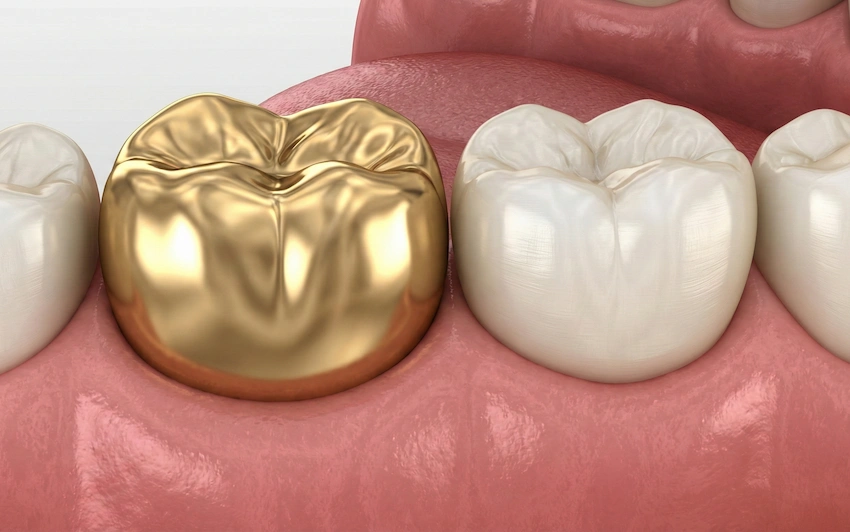
Let’s set aside the technical terms for a moment. Think of it like this: if you put a metal spoon in the boiling soup and then touch that spoon, you will get the feel of burning fingers. But if it’s a wooden spoon in the same pot, it stays cool. That is what the term “thermal conductivity” means.
Gold has a very high thermal conductivity. In fact, it does it so well that the heat or the cold gets to the other side of the gold very quickly, even faster than if it were zirconia, porcelain or natural tooth structure. Just think of it a moment: when you take a sip of very cold ice water, the coldness will be conducted by the gold so fast that it will reach the bottom of your tooth almost instantly.
At Lema Dental Clinic, as a result of our hands-on experience, we have noticed that patients with gold fillings are more vulnerable to that sharp and short “zing” sensation that occurs in the beginning than those who have chosen non-metal teeth restoration. The reason is the nerve (pulp) inside the tooth that is reached so quickly by the shock of the temperature change that it cannot get ready for it.
Why the Sensitivity Usually Disappears
So, does this mean that you will never be able to have cold water again, but only lukewarm water for the rest of your life? It’s definitely a No.
Dr. Polen Akkılıç and her team strongly emphasize to the patients that the tooth is a living, reactive organ. There are microscopic channels called dentinal tubules inside your tooth leading to the nerve. When we place a new restoration, these channels can overreact.
The body, nevertheless, is quite clever. At last, the tooth creates a defensive layer which is termed as reparative dentin. Imagine it like a callus that you get on your hand after working out and it somehow protects the nerve. Metal remains a good conductor; however, now, the tooth has an internal barrier of its own.
Clinically, the majority of patients experience a gradual disappearance of their sensitivity to gold in a few weeks. If it is still there after that time, or if it is serious enough to disturb your sleep, it is not simply “new crown” sensitivity. It might be a sign that the nerve contains a problem, which will require treatment.
Precision Fit: How Exact Margins Prevent Sensitivity
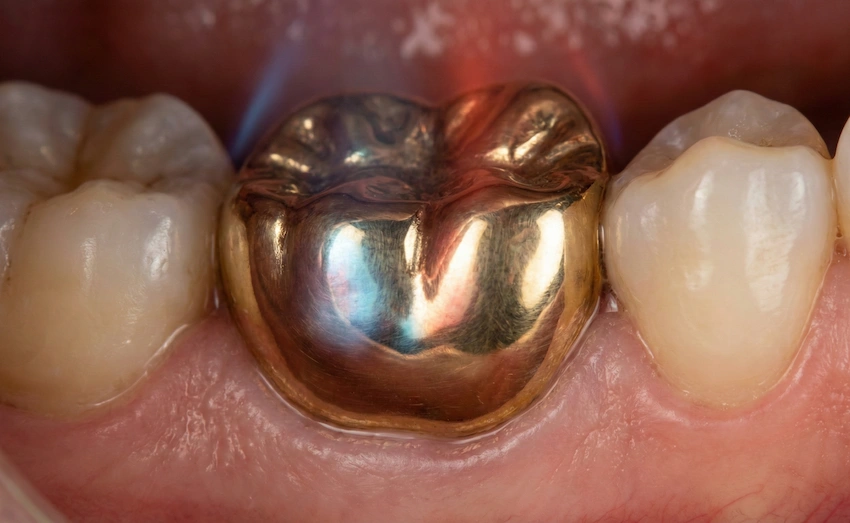
A good fit is what matters most. The material is an aspect that only counts for a part of it.
If a gold crown is not cemented in a way that’s absolutely precise, very tiny gaps may stay at the edge where gold and tooth meet. These openings let the air and the secretions get to the dentin which causes very severe pain.
This is the expertise of Professor Doctor Coşkun Yıldız that we can totally rely on. In our clinic in Turkey, we use top-quality luting cements, which are a kind of buffer. We don’t just glue the gold; we close the dentinal tubules first. By applying desensitizing agents and the particular liners before the gold is set, the thermal shock can be reduced dramatically.
A Material Showdown: Gold vs. Others
Here is a quick summary of how gold compares with other materials that we most commonly use in Istanbul in terms of comfort and durability.
| Feature | Gold / Precious Metal | Zirconia | Porcelain-Fused-to-Metal (PFM) |
| Thermal Conductivity | High (heat/cold transfers quickly) | Low (excellent insulator) | Medium (metal core conducts, porcelain insulates) |
| Initial Sensitivity Risk | Moderate to high | Low | Low to moderate |
| Durability | Extreme (virtually fracture-proof) | Very high | Moderate (porcelain may chip) |
| Wear on Opposing Teeth | Gentle, similar to natural enamel | Can be abrasive if unpolished | Abrasive |
| Best For | Back molars, heavy grinders | All areas, high aesthetics | Bridges, strong structural support |
5 Most Common Questions Patients Ask Us
Dr.’s answer: It’s very rare. For almost all of our patients, the tooth gets used to it within 2 to 4 weeks. However, if the pain is unprovoked (no hot or cold involved), that’s something else, and we will need to take an X-ray. In most cases, thermal sensitivity disappears as the tooth “settles in.”
Dr.’s answer: Yes, and you really should. We advise the use of toothpastes that contain potassium nitrate. You may see it as a sedative for the tooth’s nerve. It inhibits the transmission of pain signals through the tubules. Two weeks of continuous use is all that’s needed to see a huge difference.
Dr.’s answer: Absolutely. The higher the gold content (high noble metal), the better the biocompatibility and the better fitting since it is softer and can be burnished against the tooth more tightly. Though pure gold is also an excellent conductor. We usually work with specific alloys that give a perfect balance of durability and biocompatibility in order to provide you with the best of both worlds.
Dr.’s answer: A removable grill generally doesn’t give you sensitivity because it is just lying on the teeth, almost acting like an insulator. Nevertheless, permanent grills (cemented on) are just as risky as crowns. So you will have some short-term sensitivity if the healthy enamel is removed to fit the grill.
Dr.’s answer: Besides the low price, a clinic like Lema Dental is where the gold restoration can fit perfectly with the help of digital dental workflows. A smaller gap means less cement wear, which means less sensitivity. And, on top of that, you get to stay and rest in one of the world’s most beautiful cities.
- Donovan, T. E., & Chee, W. W. (2018). A review of current dental materials: The use of gold in restorative dentistry. Journal of Esthetic and Restorative Dentistry, 30(2), 98-105.
- Garaicoa, J., & Fischer, N. G. (2020). Thermal conductivity of restorative materials and its effect on pulp health. Journal of Prosthodontics, 29(1), 15-22.
- Rosenstiel, S. F., Land, M. F., & Fujimoto, J. (2021). Contemporary Fixed Prosthodontics (6th ed.). Elsevier Health Sciences.
- Berman, L. H., & Hargreaves, K. M. (2020). Cohen’s Pathways of the Pulp (12th ed.). Elsevier.
- O’Brien, W. J. (2019). Dental Materials and Their Selection (5th ed.). Quintessence Publishing.

