


Yes, a tooth can be saved with root canal treatment.
You probably came across and opened this article because you had a persistent mild ache or a sharp pain you felt while drinking your morning coffee. The fear of losing a tooth is a fundamental, primal fear. It’s not just about your ability to chew; it’s also about your confidence in your smile. At Lema Dental Clinic in Türkiye, we observe this fear every day. Patients come to us from all over the world, bringing with them the despair that the only solution will be tooth extraction.
In fact, tooth extraction should be the last thing you consider. You should first think about root canal treatment.
If you think about it, your natural tooth is biologically perfectly configured to withstand forces that even the best implants only try to replicate.
Therefore, think of your natural tooth like the first pillar of an old building. You can strengthen it, decorate it, and support it. But if you destroy that pillar, the entire structure—the jawbone—is permanently weakened.
Where the Problem Really Lies: The Tooth Mortality Factor
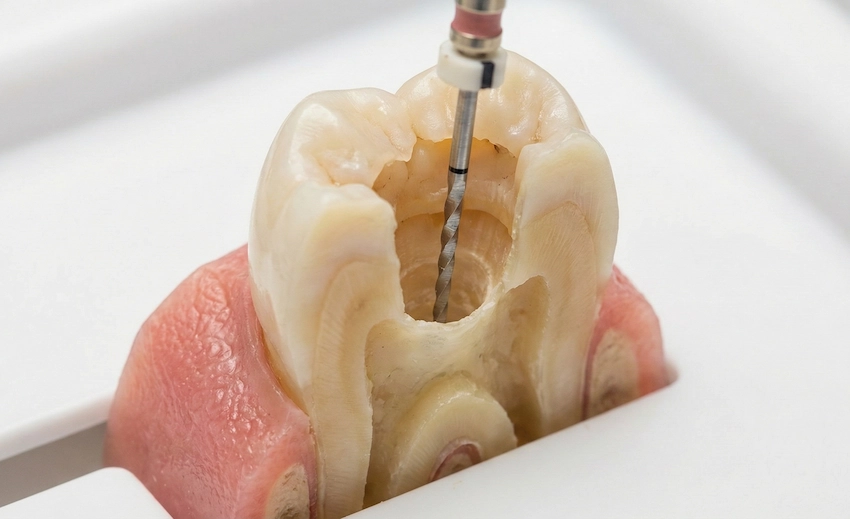
You can’t really get to the point of deciding whether to save the tooth until you figure out why it’s hurting. Under the protective, hard layer of enamel is the pulp of the tooth—a soft, living tissue which contains nerves and blood vessels.
Let’s look at the tooth as one sealed-off, sterile room. If a crack or cavity forms in such a door that lets bacteria in, then the room gets flooded by bacteria. Since the room is sealed, the infection resulting from this has no exit. Pressure builds up. That pressure is the pain you experience.
Dentist Polen Akkılıç and her team are very careful in dealing with this issue and they have just one aim: to throw the bacteria out, close the entry point, and save the piece of architecture.
How Is Dental Infection Removed?
We get a lot of patients who ask, “Will it hurt during the treatment?” Allow me to come clean first: the treatment itself is not the reason that it hurts; on the contrary, it is the treatment that will stop the hurting. The pain is due to the infection that is irritating the nerve.
In a root canal procedure in our Istanbul clinic, we extract the infected “living” tissue. We thoroughly disinfect the canals—which can be quite complicated, like the roots of a tree—and after that, we close them with a biocompatible material.
After that, the inside is so sterile that we put a high-quality zirconium crown over the tooth most of the time. In this way, the crown acts like a “helmet” that safeguards the tooth under it that is already fragile, from being crushed by the heavy chewing forces.
When We Need to Bring Specialists On Board
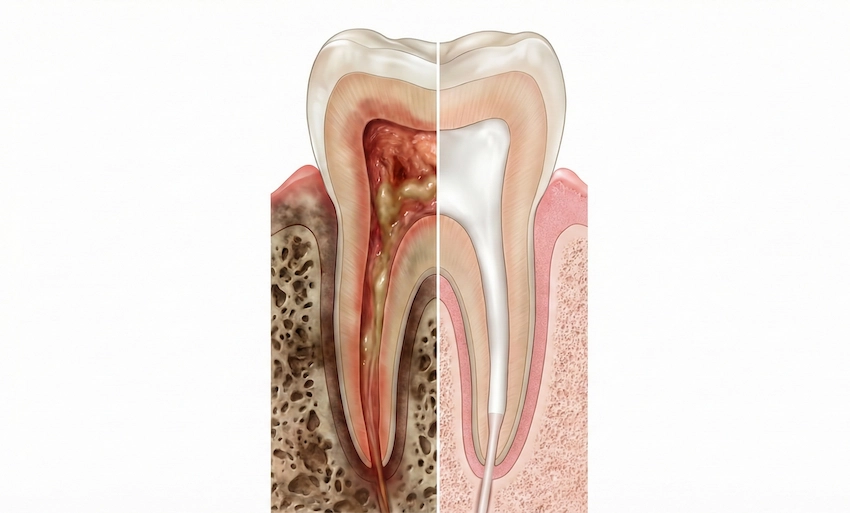
However, sometimes a tooth is beyond saving. For example, the gum crack is just a tiny crack in a building’s foundation if the crack extends below the gum line. It is almost impossible to save a tooth in this case; saving it becomes a matter of chance.
Professor Doctor Coşkun Yıldız enters the picture for the assessment of the surgical aspects of cases that are this complex. If the local bone is very thin because the infection has been there for a long time, it could be more damaging to keep the tooth. Hence, in this particular scenario, the best thing for your jawbone health would be to have the tooth removed and an implant placed.
Comparing Your Alternatives
It is of utmost importance to decide whether to save the tooth or to remove it only after carrying out a thorough comparison of the two options. Below, we outline what our typical clinical situations look like.
| Feature | Root Canal Treatment (Saving the Tooth) | Extraction & Implant (Replacing the Tooth) |
| Primary Goal | Conserve natural biological structure | Artificially replace lost structure |
| Invasiveness | Minimal to moderate (routine dental procedure) | Moderate to high (surgical intervention) |
| Treatment Time | 1–2 visits, completed within days | 3–6 months for full bone integration |
| Bone Health | Maintains natural jawbone stimulation | Initial bone loss after extraction, an implant helps preserve bone later |
| Cost | Usually lower upfront | Higher due to surgery and implant components |
| Sensation | Preserves natural tooth sensation (proprioception) | Artificial root, no natural feeling |
Frequently Asked Questions
We take out the nerve and blood supply, so from the technical point of view, yes. On the other hand, the tooth stays fixed to your jawbone through the periodontal ligament. Thus it still acts just like a normal tooth and you can even feel pressure when biting, which is crucial for comfortable chewing.
This is a legend that goes back to the 1920s and was based on discredited data. Today, endodontics is an extremely safe and effective field of medicine. Actually, if you don’t treat an infected tooth, that’s when you really expose yourself to the risk of the infection spreading to your jaw, throat, or heart.
Because we use high-tech digital imaging and advanced rotary instruments here at the Lema Dental Clinic in Turkey, most of the time we can carry out the whole root canal process at a single visit. If there is a need for a crown, the whole thing, including the personally tailored creation of your new smile, usually only takes a few days while you are here.
It is not unusual for us to hear your kind of frustration. Nevertheless, tooth extraction leaves a space between your teeth. Just after the extraction, your adjacent teeth will drift towards that space just like already placed books on a shelf that one is taken away. That’s why your bite gets misaligned and eventually you might start having jaw problems. Tooth-saving treatment is the answer to this chain reaction.
Nothing in medicine has a 100% success rate. Sometimes there are tiny, undetected canals where bacteria could hide. Besides, if the root canal treatment does not bring the desired results, there is always the option of “retreatment,” where the canal is cleaned once more. Should that not be an option either, only then will we seek the surgical expertise of Professor Coşkun Yıldız or look at implant possibilities.
- American Association of Endodontists. (2023). Tooth Saving Tips: Root Canal Treatment Explained. Journal of Endodontic Care.
- Holland, R., et al. (2018). Healing process of the dog’s dental pulp after pulpotomy and protection with calcium hydroxide. Dental Traumatology, 34(2), 101-109.
- Iqbal, M. K., & Kim, S. (2007). For teeth requiring endodontic treatment, what are the differences in outcomes of restored endodontically treated teeth compared to implant-supported restorations?. International Journal of Oral & Maxillofacial Implants, 22.
- Ng, Y. L., Mann, V., & Gulabivala, K. (2011). A prospective study of the factors affecting outcomes of nonsurgical root canal treatment: part 1: periapical health. International Endodontic Journal, 44(7), 583-609.
- European Society of Endodontology. (2006). Quality guidelines for endodontic treatment: consensus report of the European Society of Endodontology. International Endodontic Journal, 39(12), 921-930.

