


Gold dental veneers provide high strength, precise fit, and long-term durability.
While the general public sees a huge trend in modern dentistry towards the usage of porcelain and zirconia for their “Hollywood” aesthetics, the discussions in high-end clinical circles are often very different. At Lema Dental Clinic in Istanbul, based on our clinical experience, we believe that for certain patients, the decision is not just about the mirror—it’s about the mechanics.
Gold is far from just a luxury; it is a bioengineering wonder. When Professor Doctor Coşkun Yıldız talks with patients who come to Turkey for restorations, he frequently explains that among all the materials, gold is the one that truly “behaves” like a human tooth.
Gold Mimics Nature Better Than Ceramic: Here’s the Reason
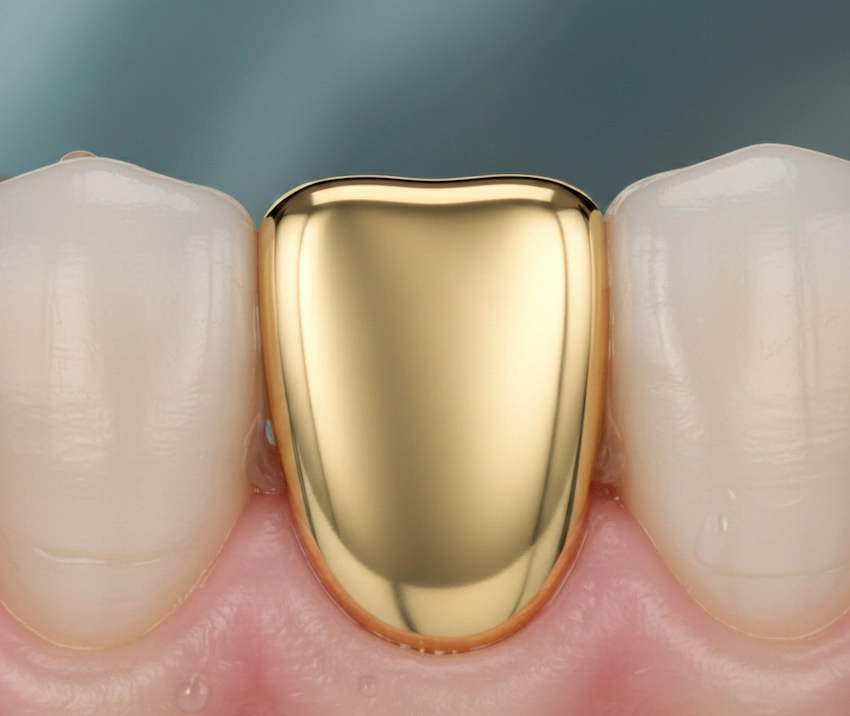
The truth is that your teeth are constantly being attacked. With every chew, your jaw puts a great amount of pressure. Although ceramic materials are pretty, they are basically “stiff.” Imagine a ceramic plate versus the leather sole of a nice shoe. The ceramic is hard but it is also brittle; therefore, if it hits a stone at the wrong angle, it breaks.
However, gold is characterized by a feature called ductility. So it is somewhat flexible. In other words, it cushions the shock of chewing instead of redirecting this stress into your jawbone or the teeth that are touching it.
Coefficient of Thermal Expansion
Here’s what happens in the clinic: when you consume hot coffee or ice cream, the materials in your mouth expand and contract. In fact, gold expands at a rate very comparable to natural tooth enamel. This results in what is called a “thermal harmony” that helps in preventing tiny leaks which are common with other materials and are the main cause of decay under restorations.
Biomaterials: How Gold Helps the Other Teeth
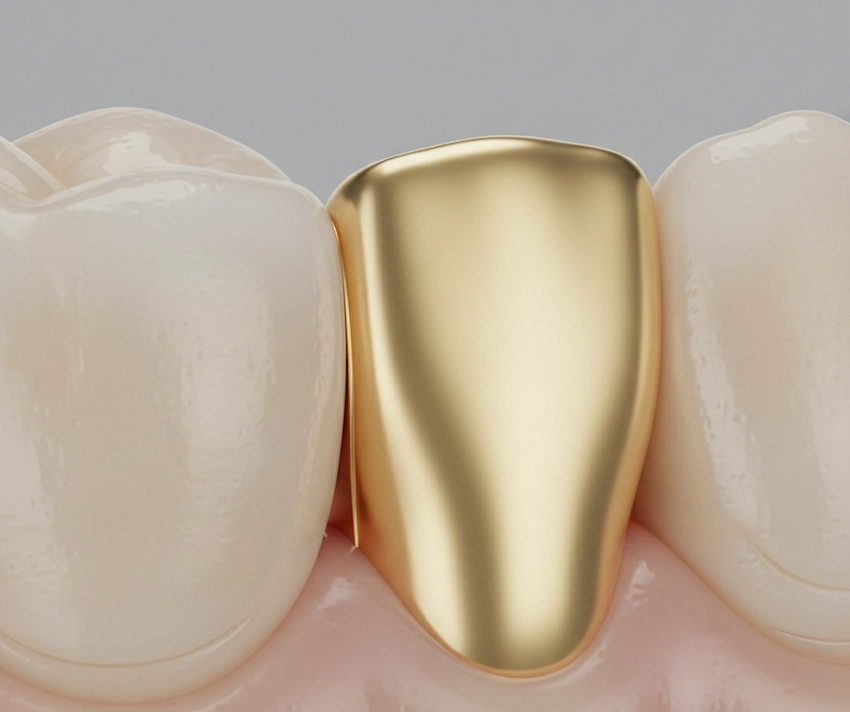
This is one of those features of gold that has a profound impact from the biomechanical point of view, which has to do with how it “treats its neighbors”. Dentist Polen Akkılıç and her staff point out the “wear factor” very often.
In our dental vocabulary, the teeth that interact with the veneers are called the “antagonists.” Porcelain is actually harder than natural enamel. Eventually, a porcelain veneer may act as a brasive, gradually wearing down the healthy natural tooth it touches. But gold is a different story. Being softer than porcelain, it prevents your natural bite from premature wear. The analogy goes like this: walking on a concrete floor at home versus walking on a padded gym mat.
| Feature | Gold | Gold Alloys | Porcelain (E-max) | Zirconia |
| Edge Strength | Extremely high (won’t chip) | Extremely high (won’t chip) | Moderate (can chip) | High (rarely chips) |
| Wear on Opposite Teeth | Minimal (protective) | Minimal (protective) | Abrasive | Moderate to high |
| Biocompatibility | Excellent | Excellent | Excellent | Good |
| Longevity | 20+ years | 20+ years | 10–15 years | 15+ years |
| Best Used For | Molars (back teeth) | Molars & high-load areas | Front teeth (aesthetics) | Bridges & high-stress areas |
| The “Gold Margin” Precision | Exceptional | Exceptional | Limited | Limited |
Still, the question is this: what makes gold so durable? The solution can be found in the “margin”—the small patch where the veneer is in contact with your natural tooth. Gold is extremely malleable and that is why a skilled technician may burnish the edges so thinly that the distance between the tooth and the gold is practically zero.
We, at Lema Dental Clinic, consider it a master seal. When we close this gap, we do not allow the bacteria to “hide”. Hence, gold restorations are rare to break down even after several decades of usage if the patient maintains proper hygiene.
Frequently Asked Questions
That is not always the case. While some patients want that ‘bold’ look of gold, for the majority of cases, the gold veneer will be placed on the molars where no one can see it. In this way, you receive the full biomechanical strength at the hardest chewing spots while we use the aesthetic ceramics for your ‘social’ smile.” – Dentist Polen Akkılıç.
“Definitely. Bruxism, or teeth grinding, can cause porcelain to break under the stress. On the other hand, gold is very forgiving. It wouldn’t crack; instead, it would absorb the pressure, just like a shock absorber would in your jaw.” – Professor Doctor Coşkun Yıldız.
Not really. Because our gold casting is extremely thin and yet strong, you hardly notice it. Also, since its thermal conductivity is the same as that of your teeth, you won’t experience any more temperature sensitivity than you already have with your natural teeth.
At Lema, we know how to get the best out of the Turkish market with its low cost of high-noble alloys combined with world-class laboratory technicians. You get the top ‘karat’ of dental care—specifically 18k to 22k gold alloys—at a fraction of the cost you’d pay in the UK or US.
High-noble gold alloys are among the most biocompatible materials. While base-metal ‘gold-colored’ alloys might trigger allergic reactions, the high-purity gold that we use is very friendly to the gum tissue, often causing less inflammation than other materials.
- Anusavice, K. J., Shen, C., & Rawls, H. R. (2012). Phillips’ Science of Dental Materials. Elsevier Health Sciences.
- Donovan, T. E., & Cho, G. C. (2004). Predictable aesthetics with metal-ceramic and all-ceramic crowns: The critical importance of soft tissue management. Journal of the California Dental Association.
- Kelly, J. R., & Nishimura, I. (2008). Science-based decision making in restorative and implant dentistry. Journal of Prosthodontics.
- Milleding, P. (1992). Resistance to wear of dental ceramics of different compositions. The Journal of Prosthetic Dentistry.
- Richter, W. A., & Ueno, H. (1973). Relationship of crown margin placement to gingival inflammation. The Journal of Prosthetic Dentistry.

