


Tooth gold is a medical alloy, usually equivalent to 10–18 karat, not pure gold.
Dental patients walking through the doors of Lema Dental Clinic here in Turkey often inquire about “gold teeth” with a blend of curiosity and nostalgia. Some of them picture 24-karat pure gold bars kept in a bank vault, while others are concerned about how it will look. The truth is that dental gold is never “only gold.” It is a very sophisticated metallurgical work, which is made to endure the most difficult environment of the human body: your mouth.
Why 24K Gold Isn’t the Answer?
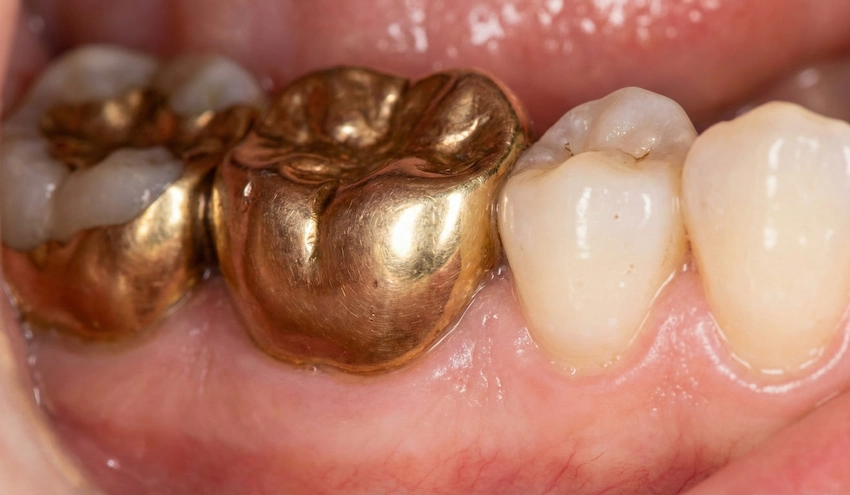
You might guess that the purest gold – 24-karat – is the one to be used for a crown or inlay. Usually, that would be the case. Still, in a clinical setup, pure gold is almost worthless. It is simply way too soft. If Professor Doctor Coşkun Yıldız fitted a 24k gold crown on your molar, even chewing a piece of meat chewing would make the metal lose its shape in a few weeks.
Gold has to be fortified, to be functional. We do this by making an alloy — a mixture of gold and other noble metals such as platinum, palladium, and silver.
The Sweet Spot: 16-Karat to 18-Karat
At Lema Dental Clinic, based on our experience, we believe that the best dental gold commonly ranges between 16 and 18 karats. In other words, the gold content is approximately 60% to 75%.
Why this particular range? It offers a perfect balance. It is sufficiently soft for a dentist to be able to “burnish” (carefully adjust) it to create a tight seal with your natural tooth, thus preventing new caries. On the other side, it is sufficiently strong to endure the biting pressure of hundreds of pounds per square inch. Dentist Polen Akkılıç and her team commonly explain it to patients as the “Goldilocks” of materials for restoration – not too hard, not too soft, but just right to last a long time.
Categorizing the “Gold Standard”
The American Dental Association (ADA) doesn’t actually use “karats” to classify these metals. Instead, we look at the “nobility” of the alloy.
| Alloy Type | Gold Content | Other Metals | Best Used For |
| High Noble | At least 40% Gold | Platinum, Palladium, Silver | Long-term crowns and bridges |
| Noble | At least 25% Noble Metal | Palladium, Silver, Copper | Budget-friendly durability |
| Base Metal | Less than 25% Noble | Nickel, Chrome, Cobalt | Rarely used at Lema due to allergy risks |
The “Wear” Factor: A Gift to Your Other Teeth
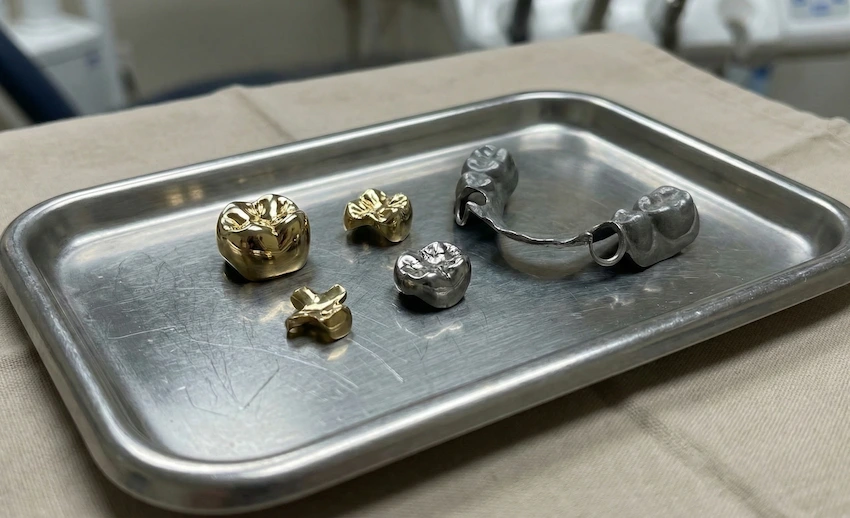
It is almost like gold in the mouth does not get talked about for the sake of gold only but more because of the benefits it brings to the opposite teeth. A ceramic or zirconia crown is like a diamond ring: it scratches glass. Since zirconia is very hard, it is capable of wearing down your natural teeth on the opposite side.
Gold is another story. Its properties of wear are very close to those of human enamel. It’s like a cushion for your jaw. Eventually, the gold will softly give in to your bite, becoming more and more comfortable as time goes by. Doctor Professor Coşkun Yıldız gives this consideration a lot when he has to treat bruxism patients.
Why Choose Turkey for Gold Restorations?
Lema Dental Clinic probably offers you not only offer you the technical perfection of our laboratory but also the opportunity to have your restorative work done in Turkey. It is about having first-class quality materials at costs that are not exorbitant as in the most expensive regions of Western Europe or the US. A gold inlay, when crafted by us, is not just a simple filling; it is a full-lifetime restoration of up to 30-40 years with proper maintenance.
FAQ: Common Questions About Dental Gold
While it does have a warm, yellow shade, it is an alloy and therefore, it won’t be as “bright” as a wedding ring. Its glow is more subdued and refined. In fact, we generally only use it for the back molars where it isn’t visible when you smile, but it offers the greatest strength.
The question remains a quite common concern! No, the answer is that the single crown’s metal content is way too little to activate security scanners nowadays. You can travel back home after getting your dental treatment in Turkey without worrying.
It’s not necessarily a “better” choice, but it is “different.” Zirconia is undoubtedly the most beautiful—it hardly differs from a real tooth in appearance. On the other hand, gold is the most durable material and also the most gentle one for the opposing teeth. We make the decision based on your particular bite and the location of the tooth.
It is said that allergies to pure gold are almost non-existent. But some “base metal” alloys of lower quality may have nickel in them. At Lema, Dentist Polen Akkılıç and her staff are committed to working with high-noble alloys as their first choice in order to prevent the occurrence of inflammatory reactions that are quite common with cheap metals.
Just like a natural tooth. Even though gold doesn’t corrode or tarnish, the tooth underneath it can still decay at the gumline. You should brush and floss regularly and during your yearly checkups, we will take a look at the existing margins.
- Anusavice, K. J., Shen, C., & Rawls, H. R. (2012). Phillips’ Science of Dental Materials. Elsevier Health Sciences.
- Donovan, T. E., & Cho, G. C. (2004). Contemporary evaluation of gold foil as a restorative material. Journal of the California Dental Association, 32(10), 819-825.
- Kelly, J. R., & Nishimura, I. (2008). Science-based guidelines for maximizing the service life of crowns and fixed partial dentures. Journal of Prosthodontics, 17(5), 380-391.
- Knosp, H., Holliday, R. J., & Schnetzer, M. (2003). Gold in dentistry: Alloys, uses and performance. Gold Bulletin, 36(3), 93-102.
- Wataha, J. C. (2002). Alloys for prosthodontic restorations. Journal of Prosthetic Dentistry, 87(4), 351-363.

