


Yes, dental implants are safe and effective in older adults with proper evaluation.
For us, Lema Dental Clinic Turkey, it is a common hearing that our elderly patients come to us with the same concern several times a week. They walk into the treatment room, look at the X-rays on the screen, and the very first question they ask is: “Doctor, isn’t it too late for me?”
This question makes sense. Older people are generally considered fragile. Yet, if we focus on oral health, it is the bone structure that impacts us the most, not how many years we have been alive.
In short, the chances are that your age is not a limitation. Actually, the benefits of dental implants for a 75-year old are much greater than for a 35-year old. Let’s find out how.
The Biological Reality: Bone Heals at Every Age
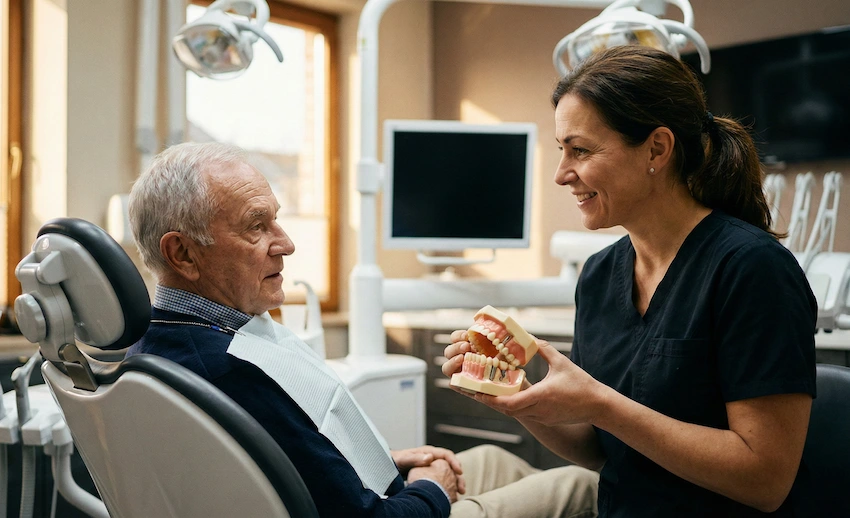
One of the myths is that after worklife people body cannot be capable of self-regeneration anymore. Healing processes do take a longer time, but the essential part of osseointegration (when a titanium implant merges with the jawbone) is equally efficient for elderly people in their 80s or even 90s as it is for younger adults.
You can liken your jawbone to a piece of ground in a garden. It is of no consequence whether the garden is old or new. If the soil (bone density) is fertile and the gardener (the surgeon) is skillful, the plant (the implant) will thrive.
Professor Doctor Coşkun Yıldız, one of our top-notch maxillofacial surgeons in Turkey, says that an implant is an equally successful treatment for healthy old people as it is for the young. He also adds that the main factors that influence the result of the implant are not the old age itself but the health condition of the individual.
Medical Conditions vs. Chronological Age
Your date of birth is not what we want to see. We want to see if you have your system under control.
Unhealthy diabetics, people with gum disease that has not been treated, or heavy smokers are not good candidates for dental implants. But a 70-year-old patient who has mild hypertension that is controlled by medication will probably have a dental implant successfully working longer than a 40-year-old who smokes one pack of cigarettes per day.
This is what we encounter in the practice:
- Osteoporosis: A lot of patients are frightened that this might allergic reaction as a reason for them not being able to get the treatment. Generally, it does not. While the bone is less dense, nowadays, implant surfaces are tailored to securely attach to the bone structure.
- Medications: We check your medication chart. Certain bisphosphonates (used for bone density) call for a different approach, but they hardly ever represent an absolute “no.”
The “Quality of Life” Argument
There is no reason why we should not put dentures aside and start advocating for implants in senior patients because they are the opposite of ill-fitting dentures that are a disaster.
Can you picture yourself trying to enjoy your golden years while you are afraid that your teeth will fall out when you laugh at the dinner table? Or not being able to have a steak because it is too hard and you can only have pureed food? Dentist Polen Akkılıç and her team at their practice keep emphasizing to their patients that digestion starts in the mouth. And if you cannot chew properly, then your health as a whole will deteriorate.
Implants prevent that deterioration in health. Besides that, implants help keep the bone intact, so you do not develop this “sunken face” look that is the telltale sign of long-term denture wear.
Comparing Solutions for Senior Patients
It goes without saying that we support an open culture. Here are some features of how implants are compared to conventional options for our senior patients.
| Feature | Traditional Dentures | Implant-Supported Dentures (Overdentures) | Full Dental Implants |
| Stability | Low (relies on suction/adhesive) | High (snaps onto implants) | Maximum (fixed in jaw) |
| Bone Preservation | None (bone continues to shrink) | Moderate (implants stimulate bone) | High (mimics natural roots) |
| Chewing Power | ~20–30% of natural bite | ~60–70% of natural bite | ~90–100% of natural bite |
| Maintenance | Daily removal & soaking | Daily removal for cleaning | Brushing & flossing like natural teeth |
| Long-Term Cost | Lower initially, frequent relining | Moderate | Higher initially, lifelong solution |
The Lema Protocol: Safety First
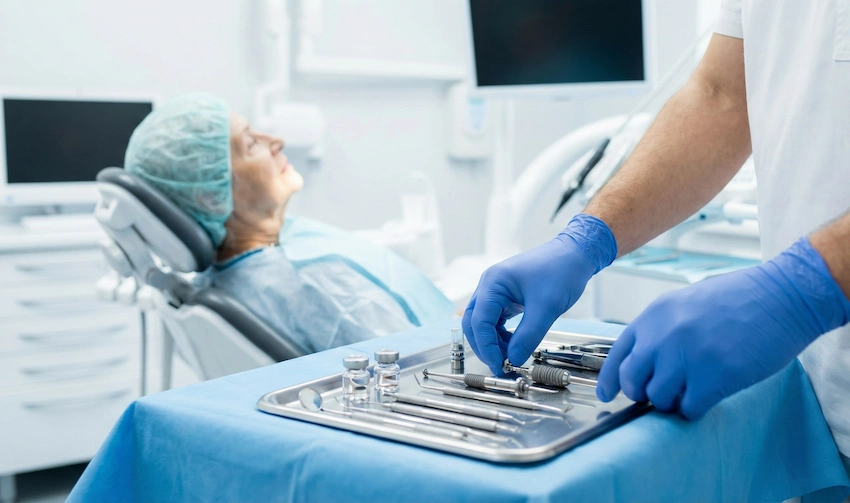
Safety is not something that just happens. It is a set of rules, regulations. Lema Dental Clinic booking in Turkey, your journey does not end with a quick cavity filler procedure or a tooth extraction.
With 3-dimensional tomography we locate your nerves and sinus to see which way a drill will go. If you are an elderly patient with very low bone volume as a result of long years of missing teeth, we will not put you through an implant at once. We will first prepare the ground under the implant.
Sinus Lift (raising the sinus membrane by analogy with lifting a tent floor to slide a pole under it) or bone grafting might be our answers for a solid jaw to welcome implants.
Clinical Note: Older patients’ recovery is mostly uneventful. The mouth is very well-supplied by blood and quite resistant. The majority of our elderly patients are less desperate with pain than they thought, hence they only rely on OTC painkillers after the first post-op day.
Frequently Asked Questions
Actually, no. Putting in the implants is far less invasive than pulling out a multi-rooted tooth. Also, the process is very exact and controlled. We do keep track of your vitals, and if you have a heart problem, we see to it that your medication blood thinners, etc., are controlled by the cardiologist. We don’t simply view a patient’s mouth as ‘teeth only’ we consider the patient as a whole.
The soft tissues on the exterior usually recover in a week to 10 days. However, the crucial healing, i.e. the bonding of the bone to the implant, requires a period of 3 to 6 months. There is no doubt about it with us. Elderly patients we simply allow nature to take its course, but to be certain that their outcomes will be very strong.
Definitely not. A patient will be forcibly kept away from teeth at no time, ever. At the time of your treatment, you will be provided with a temporary prosthesis which will enable you to talk, smile, and eat (soft foods) while the work below the surface is being done.
Quality and care are the two answers here. In most countries, if a retiree wanted a full-mouth restoration, he/she would have to pay an arm and a leg. At Lema Dental Clinic, we use only premium Swiss and German implant brands, and our prices are just a fraction of those in other countries with the bonus of a ‘VIP’ service including transfers and accommodation that makes your stay more like a holiday rather than a treatment.
Osteoporosis affects the body’s long bones (like the hips) more than the jaw. Regardless of this, if your jawbone is less dense we can solve the problem by using longer implants, tilting them to get a better grip on the bone (like in the All-on-4 technique) or simply choosing surface-treated implants specially designed for soft bone.
- Dudley, J. (2015). Implants for the ageing population. Australian Dental Journal, 60(s1), 28-43.
- Srinivasan, M., Meyer, S., Mombelli, A., & Müller, F. (2017). Dental implants in the elderly population: a systematic review and meta-analysis. Clinical Oral Implants Research, 28(5), 920-930.
- Jemt, T. (2018). Implant treatment in the elderly. International Journal of Prosthodontics, 31(s), s28-s31.
- Schimmel, M., Müller, F., & Suter, V. (2017). Implants for elderly patients. Periodontology 2000, 73(1), 228-240.
- Razavi, A., et al. (2020). Biomechanical analysis of dental implants in osteoporotic bone. Journal of Biomechanics, 108, 109893.

