


All-on-4 uses 4 implants per jaw, while All-on-6 offers extra support with 6 implants.
All-on-4 and All-on-6 dental implants are both ways of replacing full-arch teeth with fixed prostheses through implants for patients who have lost a large number or the entire set of teeth already.
The two main treatments basically serve the same objective of restoring chewing and a stable, toothed smile. The differentiating factor is the number of implants: All-on-4 uses 4 implants, and All-on-6 employs 6 implants, as its name suggests.
Still, more implants don’t necessarily mean a better outcome or treatment of the patient.
Clinical decisions are based on the individual case analysis at Lema Dental Clinic by Dentist Polen Akkılıç and Prof. Dr. Coşkun Yıldız. In their planning of an ideal implant treatment, the dentists look into factors such as the quality of bone, occlusion, the number of leftover teeth, and whether restorative work is needed.
What Are All-On-4 and All-On-6 Dental Implants?
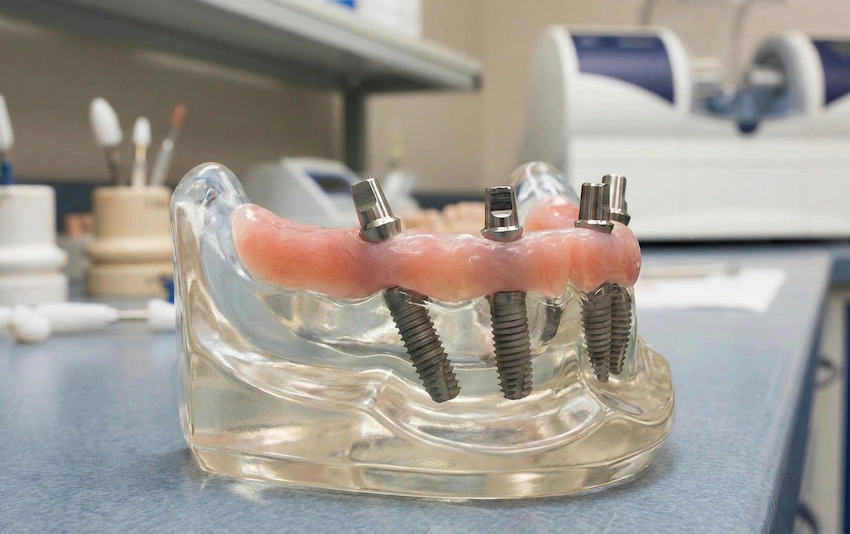
All-on-4 is a full denture supported by 4 implants and fixed to them. Implant placement is such to spread out load on the implants optimally. One of the tricks to achieve greater use of the limited amount, if the remaining bone is at a certain height, it is a possibility also possible to angle the last posterior tooth implants towards the back so that more bone volume is utilized.
All-on-6 is a similar type of treatment and involves the use of six implants instead of four. These two extra implants can be seen more or less as a sort of insurance. For instance, the support can be stronger, and the stress of chewing forces can be better distributed onto various implants through these two extra ones.
In fact, both options can be the answer for patients who lost their teeth entirely or who had few teeth left that could not be restored in a reliable way through conventional means.
But what is more decisive in the selection of one or the other is how the jaw bone is in terms of structure and density, the intensity of the bite of the individual, and to some extent the treatment plan as a whole.
The Difference Between All-On-4 and All-On-6
The main distinction is the number of implants. Still, there are a few clinical factors that affect the suitability of the treatment options.
| Feature | All-on-4 | All-on-6 |
| Number of implants | 4 per arch | 6 per arch |
| Full-arch support | Yes | Yes |
| Bone requirement | Can be a solution for cases with less available bone | Usually requires sufficient bone for six implants |
| Force distribution | Load is transferred through four implants | Load is distributed over six implants |
| Surgical placement | Placement of four implant sites | Placement of six implant sites |
| Main advantage | Full-arch coverage with fewer implants | Increased number of supporting implants |
| Final decision | Based on clinical evaluation | Based on clinical evaluation |
When sufficient bone volume is present, the All-on-6 technique can distribute the biting forces over a larger span. Nevertheless, it is not recommended for all patients to have six implants.
The specialist Dentist Polen Akkılıç and Prof. Dr. Coşkun Yıldız from Lema Dental Clinic may assist in the clinical examination and assessment of the patient to determine the most suitable treatment plan. Diagnostic tools such as X-rays and 3D imaging may also be utilized to assess the quantity and quality of bone and to visualize the surrounding anatomical structures.
Who Should Not Get Implants
Dental implants are often a great option for adults,s but certain conditions may lead to more complications or even prevent the surgery altogether.
People who suffer from the following problems may need special care:
- Active gum disease
- Bad oral hygiene
- Uncontrolled diabetes
- Smoking at a high frequency or level
- Severe bone loss
- Particular medical conditions
- Radiation therapy that has affected the jaw area
- Very strong teeth gnashing
Possession of one or more such characteristics by the individual does not necessarily render dental implants a non-viable option.
Rather, the dentist could have recourse to controlling the condition, changing the plan of the treatment or, in certain cases, suggesting other forms of additional therapeutic procedures.
Indeed, some patients with inadequate bone structure will be advised to first undergo bone grafting or use an implant alternative if they want to be eligible for a full-arch restoration.
All-on-4 in Turkey: How Long Will the Treatment Take?
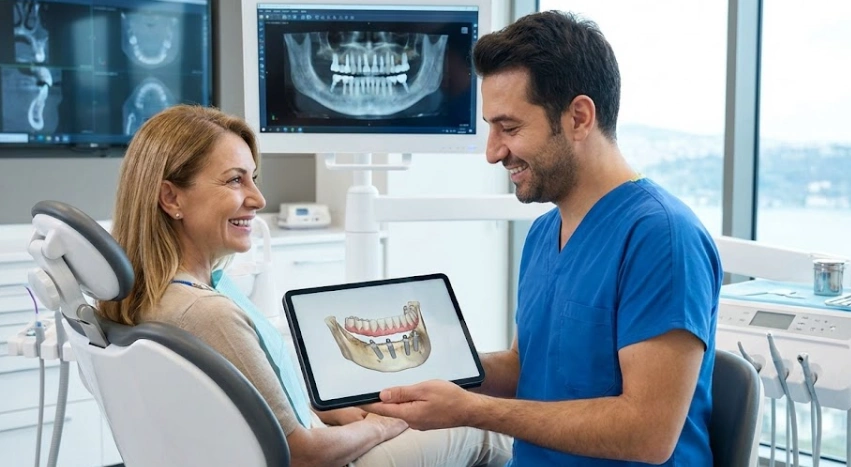
All-on-4 treatment generally takes place in various steps.
In the initial session, an exam takes place, and X-rays and dental images are used in diagnostic procedures. If the situation is such that it is impossible to repair a tooth, then that particular tooth gets extracted before proceeding with the placement of a total of four dental implants.
If the status of the implants and a number of other clinical factors are good enough to justify it, a temporary prosthetic can be delivered while still waiting for healing.
After implant placement, the implants undergo a healing period where they become firmly connected to the surrounding bone. This healing process is referred to as osseointegration and usually lasts several months.
When your dentist is satisfied with the level of healing, the patient should be able to show up again for the next phase. At that point, the design of the final prosthesis can be based on the implant position, bite characteristics, soft tissue, and facial esthetics.
The individual treatment plan and timeline are one of the principles in the operation of Lema Dental Clinic.
How Long is the Process of All-on-6 in Turkey?
All-on-6 therapy proceeds basically in the same way as All-on-4. A difference in this technique is that you only use six implants instead of four.
The initial session comprises an examination, a 3D X-ray scan, a treatment planning session, and implant insertion. If the status of the mouth and clinical factors are good enough, a provisional prosthesis can also be done.
In most cases, the implants have to go through a few months in which they integrate with the jaws. Then, the patient is able to come again for assessment and the production of permanent tooth replacement.
It has to be understood, though, that the mere fact of having six implants will not necessarily mean that the healing phase will last much longer. What determines the healing length and osseointegration mainly are bone quality, implant stability factors, supplementary procedures, and the patient’s ability to heal.
The two experienced dentists, Dentist Polen Akkılıç and Prof. Dr. Coşkun Yıldız, are capable of evaluating these factors as part of the treatment-planning process at Lema Dental Clinic. It is our policy to make your implant selection, their number, and the layout according to the need rather than simply by the fact of being a larger number of implants option.
FAQ
Are All-on-6 implants better than All-on-4?
It is not always black or white. The key difference lies in the fact that All-on-6 implants have two extra points where implants are placed relative to the All-on-4. There are still cases where the All-on-4 is the right solution. The decision as to which of the two options a doctor will settle with really depends on such things as the patient’s jaw bone type, bite, and the treatment requirements.
What are the drawbacks of All-on-4 dental implants?
All-on-4 implant treatment involves a surgical procedure which requires some recovery time. In addition, patients are expected to practice good oral hygiene and make regular appointments for check-ups. Although complications for the implant or the restorative portion of the treatment are relatively rare, a well-planned treatment is very necessary.
Is there anything better than All-on-4 dental implants?
No one alternative is universally better suited than the other. All-on-6 implant bridges, traditional implant-supported bridges, or other full-arch implant solutions are all possibilities for the right patient depending on specific needs and condition.
How uncomfortable is the process of receiving All-on-6 dental implants?
With the use of local anesthesia during implantation, you should not be experiencing severe discomfort during the procedure. Some degree of swelling, slight discomfort, and tenderness are typical after the surgery, which are expected to ease gradually.
What would I tell myself before undergoing dental implants?
Dental implant surgery is more of a journey that involves various stages and not just one treatment. To achieve a successful outcome, surgery, healing time, interim restoration, final prosthetic, dental cleaning, and long-term maintenance all play an important role.
References
- PubMed – All-on-4 and All-on-6 Implant-Supported Fixed Prostheses
Research comparing clinical outcomes of All-on-4 and All-on-6 treatments. - PubMed – Complete-Arch Fixed Implant-Supported Prostheses
Evidence relating to implant numbers, loading protocols, and full-arch restorations. - PubMed – Dental Implant Risk Factors and Contraindications
Scientific information about medical and lifestyle factors that may influence implant treatment. - PubMed – Prevention and Management of Peri-Implant Diseases
Evidence on implant maintenance, risk factors, and long-term tissue health.

