


All-on-X uses more implants, while All-on-4 uses four.
Full-arch dental implant systems are used to replace missing teeth by permanently attaching a prosthesis to titanium implants that are surgically placed in the jawbone. In conducting a thorough diagnostic work-up to plan their routine clinical work, Dr. Polen Akkılıç and her team always evaluate bone density, biting force, and soft tissue condition before they make the final decision between All-on-4 and All-on-X treatment plans.
On a cellular level, both these systems are alike in functioning, but they differ in how many implants, force sharing, and maybe long-term biomechanical effects.
Deciding between All-on-x and All-on-4 dental implants is mainly a clinical judgment II that varies with the patient’s condition. They can be patients with severely resorbed jaws, parafunctional habits, or indeed those exerting very high masticatory forces. Professor Doctor Coşkun Yıldız also explains that the number of implants affects the distribution of the load, the prosthesis’ permanence, and the remodeling of the peri-implant bone over time. Therefore, choosing the right one for you is the secret to a successful and predictable treatment result.
What Are All-on-4 and All-on-X?
All-on-4 dental implants are a treatment concept that only requires four titanium implants for a full-arch fixed prosthesis support, and they are surgically inserted at the exact anatomical locations.
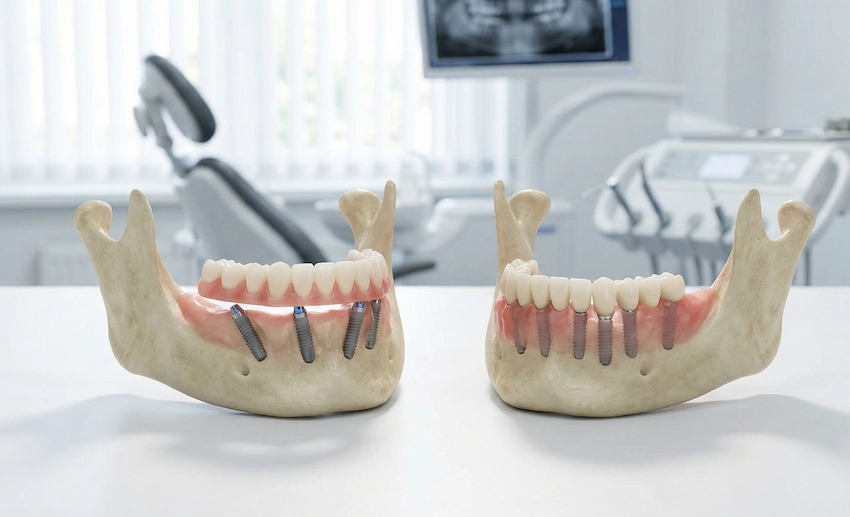
In summary, two implants are inserted into the anterior region vertically, and the other two are implanted at an angle in the posterior region thereby increasing the implants’ contact with the bone and avoiding anatomical restrictions, such as the maxillary sinus or the inferior alveolar nerve.
All-on-X is basically a more advanced version of the regular full-arch concept where in most cases the number is increased from four to five, six, or eight implants. The team including Dentist Polen Akkılıç is able to offer a more personalized therapy by locating the implants in correspondence with the patient’s bone structure thus getting better primary stability and, ultimately, providing greater prosthetic support both immediately and in the long term.
Key Differences: All-on-X and All-on-4
The greatest distinction between All-on-X and All-on-4 is that the former employs more implants to hold the prosthesis than the latter, hence the masticatory forces are more evenly distributed over the jaw.All-on-4 concentrates the load on four implants, whereas All-on-X spreads the occlusal forces over a larger implant base, each implant thus being exposed to a lower mechanical load.
Speaking about clinical safety, Professor Doctor Coşkun Yıldız points out that the strength of the implant to resistance against micromovement during healing increases and thus the risk of mechanical overload decreases with the higher number of implants. This variation is critically important for patients with poor bone density or who have previously had implant complications.
All-on-X and All-on-4: Which Option Is Better?
No system is better than the other one universally because the success of the treatment hugely depends on a patient’s anatomical and functional conditions. Dentist Polen Akkılıç and the team decide on the implant system after thoroughly evaluating the cone-beam computed tomography, bite force, and soft-tissue condition for a predictable osseointegration.
In many cases, All-on-4 can be the efficient and reliable treatment choice for patients having sufficient bone in the front segment of the jaw, whereas, All-on-X provides better biomechanical control in complicated cases. The correct choice ensures the patient’s stability, bone preservation, and oral health maintenance for the long term.”
When Is All-on-X a Better Option?
All-on-X has been favored by patients with low bone density, uneven bone distribution, or higher functional demand cases like bruxism. Placement of more implants, Professor Doctor Coşkun Yıldız is able to lower the stress concentration and facilitate load sharing over the prosthesis.
Moreover, this method will also help patients who are looking for the greatest longevity of their restorations and the least risk of implant repeat. This is because, by increasing the number of implants, the force balance is improved, thus both the implants and the bone tissue around them are protected from breaking down over time.
When Is All-on-4 a Better Option?


All-on-4 treatment is usually an option for patients who have enough bone in the front part of their jaws and do not exert too strong bite forces. Dentist Polen Akkılıç and her team often suggest this method when patients desire a fixed prosthesis, but with fewer implants and a less complicated surgical procedure.
By using the angled placement of implants, the surgeon can secure the implant more firmly and at the same time, in many cases it is possible to do without a bone graft. If done right and by keeping up good oral hygiene, All-on-4 can be a reliable, functional and at the same time a very attractive solution.
Clinical Decision Factors Considered During Planning
At the stage of treatment planning, clinicians assess various criteria to choose the implant system that is the safest:
- Bone density and bone volume of the anterior and posterior regions respectively
- Occlusal force, chewing pattern, and parafunctional habits
- Periodontal status and soft-tissue health
- Medical background and capacity of tissue repair
- Prosthetic-related expectations of the long term
There is a direct effect of each factor on implant stability, prosthetic longevity, and the patient’s comfort.
Comparison Table: All-on-X vs All-on-4 Dental Implants
| Clinical Feature | All-on-4 | All-on-X |
| Number of implants | 4 | 5–8 |
| Force distribution | Concentrated | Widely distributed |
| Bone demand | Moderate | Adaptable to low density |
| Stability margin | Standard | Enhanced |
| Long-term load control | Limited | Advanced |
| Ideal patient profile | Adequate bone, normal bite | Bone loss, high bite force |
Frequently Asked Questions About All-on-X and All-on-4 Dental Implants
The distinction is basically an implant number and the distribution of force. Biomechanical wise All-on-X is more stable since the chewing forces are spread among more implants.
Indeed, the more implants there are the less each one has to bear the load. The mechanical safety aspect is improved for the long term.
All-on-4 treatment is safe if the bone quality is good and the person’s bite force is not too high. Besides that, the right planning and maintenance are a must.
All-on-X, with its less concentrated stress, might lead to better bone preservation. However, most importantly, it is one’s own physical features that decide.
Yes, both All-on-4 and All-on-X can hold fixed, non-removable full-arch prostheses. Both try to bring back the function and comfort that are stable.
- Malo, P., Rangert, B., & Nobre, M. (2003). All-on-4 immediate-function concept with Brånemark System implants for completely edentulous mandibles: A retrospective clinical study. Clinical Implant Dentistry and Related Research, 5(Suppl. 1), 2–9.
- Misch, C. E. (2015). Dental implant prosthetics (2nd ed.). Elsevier Mosby.
- Papaspyridakos, P., Chen, C. J., Singh, M., Weber, H. P., & Gallucci, G. O. (2012). Success criteria in implant dentistry: A systematic review. Journal of Dental Research, 91(3), 242–248.
- Sadowsky, S. J. (2019). Mandibular implant-retained overdentures: A literature review. Journal of Prosthetic Dentistry, 121(1), 15–22.
- Esposito, M., Grusovin, M. G., Polyzos, I. P., Felice, P., & Worthington, H. V. (2014). Timing of implant placement after tooth extraction: Immediate, immediate-delayed or delayed implants? Cochrane Database of Systematic Reviews, (4).

