


Scaling, polishing, and gum check
To a large extent, routine dental hygiene is an unfamiliar concept for most people. It is almost like a secret to them how it works: you just lie down, close your eyes, hear some squeaky sounds, and in half an hour, your teeth usually feel super clean. But do you really know what is going on inside your mouth?
Here at Lema Dental Clinic in Turkey, a professional dental cleaning (prophylaxis) is not seen as just “cleaning teeth” but more like pressing a biological reset button. This is the single most effective way of stopping the body from rejecting its own teeth.
Professor Doctor Coşkun Yıldız frequently refers to this metaphor in order to explain the treatment’s necessity in a very easy way. Imagine your car. You are able to wash the windshield daily (brushing), however, if you never take the hood to have a change of oil and engine cleaning (professional cleaning), the vehicle will, at some point, stop running. Tooth plaque is, in this context, similar to the dirt on the windshield; tartar is the sludge in the engine.
If you would like to know exactly what will be done during your treatment at our clinic, here is a detailed explanation of the whole process:
Step 1: The Clinical Detective Work
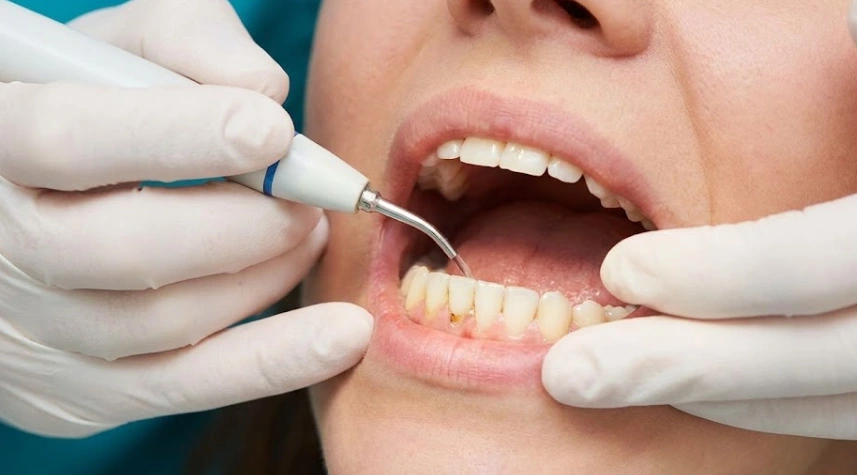
We always look before we use any tools. And we look very closely. Dentist Polen Akkılıç and the team begin each session by physically examining your whole mouth. They’re not just searching for cavities. They are checking “the foundation of the house”—your gums.
By using a very small measuring instrument known as a periodontal probe, we determine the depth of the gum pockets around your teeth. Under normal conditions, such as a healthy oral environment, gum pockets are extremely shallow (1-3mm). If the pockets are deeper, it indicates that the gum tissue is retracting from the tooth and this is a warning sign of gum disease. The results of this stage essentially determine whether you will get a routine cleaning or require a more thorough and intensive treatment.
Step 2: The Heavy Lifting (Scaling)
This is the part the majority of patients recognize from the noise. Plaque is soft, so you can get rid of it at home. But if plaque is not removed within 48 hours, it turns into tartar (calculus). Tartar is similar to concrete. Brushing is pointless for removing it. It is so tightly attached to the tooth that professional instruments can detach it.
There are two kinds of tools that we use for this:
- Ultrasonic Scalers: The wand sprays water and makes a high-pitched humming noise. The tip works by vibrating at a supersonic speed to break down the polluted tartar into tiny particles while the water is used as a cooling agent to wash it away.
- Hand Scalers: These are the metal-line scrapers (curettes). After the ultrasonic device has lifted the chunks of large tartar, we manually use the curettes to scrub the hard-to-see little pieces of tartar between the teeth.
Step 3: The “Grit” Polish
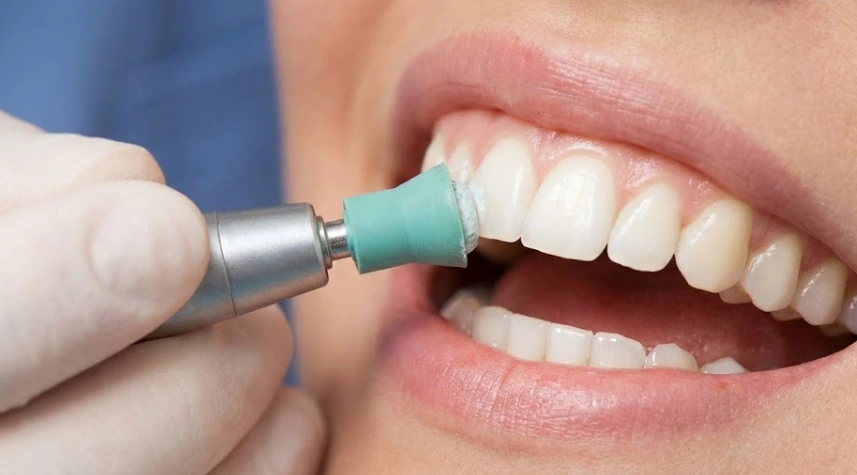
The very first thing that we must do is to level and smooth the surface. We are talking to wash it with an electric brush to be strong, that makes a loud, whirring noise. It is similar to an electric toothbrush, but the rotation speed is much higher.
The main thing in this case is the Prophylaxis Paste. The paste’s consistency is rough, like sand. The particle of this grit is the main one, as it helps in removing the surface stains caused by coffee, tea, or tobacco in a very delicate way. Besides, it also gives the enamel a nice, bright shine.
What is the point of it? The smoother, more polished, and slipperier a surface is, the harder it is for bacteria to get a grip on it. We are simply polishing the car and applying the wax so that the dirt can slide off easily.
Step 4: The Expert Floss
You could be flossing at home, but probably not in the hygienist way. Our method involves flossing deep – safely below the gumline – to remove all traces of polishing paste or plaque hidden in that area. This is also a final check. If the floss breaks in a particular area, this is telling us that there may be an overhang on an old filling or a rough spot of tartar we have overlooked.
Routine Cleaning vs. Deep Cleaning
It is very important to know that not every dental cleaning is the same. In case you have not visited the dentist for several years, the basic cleaning might not be sufficient.
| Feature | Routine Prophylaxis (Regular Cleaning) | Scaling & Root Planing (Deep Cleaning) |
| Target Area | Above the gumline mostly | Below the gumline (on the root) |
| Purpose | Prevention (Maintenance) | Therapy (Curing active infection) |
| Anesthesia | Usually not needed | Local anesthesia often used |
| Visits Required | One visit | Often 2+ visits (one side at a time) |
| Recovery | Immediate | Sore gums for 1-2 days |
Step 5: The Fluoride Shield
The final step is the armor. We put on a concentrated fluoride varnish (which usually has the taste of raspberry or mint).
You can think of fluoride as being similar to calcium in a liquid form. It penetrates very tiny pores in your enamel and then solidifies your enamel; this way, your teeth become quite resistant to the acid that will be produced by your next meal.
FAQ: Your Questions, Answered
Healthy gums do not bleed. If you see blood during your cleaning, it is almost always a sign of gingivitis (inflammation). It means the body is sending blood to the area to fight bacteria. The more you floss at home, the less you will bleed in the chair.
No. The enamel is the hardest substance in the human body. The ultrasonic vibrations are tuned to break the tartar bond without scratching the tooth surface. It is perfectly safe.
Yes, but with one caveat. If we applied a fluoride varnish, we typically recommend waiting 30 minutes before eating or drinking hot liquids to allow the varnish to fully absorb.
For most patients, every six months is the gold standard. However, Dentist Polen Akkılıç may recommend every 3 or 4 months if you have a history of gum disease, are pregnant, or are undergoing orthodontic treatment.
No. A cleaning removes surface stains (polishing), which makes teeth look brighter, but it doesn’t change your natural color. Whitening uses chemicals to bleach the tooth from the inside out. We often recommend doing a cleaning before whitening for the best results.
- Needleman, I., et al. (2015). Improving the quality of dentistry: Dental calculus and the role of the professional cleaning. Journal of Clinical Periodontology, 42(S16), S1-S5.
- Van der Weijden, G. A., & Hioe, K. P. (2005). A systematic review of the effectiveness of self-performed mechanical plaque removal in adults with gingivitis using a manual toothbrush. Journal of Clinical Periodontology, 32(6), 214-228.
- Axelsson, P., Nyström, B., & Lindhe, J. (2004). The long-term effect of a plaque control program on tooth mortality, caries and periodontal disease in adults. Journal of Clinical Periodontology, 31(9), 749-757.
- Drisko, C. L. (2001). Nonsurgical periodontal therapy. Periodontology 2000, 25, 77-88.
- Darby, M. L., & Walsh, M. M. (2010). Dental Hygiene: Theory and Practice (3rd ed.). Saunders Elsevier.

