


Match your dental floss type directly to your specific tooth spacing and dental hardware.
In fact, flossing is so often a chore that people don’t even enjoy it. They usually buy a random box of floss without the intention of making a choice about the brand. Then they put it away in the drawer, and it’s only when a food particle gets stuck and causes irritation that they dig it out.
Still, if we take a little closer look at your mouth, one could say the teeth are quite like beautiful tiles in the bathroom. Doing only the brushing is just like wiping the top of the tiles. However, the way the stained and dirty grout between the tiles is totally missed is really the point. Actually, the shiny surface can fool you, but inside, the bacteria being welcomed is the very thing that the foundation is doing.
One of the clinical observations we have at Lema Dental Clinic is a reflection of the consequences of losing your teeth. Did you know that only about 40% of your tooth enamel is on the surface of your teeth? So, if you don’t floss, you will be ignoring almost half of your oral hygiene.
Professor Doctor Coşkun Yıldız insists on the point that plaque is, in fact,t very stubborn. It is certainly not just the kind of debris you eat that is left behind. So, one may consider plaque as being similar to barnacles that have firmly stuck to the hull of a ship. Thus, a very special tool will be required for its removal, which will not break or damage the surfaces.
What we witness at the clinic is that patients are often perplexed. There are so many choices along the shelf. Waxed, unwaxed, tape, or special implant threads—it is just a lot to process. Therefore, let us simplify the process and help you decide which floss is most suitable for your unique smile.
Signs and Types of Dental Floss
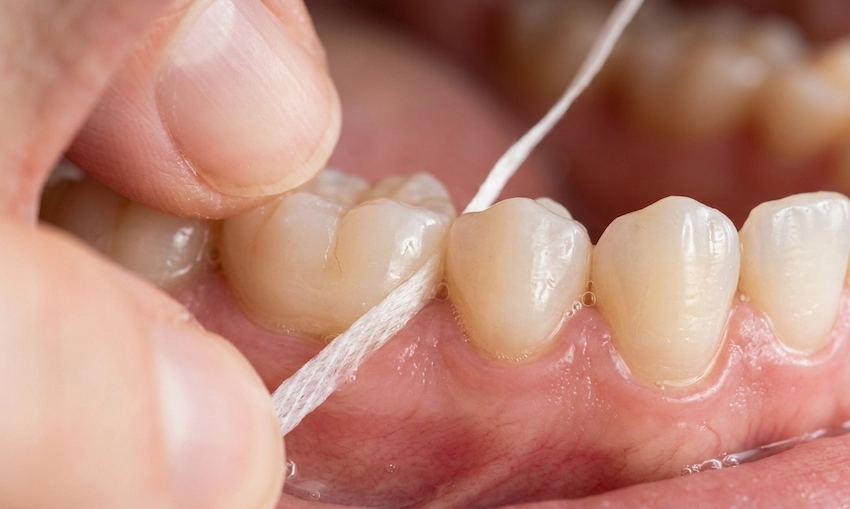
1. Unwaxed Floss: The Traditional Option
This floss is made from a fine nylon thread that’s closely twisted. It lacks any kind of smooth coating. As a result, it holds onto plaque very tightly. It also produces a very nice “squeaky clean” sensation when rubbed against a tooth.
The clinical verdict: It’s great for very tight spaces. However, if your teeth are extremely crowded, they might get torn or broken.
2. Waxed Floss: The Soft Glider
This type is standard nylon floss covered with a thin layer of wax. The wax enables the floss thread to glide through your teeth without any issues or causing breakage.
The clinical verdict: Waxed floss is excellent if your teeth are touching tightly. It slides in without any problems. So, it basically prevents the sudden snap that can lead to accidental cutting or damage to your sensitive gums.
3. Dental Tape Floss: The Large Sweeper
Dental tape differs from regular floss in that it is wider and flatter. Another method to illustrate this visually is that mopping a floor with a big broom is much easier than using a tiny brush.
The clinical verdict: Initially, it’s recognized that some people have bigger gaps between their teeth than others. For these patients, regular floss will be too small. Dental tape, on the other hand, can handle a bigger area at the same time, and it is very soft to the touch as well.
4. PTFE (Teflon) Floss: The Superior Glide
PTFE floss is a product of Teflon synthesis. This is the very material that is used to make non-stick pans. Besides being very strong, it is hardly ever capable of fraying.
The clinical verdict: If you have tightly placed teeth or rough surfaces due to old fillings, PTFE could be your best floss. It goes over rough surfaces nicely and will not break.
5. Super Floss: The Customized Instrument
Super Floss is made up of three different sections. It has a stiff end, which is used for threading through, a soft middle for sweeping, and regular floss at the other end.
Nevertheless, the question still stands: who really requires this product? Patients traveling to Turkey for complete dental restoration can definitely answer that one. Dentist Polen Akkılıç and her crew are faithful consumers of Super Floss. Are you an owner of an implant or brace? Then this tool will undoubtedly be very useful. The stiff end makes it easy for you to go under the hardware part,s while the spongy section is a safe option for cleaning near the gumline.
Fast Track to Floss For You

| Floss Type | Will Work Best | Main Advantage | Potential Disadvantages |
| Unwaxed Nylon | Able to handle most cases | Leaves teeth feeling very clean | May snap if teeth are quite close together |
| Waxed Nylon | Easily works with close teeth | Floss moves smoothly and effortlessly | Might feel a little thick |
| Dental Tape | Good for wide spaces | Wipes a larger area at once | Will not fit narrow spaces |
| PTFE (Teflon) | Good for filling the surface | Almost impossible to break | Somewhat expensive |
| Super Floss | Dental appliances | Works under the hardware | Being thorough takes more time |
FAQs
Definitely, yes. Plaque can turn into tartar very rapidly—sometimes only within one to three days. After tartar has formed, soft floss will not be able to remove it. You will have to get it scraped off by a dentist. Daily flossing will prevent this from happening in the first place.
Water flossers really make a fantastic partner in an oral hygiene routine. They are incredibly useful when it comes to the deep cleaning of the area around huge dental implants. Still, let’s be frank: these devices do not clean the tooth surface even close to the way string floss does. For the best possible care day in and day out, we strongly suggest using both.
It’s a myth that has been spread so far and wide. Actually, bleeding is an indication that your gums are inflamed and have become unhealthy. This is an immediate result of the bacteria that you failed to eliminate. So, don’t stop! If you do gentle flossing daily for seven days, the swelling will not only reduce, but also the bleeding will cease on its own.
First of all, the floss you use should be approximately 18 inches/45 centimeters long. Make sure to transition from a clean, fresh portion of the floss each time you move to the next tooth. Reusing the same section of floss will just be like carrying bacteria around from one region of your mouth to another.
You will need to maintain very high levels of care and hygiene as the implants do not possess the natural defenses of real teeth. Therefore, if food is left behind, the gums can get infected very easily. Apart from regular flossing, you will also need to use other care instruments like Super Floss or a brush daily to help you confidently clean under your new teeth without risking damage to the area.
- Sambunjak, D., Nickerson, J. W., Poklepovic, T., Johnson, T. M., Imai, P., Tugwell, P., & Worthington, H. V. (2011). Flossing for the management of periodontal diseases and dental caries in adults. Cochrane Database of Systematic Reviews, (12).
- Poklepovic Pericic, T., Worthington, H. V., Johnson, T. M., Sambunjak, D., Imai, P., Clarkson, J. E., & Tugwell, P. (2013). Interdental brushing for the prevention and control of periodontal diseases and dental caries in adults. Cochrane Database of Systematic Reviews, (12).
- Chapple, I. L., Van der Weijden, F., Doerfer, C., Herrera, D., Shapira, L., Polak, D., … & Graziani, F. (2015). Primary prevention of periodontitis: managing gingivitis. Journal of Clinical Periodontology, 42(S16), S71-S76.
- Ng, E., & Lim, L. P. (2019). An Overview of Different Interdental Cleaning Aids and Their Effectiveness. Dentistry Journal, 7(2), 56.
- Sälzer, S., Slot, D. E., Van der Weijden, F. A., & Dörfer, C. E. (2015). Efficacy of inter-dental mechanical plaque control in managing gingivitis—a meta-review. Journal of Clinical Periodontology, 42(S16), S92-S105.

