


Months to years; varies greatly.
At Lema Dental Clinic, a recurring theme that comes up is when patients spot a small dot on their X-ray and then ask, “Is it okay if I wait until my next appointment to get it treated?” It is certainly a fair question. But knowing how fast dental caries develop can be the difference between just a simple filling and a cumbersome root canal.
According to our clinical experience, the progression of a cavity is not a straightforward process. It isn’t, like a car, moving at a constant ‘miles per hour’ pace. Rather, decay is more like a fire in a house; it creeps slowly and silently in the fire-resistant outer walls before bursting into the wooden frame and rapidly spreading through the entire structure.
The Enamel Barrier: The Slow Burn
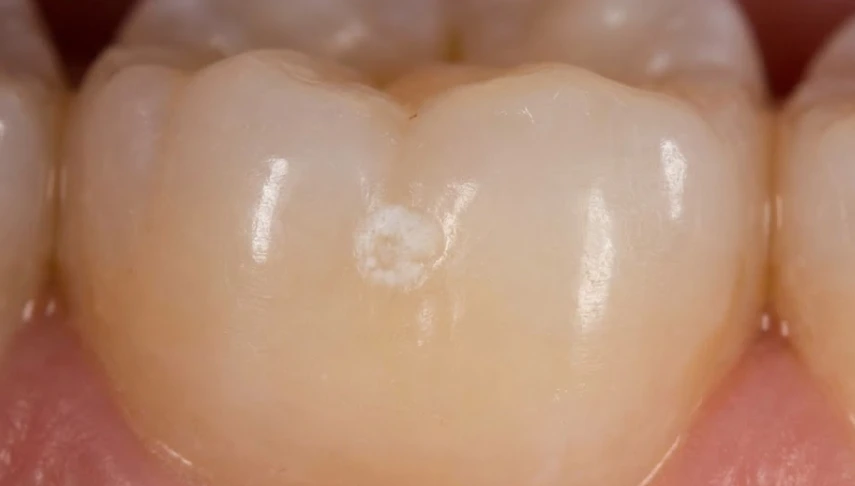
Enamel, the outermost layer of your tooth, is the hardest material in the human body. Since it contains such a high level of minerals, bacteria must exert a lot of effort to destroy it. The truth is that a healthy adult’s tooth enamel can be completely penetrated by a cavity in a time range from as little as six months up to a few years.
Professor Doctor Coşkun Yıldız most of the time refers to it as the “golden window” for intervention. At this point, the decay is generally reversible by means of remineralization therapies or better hygiene. But once this protective layer is broken through, time starts to run much faster.
The Dentin “Fast Track”
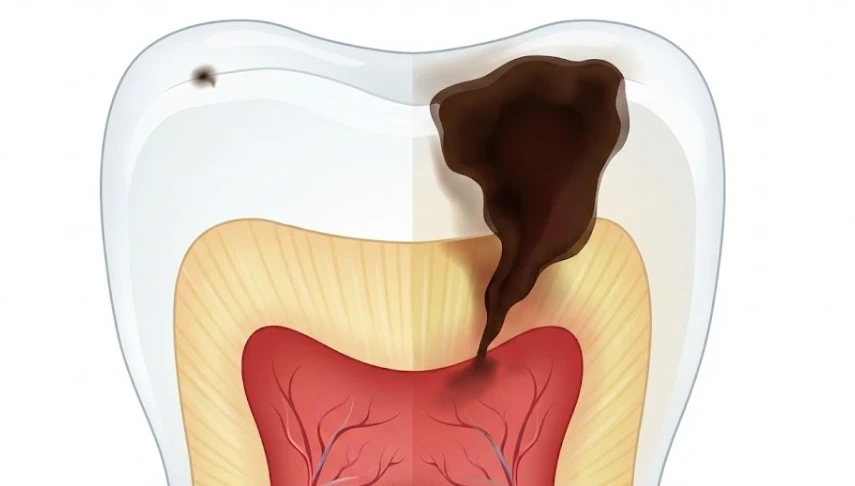
Underneath the enamel lies the dentin. If enamel is a fortress wall, dentin is the soft limestone beneath it. Dentin is much more organic and contains microscopic tubules that lead directly to the nerve. Here is what we see in the clinic: once decay hits the dentin, its speed can triple.
At this point, the decay isn’t just sitting on the surface; it is traveling. It follows the path of least resistance. What started as a tiny pinhole on the surface can bloom into a massive hollow cavern inside the tooth within just a few months. This is why a tooth that “looked fine” in the mirror last month can suddenly fracture or start throbbing today.
Factors That Accelerate the Clock
The question remains: why does one person’s cavity take years to grow while another’s destroys a tooth in months? Dentist Polen Akkılıç and her team look at several accelerating factors when treating patients in Turkey:
- Sugar Frequency: It isn’t just about how much sugar you eat, but how often. Frequent “acid attacks” keep the enamel in a constant state of demineralization.
- Dry Mouth: Saliva is your mouth’s natural fire extinguisher. Without it, acid runs rampant.
- Location: Decay in the pits of molars or between teeth (where the enamel is thinner) moves faster than on the smooth front surfaces.
- Age: Children have thinner enamel and larger pulps, meaning decay can reach the nerve of a baby tooth with terrifying speed.
Timeline of Decay Progression
| Stage of Decay | Typical Duration | Risk Level | Treatment at Lema Clinic |
| Enamel White Spot | 6 Months – 2 Years | Low | Fluoride & Observation |
| Enamel Cavitation | 6 Months – 1 Year | Moderate | Composite Filling |
| Dentin Invasion | 3 – 6 Months | High | Deep Filling / Inlay |
| Pulpal Involvement | Weeks | Critical | Root Canal Therapy |
| Abscess/Bone Loss | Days to Weeks | Extreme | Extraction or Surgery |
Why Timing Your Treatment in Turkey Matters
When you visit us at Lema Dental Clinic, we aren’t just looking at where the decay is today; we are projecting where it will be in six months. Professor Doctor Coşkun Yıldız emphasizes that preventative care in Turkey is far more cost-effective and less invasive than reactive care.
But let’s take a closer look at the “silent” aspect of this process. The majority of cavities are not painful until they actually come into contact with the dentin or the pulp. Expecting pain is similar to waiting for the car’s engine to emit smoke before checking the oil. At that point, the harm has already been quite substantial!
FAQ: Direct Insights from the Surgeons
Professor Doctor Coşkun Yıldız: It is rare, but possible. We call this “arrested caries.” If you drastically improve your hygiene and diet, the environment changes, and the decay can “freeze.” However, it requires constant monitoring to ensure it doesn’t wake up.
Dentist Polen Akkılıç: Decay between the teeth (interproximal) is notoriously difficult to see without X-rays. It can hide under the contact point of the teeth, hollowing them out from the inside while the top looks perfectly white.
The Lema Team: Indirectly, yes. Changes in diet, morning sickness (acid exposure), and hormonal changes in saliva can create a “perfect storm” for bacteria to thrive during this period.
Professor Doctor Coşkun Yıldız: While genetics play a role in the shape of your teeth and the quality of your saliva, the “soft teeth” myth is usually down to the oral microbiome and habits. With the right care here in Turkey, anyone can slow down the decay process.
Dentist Polen Akkılıç: In most cases, yes. If the decay is still in the enamel, a few months won’t typically result in a disaster. However, we always recommend sending us your recent X-rays for a virtual consultation so we can give you a safe timeline.
- Featherstone, J. D. (2008). Dental caries: a dynamic disease process. Australian Dental Journal, 53(3), 286-291.
- Lussi, A. (2006). Dental Erosion: From Diagnosis to Therapy. Karger Medical and Scientific Publishers.
- Pitts, N. B. (1983). Monitoring of caries progression in permanent teeth. Community Dentistry and Oral Epidemiology, 11(4), 228-235.
- Selwitz, R. H., Ismail, A. I., & Pitts, N. B. (2007). Dental caries. The Lancet, 369(9555), 51-59.
- Zero, D. T. (1999). Dental caries process. Dental Clinics of North America, 43(4), 635-664.

