


Sinus lift complications are rare and manageable.
Sinus Lift Complications: A Surgeon’s Honest Guide to Risks and Management
Let’s be honest. Are you considering dental implants in your upper jaw? If that’s the case, the term “sinus lift” probably popped up in your research. It does sound quite alarming, doesn’t it? You may be scared of the idea of lifting a sinus membrane, but in fact, it is a very safe and common method of tooth restoration if the person is a professional.
We at Lema Dental Clinic in Istanbul, Turkey, fully support that a well-informed patient is a relaxed patient. Not only the advantages, but also the realities of biology must be taken into consideration. Complications may be statistically rare, but they can occur. The difference between a minor hiccup and a big problem is entirely due to how the surgical team handles the situation.
The Anatomy of the Lift: Walking on Eggshells
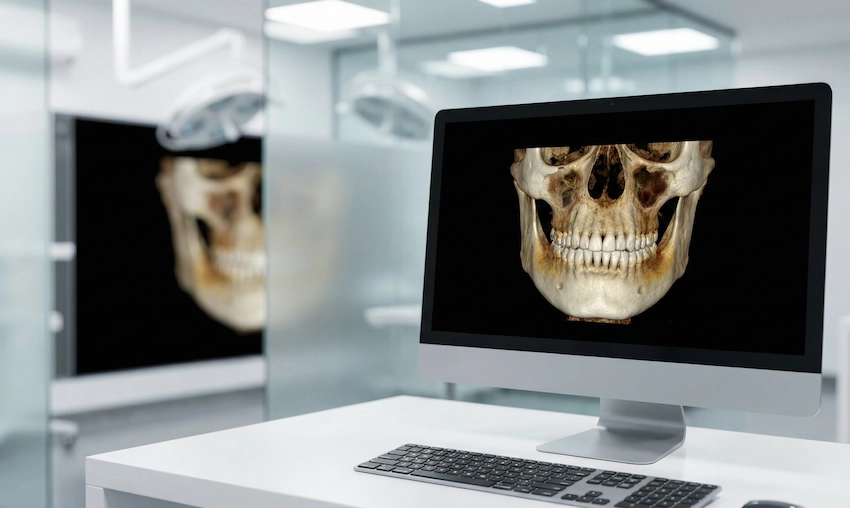
To appreciate the dangers, you have to imagine the anatomy. Take your maxillary sinus – the air-filled cavity above your upper teeth – consider it as a tent. The bone of your jaw is the ground of this tent. When the teeth are lost, the ground gets eaten up by the natural process and the tent falls. To install an implant, we need to raise the tent floor (bone) and fill it with the bone graft material.
The most sensitive part is the lining of that tent called the Schneiderian membrane. It is extremely thin—approximately the thickness of the skin inside an eggshell. We have to detach that membrane from the bone without damaging it.
Professor Doctor Coşkun Yıldız frequently tells the patients that the “membrane is treated as a diamond by a jeweler.” It needs a very steady hand and a special tool, which is why your safety depends on how experienced a clinic in Turkey is, which is why you must choose a highly experienced dental clinic in Turkey.
The Most Common Complication: Membrane Perforation
During sinus lift, the most frequent issue is a small rupture of that ” eggshell” membrane. Globally, it is estimated that around 20-25% of cases are affected by this problem.
However, here is the truth: rupture is not a catastrophe but just one of the variables that can be handled.
It is only if a tiny perforation is detected during the surgery that Dentist Polen Akkılıç and her associates are capable of fixing it on the spot. Words used in this context are with collagen membrane – a biological “patch” – that is used for closing the gap. If the patch is applied properly, mineralization can continue as normal and the bone graft material remains in the original place. As long as immediate detection and treatment take place, membrane perforation hardly ever affects the implant survival rate.
Infection: Rare, But Real
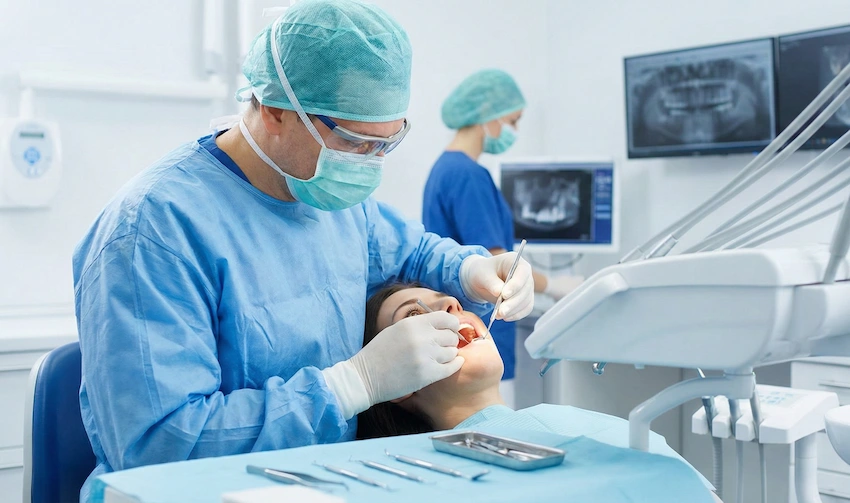
Sinuses connect to the nasal passage thus they are not sterile like the inside of the bone. Therefore there might be an infection after surgery (sinusitis) if the graft gets contaminated or if the patient has pre-existing sinus issues.
At Lema Dental Clinic, we take this risk very seriously and work hard to minimize it. Before the procedure, we conduct detailed 3D CBCT scans and evaluate the scans. If we observe a ”foggy” sinus signaling inflammation, then we stop the procedure. We treat the sinus first, often in collaboration with ENT specialists, before scheduling the lift.
Graft Failure & Migration
To illustrate this point picture pouring cement into a wooden mold. If a mold isn’t closely held, the cement will leak out. Likewise, graft material, if not properly confined, will move into the sinus cavity. This will most likely bring about blockage and the patient will have to undergo revision surgery.
The application technique counts here. Instead of the conventional drills, we opt for piezoelectric surgery (ultrasonic vibrations). This technique enables the bone to be cut but as soon as the device touches the membrane it will stop. This way we can significantly reduce the risk of injury.
Clinical Management: How We Handle Complexity
The table below shows how we classify risks and the specific protocols we follow at our clinic to tackle them.
| Complication | Risk Level | Symptoms | Management Strategy at Lema |
| Membrane Perforation | Moderate (Common) | Usually none (diagnosed during the operation) | Immediate closure using a collagen patch or PRF (Platelet Rich Fibrin) membranes |
| Acute Sinusitis | Low | Pain, sinus pressure, yellow nasal discharge | Antibiotic therapy, decongestants, and saline irrigation; in severe cases, graft removal may be required |
| Graft Migration | Very Low | Persistent nasal congestion, sensation of “loose grit.” | Revision surgery to remove the migrated graft material and re-secure it |
| Bleeding | Low | Recurrent nosebleeds (epistaxis) | Intraoperative coagulation; patients are instructed not to blow their nose for 14 days |
The Role of Biological Growth Factors
One of the terms that you might be hearing from us is ”sticky bone” or PRF. These are not just fancy words. We take a little of your blood, put it into a centrifuge, and separate a concentrate of your own healing cells (platelets and fibrin). Then, we combine these cells with bone graft material.
What’s the purpose? To turn sand (bone graft) into clay (sticky bone). Thus, the graft is not only stable and moldable but it will also heal faster as it is now loaded with growth factors from the patient’s own body. For advanced cases in Turkey it constitutes the standard of care.
Frequently Asked Questions
There is no way you can feel it. You are being numbed or sedated so there is no way you can feel the tear. Maybe you hear the change in breathing of the patient or the instrument of the surgeon, but you won’t be in pain. Usually the membrane is repaired without the patient’s knowledge while the patient is insensible.
In general, we advise that you avoid flying for 48 to 72 hours. During the flight, the change in air pressure may cause discomfort to the sinus that has just been operated on. It will only be permissible to travel when Professor Doctor Coşkun Yıldız is entirely confident that the graft is stable.
The answer is yes; however, the right time must be chosen. Operating on the sinuses while they are inflamed and full of fluid due to the season of peak allergies is not an option. We will arrange for your trip to Istanbul for a time when your allergies are less severe so that you get the best possible healing.
If a graft fails (mainly due to infection), we take out the graft material, allow the area to heal for a while, and then redo the operation. The maxillary sinus is a very good healer. An unsuccessful graft doesn’t mean that implants will never be an option for you; it just means that we have to reset the biological clock.
It mostly comes as a surprise that the pain is in fact less than that of a tooth extraction. Swelling is the most likely side effect, and bruising often happens too but acute pain is actually very rare. The majority of patients are doing fine with regular painkillers purchased over the counter after the first day.
- Testori, T., Drago, L., Wallace, S. S., & Del Fabbro, M. (2012). Prevention and treatment of postoperative infections after sinus elevation surgery: clinical consensus and recommendations. International Journal of Dentistry, 2012, 365809.
- Pikos, M. A. (2008). Maxillary sinus membrane repair: update on technique for large and complete perforations. Implant Dentistry, 17(1), 24-31.
- Chiapasco, M., & Zaniboni, M. (2009). Methods to treat the edentulous posterior maxilla: implants with sinus grafting. Journal of Oral and Maxillofacial Surgery, 67(4), 867-871.
- Wallace, S. S., & Froum, S. J. (2003). Effect of maxillary sinus augmentation on the survival of endosseous dental implants. A systematic review. Annals of Periodontology, 8(1), 328-343.
- Misch, C. E. (2008). Contemporary Implant Dentistry. Mosby Elsevier.

