


Puntos blancos o sensibilidad a los azúcares.
A dental implant is more than a cosmetic enhancement; it’s a revival of a functional base. When you put in the effort, feel, and money picking up your smile—maybe even making the trip to us in Turkey for the procedure—you definitely expect that fix to be permanent.
Fortunately, modern dental implants are equipped with extremely high success rates, in fact, around 95-98%. However, here at Lema Dental Clinic based on our clinical experience, we realize that stats are just numbers if you happen to be among the unlucky few people.
In fact, the truth is that dental implants are capable of failing. Sometimes, they don’t even fail since the bone has locked them in properly, but they fail early. Sometimes, they fail years later, after there has been a huge bone loss that was silent.
You must differentiate normal post-operative recovery from alarming signs of a much bigger problem. Always come to terms with the idea that these signals, if ignored, will just multiply the damage to the surrounding bone and, in the end, will make the reconstruction much more complicated than today.
Below is a professional guide to detecting a damaged dental base.
The Foundation Metaphor: Understanding Success vs. Failure
Simply put, to comprehend a failure, one has to comprehend success first. Professor Doctor Coşkun Yıldız, when he installs an implant, is not just screwing a titanium post in a tree. He is actually putting a biocompatible component in the bone tissue that is still alive.
Success is all about the mechanism of osseointegration. Think of a steel pylon being surrounded by concrete. The pylon can only hold up a skyscraper if the concrete hardens perfectly against the steel, resulting in the two forming one solid piece. However, if the concrete stays sandy or wet right next to the steel, the pylon will start to shake eventually.
Dental implant failure is basically that “wet concrete.” The bone is either not growing tightly against the titanium surface or, after several years, the bacteria are eating away that established connection.
Early-Stage Failure Signs (The First 3-6 Months)
These problems are related to the recovery period and happen before the final crown is put on. They are mostly a sign that the body does not accept the implant or that an infection has been contracted right after the surgery.
1. Persistent, Throbbing Pain
After the surgery, for a week or two, there will be some discomfort, but it should lessen day by day. If you have a sharp, throbbing pain that lasts for more than two weeks or that after initially going away, suddenly increases again, this is a very serious warning sign. It is, most of the time, a sign that there’s an infection deep inside or that a nerve is under pressure.
2. The Presence of Pus or a Nasty Taste
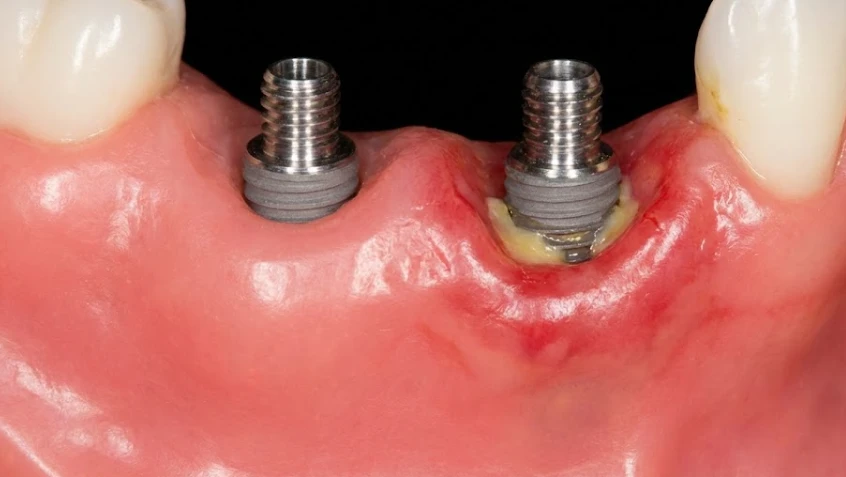
The mouth contains bacteria, and it sometimes happens that, despite strict aseptic measures during surgery, an infection develops. The signs of an abscess are yellowish discharge from the implant site and a strong smell of the mouth that even mouthwash does not get rid of.
3. Numbness or Tingling
When the anesthesia fades, a sensation of numbness in the lip, chin, or tongue (paresthesia) that lasts for a long time might indicate that the implant is pressing against a nerve in the jaw. This situation warrants immediate x-rays.
Late-Stage Failure Signs (Years Later)

These are usually the most devastating scenarios for the patients. You have been enjoying your new teeth for a couple of years, everything is fine, and then the changes come slowly.
1. Mobility: The Ultimate Dealbreaker
This is by far the most crucial symptom. You should not be able to tell that you have a dental implant when you hold it in your hand since a healthy implant, just like a natural ankylosed tooth, should be completely rigid.
If you manage to move the implant with your tongue or finger and the feeling of a slight shifting when chewing is also there, then the osseointegration has failed. The bone support has gone. Dentist Polen Akkılıç and her prosthetics team are very often told by patients that they confuse a loose crown with a loose implant. The dentist’s job is to immediately make the differentiation—a loose crown is a quick fix; a loose implant is an emergency.
2. Peri-Implantitis: The “Gum Disease” of Implants
Teeth suffer from periodontitis, while implants can contract peri-implantitis. The latter is a harmful and destructive inflammation caused by the accumulation of bacteria at the gum line.
- The tissue around the implant looks very red, puffy or irritated compared to the normal pink gums.
- Just like natural teeth, you should hardly ever see blood when brushing implant sites. In case you keep seeing “pink in the sink” after cleaning around your implant, it means there is an active disease.
3. Gum Recession and Exposed Threads
When the gums recede, titanium post threads gradually become visible, which suggest that there has already been a major bone loss under the surface.
Comparing the Timelines of Failure
We have created this side-by-side table to give you a visual representation of the times when you are at risk of each problem, based on what we observe here in our Istanbul clinic.
| Feature | Early Failure (Osseointegration Phase) | Late Failure (Maintenance Phase) |
| Timing | 0 to 6 months post-surgery | Years after successful function |
| Primary Culprit | Surgical trauma, poor bone quality, immediate infection, uncontrolled diabetes. | Peri-implantitis (bacteria), occlusal overload (bite force issues), smoking. |
| Pain Level | Often acute, throbbing, persistent. | Frequently painless until advanced stages. |
| Radiographic Signs | A dark line appears between implant and bone on X-ray. | A “crater-like” bone loss visible around the implant neck. |
| Outcome | Usually requires implant removal and grafting. | Can sometimes be saved with aggressive cleaning if caught early. |
Critical Questions on Implant Health and Longevity
No. Under no circumstances should a successfully integrated dental implant feel loose. Any perceptible movement indicates that the bone bond has broken. If you feel movement, stop chewing on that side immediately and contact a dentist. Continuing to wiggle it will only destroy the remaining jawbone, making future replacement difficult.
Yes, but time is tissue. If caught in the earliest stage (called peri-implant mucositis, where only the gums are angry), improved hygiene and professional cleaning can reverse it. Once it progresses to true peri-implantitis with bone loss, we must use more aggressive surgical cleaning protocols or laser therapy to try and halt the bone loss.
This is a very common question. The titanium post has no nerves, so it cannot feel pain. However, the bone tissue and gums surrounding it absolutely do. Pain years later usually means the surrounding tissues are inflamed due to infection, or the bone is micro-fracturing because of excessive bite pressure (bruxism).
“Guarantee” is a strong word, but it is the single biggest voluntary risk factor. Nicotine constricts blood vessels, starving the bone and gums of the oxygen they need to heal and fight bacteria. Smokers experience significantly higher rates of peri-implantitis.
Do not “wait and see.” Bone loss around a failing implant can progress rapidly. Contact your local dentist for an immediate X-ray (periapical radiograph). If you were treated at Lema Dental Clinic, contact our patient coordinators immediately so our surgical team can review your situation remote and advise on the next steps, whether that involves local care or returning to Turkey.
- Derks, J., & Tomasi, C. (2016). Peri-implant health and disease. A systematic review of current epidemiology. Journal of Clinical Periodontology, 43(S13), 504–526.
- Esposito, M., Hirsch, J. M., Lekholm, U., & Thomsen, P. (1998). Biological factors contributing to failures of osseointegrated oral implants. (I). Success criteria and epidemiology. European Journal of Oral Sciences, 106(1), 527–551.
- Heitz-Mayfield, L. J. (2008). Peri-implant diseases: diagnosis and risk indicators. Journal of Clinical Periodontology, 35(S8), 292–304.
- Jemt, T., & Häger, P. (2006). Early complete failures of fixed implant-supported prostheses in the edentulous maxilla: a 3-year analysis of 17 consecutive cluster failure patients. Clinical Implant Dentistry and Related Research, 8(2), 77–86.
- Schwarz, F., Derks, J., Monje, A., & Wang, H. L. (2018). Peri-implantitis. Journal of Periodontology, 89(S1), S267–S290.

