


Zygomatic for full upper jaw loss; pterygoid for the back.
Lots of patients come to us in Istanbul, Turkey, feeling completely hopeless. Other doctors have told them that they simply don’t have enough bone for regular dental implants. This left them with the only option of loose, painful dentures. In fact, a major problem for people with severe bone loss in the upper jaw was that it was practically impossible.
Let’s find out what modern dentistry is capable of. Based on our experience at Lema Dental Clinic, a “no” from a previous dentist for many patients represents a mere starting point. If the standard implants don’t work, that is when we consider the advanced, “miracle” procedures, Pterygoid and Zygomatic implants.
So which one will be the perfect fit for your mouth?
What the Bone in Your Jaw Really is
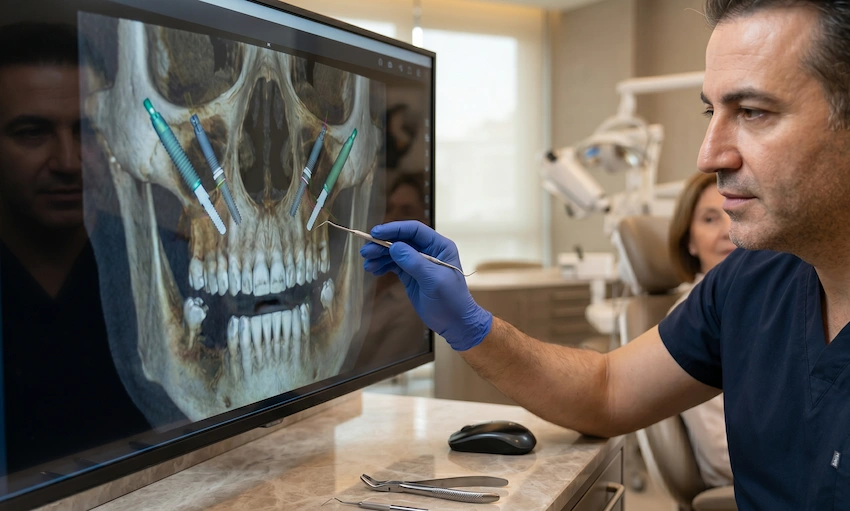
The upper jaw is the same as the foundation of a house. Tooth loss leads to the “erosion” of the top layer of the jawbone. At the same time, the sinus area above comes down. The result is that there is no more space for a regular implant.
Building a house on continuously shifting sand is obviously not a good idea. A long time ago, dentists had to resort to multiple years of painful bone grafts to replace the lost outer layer of the bone. Nowadays, we prefer a totally different approach, which is to go around the weak soil completely and fix the new teeth to the deep, solid bedrock.
These are the two main bedrock areas that we usually find in the patient’s skull and use to support their new smile. Those are typically either the cheekbones (zygoma) or the dense bone structures at the extreme ends of the upper jaw (pterygoid).
Zygomatic Implants: Fixing the Teeth on Your Cheekbones
There are cases where there is absolutely no usable bone in the upper jaw.
Here is the main fact that Professor Doctor Coşkun Yıldız always mentions. Over time, your jawbone will slowly disappear, but the cheekbone remains thick and strong. For this reason, implant placement in the cheekbone can even suffice for the immediate delivery of a fixed set of teeth. So the patient goes through surgery, and after the surgery, he/she has teeth. That is almost time for a bite, and the apple is on the table! A truly life-changing moment for someone who has been imagining apple eating as a thing of the past.
Pterygoid Implants: The Back Strong Pillar of the Jaw

What if your front bone is in decent shape, but bone loss in the back area of the jaw is extreme? This is very similar to situations where pterygoid implants can bring the greatest benefit.
This made Dentist Polen Akkılıç and her team invent the “skip sinus” technique using pterygoid implants. These implants basically provide one with support coming from the “back of the house” on a very solid and stable platform. It is the force of biting with your back teeth that gets transferred to the solid bone that is healthy enough to take the load.
Side-by-Side: Which Option is Right for You?
| Feature | Zygomatic Implants | Pterygoid Implants |
| Main Anchor Spot | Cheekbone (Zygomatic arch) | Bone pillar behind the jaw (Pterygoid) |
| Implant Length | Extra-long (30mm – 55mm) | Long and Angled (15mm – 20mm) |
| Best For | Total bone loss in the upper jaw | Severe bone loss in the back teeth area |
| Needs Sinus Graft? | No (Bypasses the sinus) | No (Bypasses the sinus) |
| Surgical Skill Needed | Extremely high | High |
Frequently Asked Questions
That’s not something you’ll feel at all! I completely understand that looking at the X-rays might be scary for you. But actually, after the implants have integrated with the bone, you won’t even know that they’re there. There are no nerve endings in the bone to feel the metal. It’s just like your own natural teeth.
Given the situation, you might think there will be a lot of pain. However, really, most of our patients only have mild swelling for a few days, if anything. This is managed very easily with simple medicine. Also, since no big and invasive bone grafting is done, you will heal faster.
Age really is just a number for us. We focus on your overall health and well-being rather than on your date of birth. If your heart is in good condition and can handle normal dental surgery, chances are you’ll be great for implants. Besides, we often treat patients well into their 70s and 80s who simply want to have their favorite foods again.
These are very advanced operations which require special training way beyond the level of basic dental school. Therefore, many patients come to our clinic in Turkey so that they get treated safely.
You don’t need to make a mistake here. When you come to see us, we will do a 3D scan of your skull as well as detail mapping of your bone structure. Your own facial features will help us decide exactly what you require.
- Aparicio, C., Manresa, C., Francisco, K., Claros, P., Alández, J., González-Martín, O., & Albrektsson, T. (2014). Zygomatic implants: indications, techniques, and outcomes, and the zygomatic success code. Periodontology 2000, 66(1), 41-58.
- Candel, E., Peñarrocha, D., Peñarrocha, M. (2012). Rehabilitation of the atrophic posterior maxilla with pterygoid implants: A review. Journal of Oral Implantology, 38(S1), 461-466.
- Chrcanovic, B. R., Albrektsson, T., & Wennerberg, A. (2016). Survival and complications of zygomatic implants: an updated systematic review. Journal of Oral and Maxillofacial Surgery, 74(10), 1949-1964.
- Graves, S. (2019). The Pterygoid Implant: A solution for the totally edentulous atrophic maxilla. Compendium of Continuing Education in Dentistry, 40(6), 346-352.
- Malo, P., de Araújo Nobre, M., Lopes, A., Ferro, A., & Moss, S. (2015). Extramaxillary surgical technique: clinical outcome of 352 patients rehabilitated with 747 zygomatic implants with a follow-up between 6 months and 7 years. Clinical Implant Dentistry and Related Research, 17(S1), e153-e162.

