


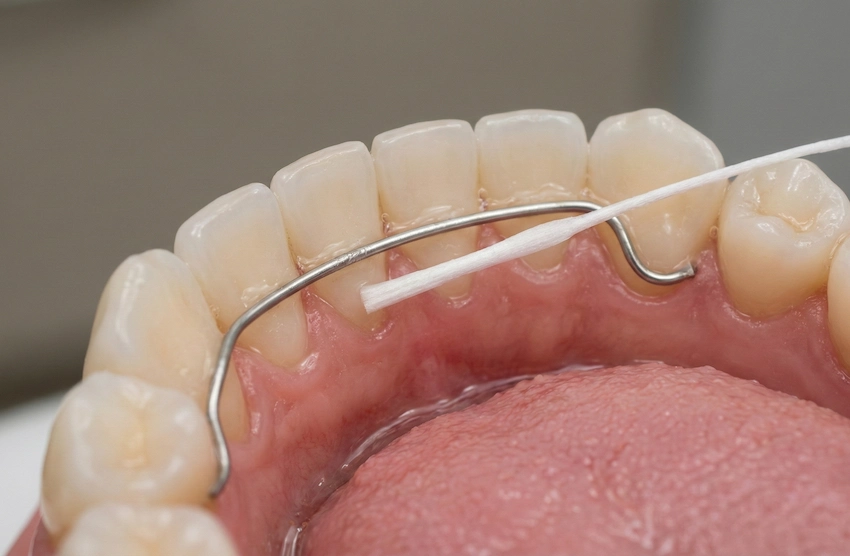
Use floss threaders or super floss to clean under the permanent retainer wire.
Flossing with a Permanent Retainer
You may have undergone months, even years, of treatment to straighten your teeth. That narrow, metal wire attached to the back of your teeth is what keeps your smile intact. At Lema Dental Clinic in Turkey, we humorously tell our patients that a permanent retainer works like a main beam in a great piece of architecture; people can’t see it, but the whole structure wouldn’t stand without it.
However, the truth is, this protector is the main attraction for plaque. Since you can’t simply slide a piece of floss between the contact points of your teeth, this spot turns into a food trap. When neglected, that lovely smile will get covered with tartar and your gums will get infected.
Yet, how to clean a fixed barrier properly without it becoming a dreaded task?
The Tools of the Trade: An Alternative to Regular Floss

It has been our experience at Lema Dental Clinic that the patients who have problems with their retainers are mostly those who have not discovered the right tool for them. It is like trying to paint a detailed portrait with a brush for the walls and ceilings – the results will be frustrating.
Professor Doctor Coşkun Yıldız in his teaching often points out that the “normal” method of flossing simply cannot be used here. One should be equipped to cross under the “underpass” constructed by the wire.
1. The Floss Threader
Think of it as a disposable plastic sewing needle. You attach your favorite dental floss to the threader’s eye and guide it under the retainer wire. At first it might seem boring but after some training, it gets very easy.
2. Superfloss
Superfloss is a special dental floss made with a stiff end that is already cut and ready to use. You can think of it as a “three-in-one” item: a stiff end for getting under the wire, a spongy section for cleaning larger spaces, and regular floss for the rest of the mouth.
3. The Water Flosser
If you find manual threading difficult, a water flosser can be a wonderful help. It sends out a powerful jet of water to wash away food particles. While it shouldn’t completely replace traditional flossing, it is a great tool for cleaning the most inaccessible areas.
Step-by-Step: The “Under-and-Over” Technique
Dentist Polen Akkılıç and her crew insist on being deliberate rather than hurried to keep a retainer in good condition. Here is what we observe in the office: patients who “snap” the floss tend to harm their gums. Instead, take this nice method for a spin:
- Thread it through: Using Superfloss or a floss threader, put the stiff end between your teeth under the wire, right at the gum level, from the back to the front.
- The C-Shape: Floss is taken out and wrapped around the side of one tooth in a “C” shape. It is then moved up and down gently and a little bit of the gum line is also reached.
- The Switch: He goes to the next tooth and once again performs the “C” shape.
- Repeat for every gap: This process has to be repeated for every tooth attached by the wire.
But let’s look closer at how these methods compare in terms of daily life.
Comparison of Flossing Methods for Fixed Retainers
| Method | Ease of Use | Effectiveness | Best For… |
| Floss Threader | Moderate | High | Precision cleaning |
| Superfloss | High | High | Travel and convenience |
| Water Flosser | Very High | Moderate/High | Patients with sensitive gums |
| Interdental Brushes | High | Moderate | Larger gaps between teeth |
Why “Good Enough” Is Not Enough
The reality is that a permanent retainer is a compromise that lasts a pretty long time. If plaque is left next to the wire, it will turn into calculus (tartar) within 24 to 48 hours. Once it is hard, you won’t be able to brush it off; you will have to go to the dentist for cleaning at Lema Dental Clinic.
You can compare your gum tissue with a thin silk scarf. When tartar is left there, it is as if you were sanding that silk with sandpaper. Eventually, the tissue gets inflamed, turns red, and bleeds easily. That is the reason why we strongly recommend a very thorough night regimen.
Frequently Asked Questions (From the Doctor’s Desk)
Actually, it is generally not the case. Bleeding is a sign that there is likely to be gingivitis in that area caused by insufficient cleaning. So, you should keep gently flossing and after a week of proper cleaning, inflammation will disappear and bleeding will cease.
Although the dental adhesive materials at Lema are very strong, they are not indestructible. You should avoid using the floss as a saw aggressively against the wire itself. Direct your pressure towards the sides of the teeth and the gum line.
It is a great device, especially for washing out sizable debris. However, it does not have the “scraping” motion that is necessary to remove the layer of sticky biofilm (plaque) that adheres to the tooth surface. We suggest that you use it together with manual flossing.
We suggest going to a professional for a check-up and cleaning twice a year. On these visits, Professor Doctor Coşkun Yıldız or Dentist Polen Akkılıç will be able to check the bond strength and examine the wire area for any unnoticed decay.
Don’t worry, it’s nothing serious! In most cases, this is just the indication that either tartar has built up or the bonding material has a rough edge. Rather than pulling it out vertically, smoothly floss in a horizontal motion. If you keep having the issue, come to our clinic.
- Booth, A. J., & Williams, S. (2023). The Efficacy of Interproximal Cleaning Aids in Orthodontic Patients with Fixed Retainers. Journal of Clinical Orthodontics.
- Littlewood, S. J., & Kandasamy, S. (2020). Retention and Stability in Orthodontics. British Dental Journal.
- Miller, T. E., & Greene, R. (2022). Biofilm Accumulation on Lingual Fixed Retainers: A Longitudinal Study. American Journal of Orthodontics and Dentofacial Orthopedics.
- Yıldız, C. (2024). Advanced Maintenance Protocols for Permanent Orthodontic Appliances. International Journal of Dentistry and Oral Health.
- Akkılıç, P., et al. (2025). Patient Compliance and Gingival Health: A Comparative Analysis of Flossing Tools. Turkish Journal of Orthodontics.

