


Fluoride stops cavities by remineralizing weakened enamel into an acid-resistant shield.
It is a universal fear to hear the sharp and high-pitched sound of a dental drill. Most of us do not look forward to the idea of having a cavity filling.
Despite this, dental caries or tooth decay remains one of the most common chronic diseases worldwide. It is silent and insidious.
The fact is, tooth decay is not a sudden event. Daily, there is a slow, invisible struggle taking place on your teeth’s surface. Bad bacteria are feeding on sugars and releasing acids. These bad bacteria are countered by your saliva and the dental care professionals you visit. According to our clinical experience at Lema Dental Clinic, professional fluoride treatment is the main weapon in this daily fight.
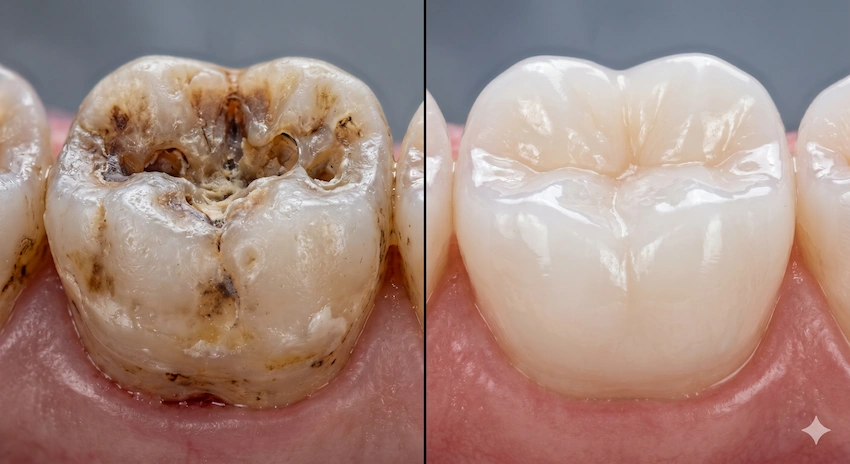
Envision your teeth enamel as a tiny brick fortress. Eating carbohydrates or sugars leads to bacteria producing acid, which acts like ‘acid rain’ on the fortress. The acid removes the chemical ‘cement’ between the bricks – this process is called demineralization. If the acid exposure remains uninterrupted, the wall will fall apart. A hole will form. A cavity appears.
The Chemistry of Rebuilding
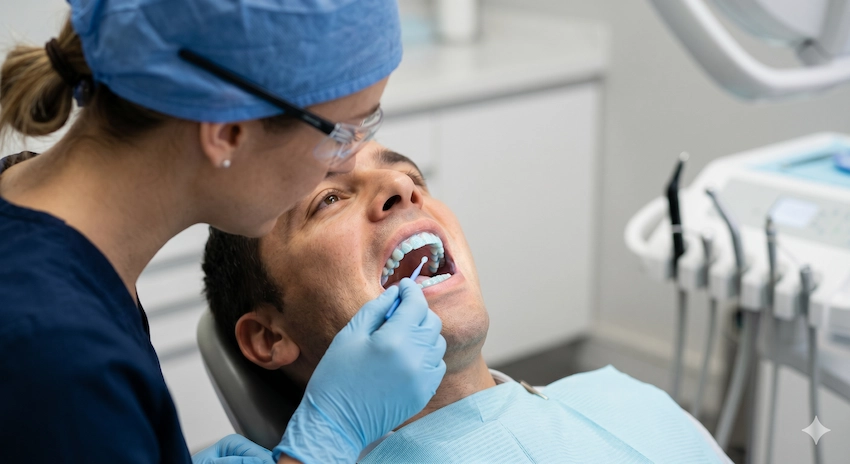
So how do we repair this damage? Fluoride is more than a protective covering; it is a chemical repair agent. When concentrated fluoride is applied to the tooth surface, it targets the damaged, demineralized spots in the enamel fortress.
The main point is not just to fill the space like cement. Rather, the fluoride interacts with the calcium and phosphate from your saliva, forming a brand new and extremely protective mineral fluorapatite. Think of normal enamel as a regular brick, whereas fluorapatite would be a reinforced titanium one. It will hardly get damaged the next time it is exposed to acids.
Professor Doctor Coşkun Yıldız likes to say that identifying a tooth at the initial stage of demineralization—which simply manifests as a chalky white spot—gives us the chance to chemically treat the tooth with fluoride, thereby completely eliminating the need for a drill or a filling.
Professional Application vs. Daily Care
Here’s what is visible in the clinic. Patients usually mistake brushing with regular toothpaste as sufficient. Although brushing daily is essential for oral health, the fluoride level present in a dental clinic is hugely different and has an entirely different medical role.
Dr. Polen Akkılıç and the rest of her team rely on fluoride varnishes and gels of very high doses, which are strictly adhering to the tooth surface for several hours. Such time-oriented contact is like a mega infusion of minerals, which greatly enhances the enamel healing.
Comparing Fluoride Sources
The extent to which you are secured depends on the amount and the way of use.
| Fluoride Source | Concentration Level | Application Frequency | Primary Clinical Benefit |
| Professional Clinic Varnish | Extremely High (up to 22,600 ppm) | Every 3 to 6 months | Actively arrests early decay, rapid remineralization, and severe sensitivity relief. |
| Prescription Toothpaste | High (5,000 ppm) | Daily (if prescribed) | High-risk cavity prevention for patients with dry mouth or active orthodontics. |
| Standard OTC Toothpaste | Low to Moderate (1,000 – 1,500 ppm) | Twice Daily | Baseline maintenance washes away quickly. |
| Fluoridated Tap Water | Very Low (0.7 ppm) | Daily through drinking | Systemic support during childhood tooth development. |
Frequently Asked Questions
This is very safe when done by professionals. The varnish we apply sets almost instantly when it comes into contact with your saliva, meaning the fluoride remains firmly attached to your teeth, and you don’t ingest it.
That is really a question. If the cavity is only in the stage of enamel softening,g then yes, fluoride can remineralize and stop the decay. However, the moment the acid physically creates a hole through the enamel and reaches the soft dentin, you will definitely need the restoration, for example, a composite filling.
Not at all. Children indeed need it the most because their teeth are still developing, but adults,s too, have problems. Gum recession exposes the roots, which are very prone to decay. Also, medications causing dry mouth negatively affect the saliva’s protective action. In fact, adults often receive fluoride treatment to protect these areas.
It actually does the quite opposite. Usually, your tooth sensitivity is a result of tiny pores opening up in the enamel and thus allowing cold water or air to reach the nerve endings. Fluoride physically blocks these tiny tubules, es resulting in great and long-lasting sensitivity relief.
Many people go to Lema Dental Clinic for the treatment of implants or veneers, which are the major restorative works. On the other hand, the protection of one’s investment also plays a major role. We use cutting-edge preventative measures, including professional cleanings and high-potency fluoride varnishes, as well as our complete treatment plans to keep patients’ natural teeth strong for a very long time.
- Featherstone, J. D. (2000). The science and practice of caries prevention. The Journal of the American Dental Association, 131(7), 887-899.
- Ten Cate, J. M. (2013). Contemporary perspective on the use of fluoride products in caries prevention. British Dental Journal, 214(4), 161-167.
- Weyant, R. J., Tracy, S. L., Anselmo, T. T., Beltrán-Aguilar, E. D., Donly, K. J., Frese, W. A., … & Meyer, D. M. (2013). Topical fluoride for caries prevention: executive summary of the updated clinical recommendations and supporting systematic review. The Journal of the American Dental Association, 144(11), 1279-1291.
- Buzalaf, M. A. R., Pessan, J. P., Honório, H. M., & ten Cate, J. M. (2011). Mechanisms of action of fluoride for caries control. Monographs in Oral Science, 22, 97-114.
- Marinho, V. C., Worthington, H. V., Walsh, T., & Clarkson, J. E. (2013). Fluoride varnishes for preventing dental caries in children and adolescents. Cochrane Database of Systematic Reviews, (7).

