


Bridges and modern dentures are effective alternatives.
At Lema Dental Clinic, Turkey, in consultation sessions, it is a familiar scene that we hear such a dialogue. A patient, having a gap or ill-fitting old appliances trouble, expresses his/her frustration and says, “Doctor, I need teeth, but I absolutely do not want surgery. No screws.”
This is a completely reasonable clinical consideration. Dental implants are ranked as the “gold standard” in terms of how closely they can reproduce a natural tooth root. Still, not everyone is suitable or wants to go through the surgical route. Maybe the bone density is not enough, certain systemic health conditions are present, or merely a strong dislike for oral surgery.
Thank goodness contemporary restorative dentistry has many other options besides the titanium implant.
We have assisted thousands of patients in regaining their beautiful smiles through non-surgical dental methods that have been continuously refined throughout the years. Function (mastication and articulation) and beauty are two essentials that must always be at the top of the priority list. Without surgical implants in the scene, prosthodontics—tooth replacement that is done with the help of your remaining teeth or gum tissues—is what we go after.
There surely are still several paths to explore without going under the knife for the sake of keeping your smile intact.
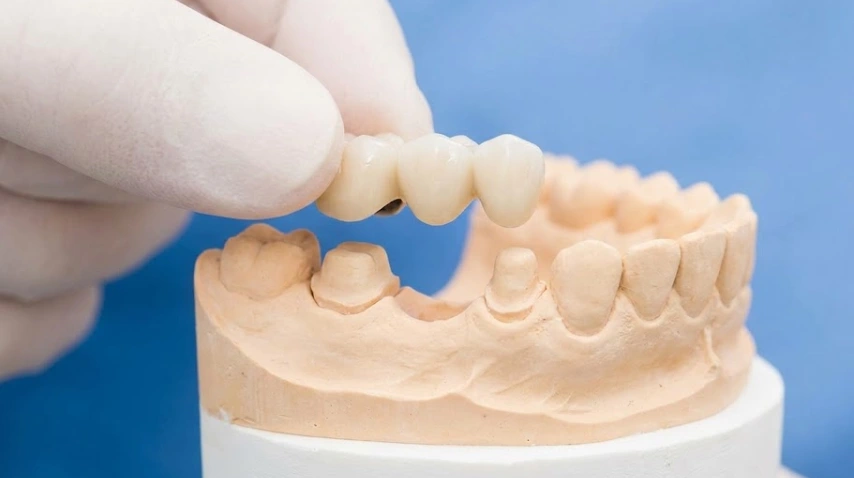
1. Fixed Dental Bridge: Middle of Two by Bridging
When a person has one or two lost teeth in a row and he/she is lucky to have the two neighboring teeth sound enough to serve as the bridge anchorage, the dental bridge will most probably be the best non-implant alternative.
The imagery of a bridge spanning a river is very close to what it is in dentistry. The river is the gap, and the natural teeth on either side of the space are the solid foundations (scientifically referred to as “abutment teeth”) of the bridge.
Polen Akkılıç, DDS, our chief prosthetic specialist, carefully screws down neighboring teeth in such a way that he is removing a little of their enamel layer in order to create a place where the bridge can rest over them without any discomfort. The finished product will be tightly held onto your natural teeth with two crowns that are attached to a false tooth (“pontic”) or teeth in the middle.
The gain in a nutshell is: It is cemented in place. It doesn’t move, you don’t take it out at night, and it feels very close to natural teeth.
The clinical compromise that may come along: the neighboring teeth’sCritical Answers on Non-Implant Restorations enzymatic layer is “sacrificed” for the support of the missing one. It is a biological cost for a mechanical gain.
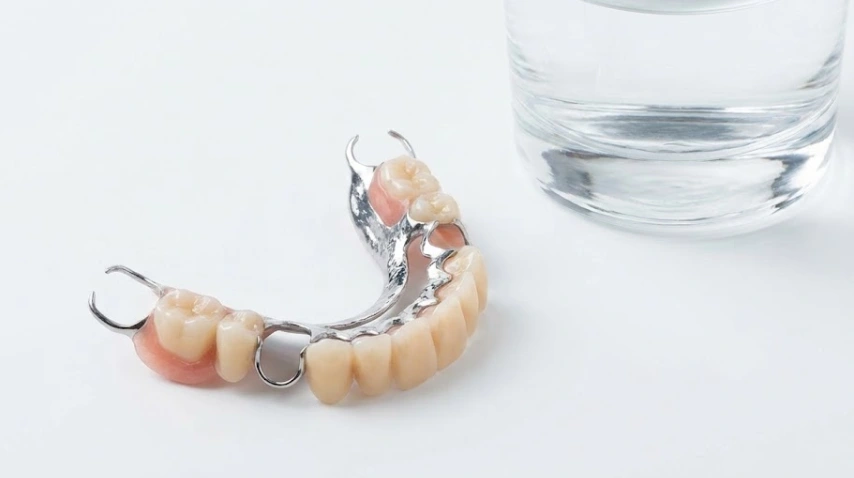
2. Removable Partial Dentures: The Versatile “Puzzle Piece.”
So what if you do not have strong teeth on both sides of a gap? Or what if you are missing several teeth scattered across your arch? You will not be able to have a mechanical fixed bridge; the distance is too great, and it will crumble under biting forces.
Here, we are talking about removable partial dentures of the modern kind. Leave behind the old-fashioned, metal-heavy, bulky ones. Nowadays, we utilize light and flexible materials such as Valplast or precision-cast metal frameworks that attach very discreetly to the remaining teeth with clips. They fit seamlessly into your smile just like a puzzle piece that goes missing.
They can efficiently help in having a balanced bite and stopping your other natural teeth from wandering and taking up the empty spaces. Nevertheless, they ought to be taken out for cleaning and sleeping.
3. Complete Dentures: A Total Reset of the Arch
In the case that all the teeth of an upper or lower jaw are missing or the remaining ones are basically dead due to a severe periodontal condition, complete dentures are the conventional method.
At Lema Dental Clinic, we see dentures from the perspective of facial prosthetics rather than just as plastic teeth. A denture that has been properly crafted will do more than just help you with the chewing process. It will also act as a prop to your lips and cheeks thus, you won’t look like a person whose face has “collapsed,” which is very common for people without teeth. We employ top-quality aesthetics that simulate natural gum tissue and tooth translucency to an extent that they are almost indistinguishable from the real ones.
Comparing Your Non-Surgical Options
Here is a breakdown of how these treatments compare in terms of procedure and longevity.
| Feature | Fixed Dental Bridge | Removable Partial Denture | Complete Denture |
| Mechanism | Cemented onto adjacent natural teeth. | Clips onto remaining natural teeth. | Rests on the gums (suction/adhesive). |
| Removable by Patient? | No (Fixed) | Yes | Yes |
| Impact on Neighbor Teeth | High (Requires shaving down healthy teeth). | Moderate (Clasps can wear slightly on enamel over time). | None (No natural teeth remain). |
| Typical Longevity | 10–15 Years | 5–10 Years | 5–8 Years (Needs relining sooner). |
| Bone Preservation | None under the false tooth. | None. | None (Accelerates bone loss). |
Critical Answers on Non-Implant Restorations
The procedure itself is painless as it is done under local anesthesia. However, we must remove a significant amount of healthy enamel from the support teeth to fit the crowns. While this structural alteration is permanent, these teeth are protected by the new bridge. The risk is that if the bridge fails years later, those underlying teeth may need further treatment.
Modern aesthetic dentistry has come a long way. At Lema Dental Clinic in Turkey, we customize the shape, shade, and arrangement of the teeth to look natural, not painfully perfect. Unless you tell someone, it is highly unlikely they will notice a high-quality modern denture or bridge.
You cannot floss down between the dummy tooth and the support teeth because they are connected. You must use specialized “superfloss” with a stiffened end to thread underneath the false tooth, or more easily, use a water flosser daily to blast away debris trapped underneath.
Yes, significantly. Implants require months of healing for the bone to fuse with the titanium. Bridges and dentures can typically be completed in a single trip to Turkey, often within 5 to 7 days, depending on the complexity of the lab work.
It is rarely the denture changing shape; it is your mouth. Because there are no roots to stimulate the bone, your jawbone shrinks over time. As the ridge of bone gets smaller, the denture that once fit perfectly becomes loose. This requires a “reline” procedure to add material to the inside of the denture to match your new jaw shape.
- Pjetursson, B. E., & Lang, N. P. (2008). Prosthetic treatment planning on the basis of scientific evidence. Journal of Oral Rehabilitation, 35(s1), 48-63.
- Misch, C. E. (2015). Dental Implant Prosthetics (2nd ed.). Elsevier Mosby. (Chapter on rationale for implants vs. fixed partial dentures).
- Goodacre, C. J., Bernal, G., Rungcharassaeng, K., & Kan, J. Y. (2003). Clinical complications in fixed prosthodontics. The Journal of Prosthetic Dentistry, 90(1), 31-41.
- Tallgren, A. (2003). The continuing reduction of the residual alveolar ridges in complete denture wearers: a mixed-longitudinal study covering 25 years. The Journal of Prosthetic Dentistry, 89(5), 427-435.
- Carr, A. B., & Brown, D. T. (2016). McCracken’s Removable Partial Prosthodontics (13th ed.). Elsevier.

