


Full is strongest, open face preserves, bars connect.
Gold has been used in dentistry for as long as almost any other restorative material. Although current trends mostly favor Zirconia or E-max for their invisible perfection, gold retains a strong and timeless demand—not only as jewelry but also as the most outstanding dental material.
At Lema Dental Clinic in Turkey, we usually have patients who want gold for different reasons: some are attracted to the bold aesthetic, while others appreciate the unique biomechanical benefits of the metal. If you want either a stylish finish or a restoration that wears like natural enamel, really knowing the structure of these types of restorations helps.
To our patients, Professor Doctor Coşkun Yıldız frequently explains that choosing gold means more than just picking a color; it is a smart decision from a functional standpoint.
Why Gold? The Biological Argument
Let’s hold off the discussion about styles until you comprehend the “why” behind it.
The biocompatibility of gold is unmatched by any metal on earth. If you look at your natural teeth, you will notice that they are like tough stones against which each other grind. Porcelain is even harder—at times it can be compared to a diamond. Porcelain can wear down natural teeth especially in people with teeth-grinding habits.
Gold, however, is different. It mimics the behavior of a firm cushion. It has a wear coefficient very close to that of natural tooth enamel. So, it can absorb the impact before sending it into the jawbone (your dental foundation) instead of reflecting it to the bone.
1. Full Gold Crowns: The “Standard” of Durability
A full gold crown, as the name suggests, is a complete coverage restoration made entirely with a gold alloy.
From our experience at Lema Dental Clinic, this restoration can be called the “tank” of the dental world. Ever since gold is flexible, we can polish the edges of the crown to fit against the tooth with microscopic precision. Such a seal is bacteria-proof to a great extent.
Dentist Polen Akkılıç and her team usually advise this kind of restoration for the molars of patients who have a strong bite or exhibit bruxism. To make a full gold crown is to make a loud, almost impossible to miss, statement in terms of style. It is extremely shiny and displays an old, highly valuable type of art.
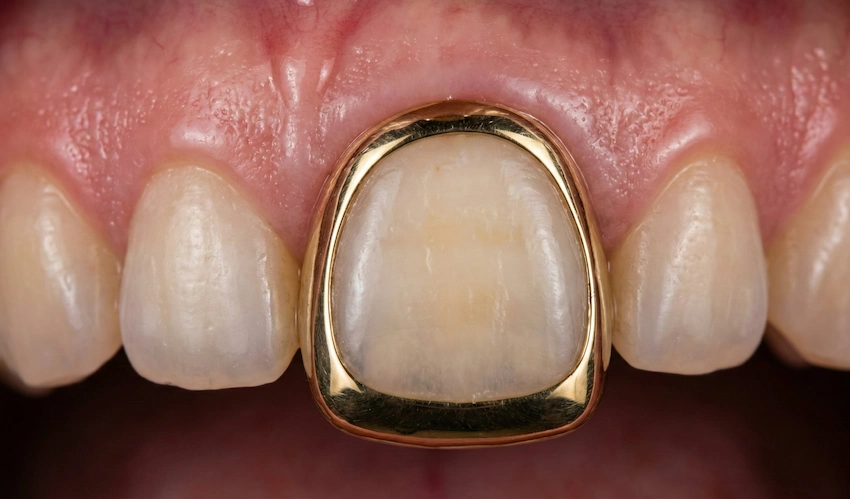
2. Open Face Crowns: The “Picture Frame.”
Making this one involves more difficulty. A gold “picture frame”, the “painting” in this case is the tooth.
We create a complete gold crown but the front side is the only one left open. This is a great way to highlight your tooth enamel naturally, with the shiny gold rim giving the entire picture a rich finish.
What is the point?
It greatly lessens the amount of tooth that needs to be taken away. We can save that front enamel since we do not cover it. However, the fitting needs to be perfect. If there is a small space between the gold frame and the natural tooth, it will become a trap for food and plaque. So Turkish laboratory craftsmanship, in this case, is of utmost importance; it is not just a matter of casting but without the slightest inaccuracy, the piece can be unusable.
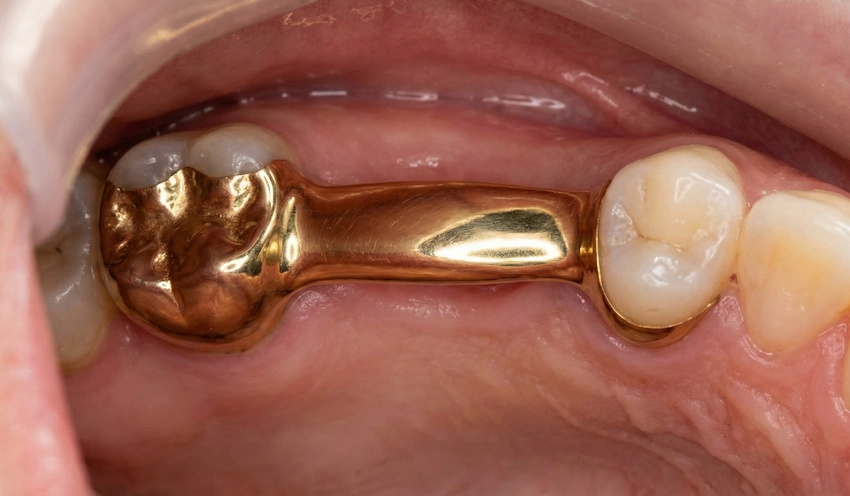
3. Bar Design (The Bridge)
The Bar or Bridge connects teeth across a gap or simply links them for visual continuity.
Earlier, it was a purely functional solution aimed at fixing loose teeth (splinting). Now, a bar made of gold running across the gumline or the biting edge linking a series of crowns or veneers is mostly considered an element of style.
It gives a sense of a continuous line of metal going across your smile. As far as hygiene is concerned we need to be pretty careful here. Just like a river bridge can get bits of garbage stuck against its pillars, a dental bar can also trap plaque and hence bacteria. In fact, the underside of these bars is designed to be “self-cleansing” or convex so that you can floss underneath them easily.
Comparing the Styles: A Quick Reference
Each and every mouth is different, so the final decision usually depends on the trade-off the patient is willing to make between biological cost (drilling) and aesthetic payout.
| Feature | Full Gold Crown | Open Face Crown | Bar Design |
| Visibility | High (Complete coverage) | Medium (Gold outlines tooth) | High (Linear connection) |
| Tooth Preparation | Moderate (Circumferential) | Conservative (Preserves front face) | Varies (Depends on anchor teeth) |
| Durability | Extreme (Highest resistance) | High (Enamel bond dependent) | High (Adds structural rigidity) |
| Hygiene Requirement | Standard brushing & flossing | Meticulous care (Edge cleaning critical) | Advanced (Requires threaders) |
| Best For | Heavy grinders / Bold look | Enamel preservation / Unique style | Gap bridging / Aesthetic continuity |
The Lema Difference: Precision in Turkey
Some people think that gold work is “from the past.” Actually, it is totally the contrary. To deal with gold means to achieve an artistry level that digital milling machines can barely compete with.
Digital scanning and lost wax casting are what we use at Lema Dental Clinic. Professor Doctor Coşkun Yıldız supports the use of high-noble alloys (high gold content). The reason is simple: low-quality metals get oxidized, give your gum a black tint, and cause allergies. Chemically, the mouth of a person wearing high-karat gold is inert.
Going to Turkey for your treatment means more than just getting a reduced price; you are tapping into the expertise of dental technicians whose focus is on the art of gold-making and clinical experts.
Frequently Asked Questions
If they are well-fitted, it is quite the opposite. Gold even has antibacterial properties. The risk comes when the fit is not perfect. It is easy to understand that if there is a tiny gap between the gold and your tooth, bacteria will be able to enter. This is why at Lema before cementing anything we are sure to check the ‘marginal integrity’ (the seal) under magnification.”
Surely, these can all be made as ‘snap-on’ types. Actually, this is often better for your teeth since we don’t have to drill or grind them. We take an impression, make a gold casting, and it just snaps right over the top of your natural smile. Dentist Polen Akkılıç is the person to direct your queries about this during your appointment.
Most of the time we would not recommend 24k (pure gold) for permanent restorations as it is too soft and may change shape under chewing pressure. In our practice, 18k to 22k dental alloy is most commonly used. You get this beautiful, deep yellow color while the addition of metals like copper or platinum assures the necessary hardness for the oral environment.
This is a typical concern. Gold has no magnetic properties. An MRI scan will not just rip gold crowns from your mouth. The problem is that images can appear blurred due to the presence of gold especially when the area being scanned is the head/neck. Always let the radiologist know about your dental gold but there will be no physical harm.
The price of the gold itself is standard across the world—gold is a commodity. Nevertheless, the labor involved in the meticulous lab work and the clinical charges are very different between locations. You are paying for the same (or better) materials, but with reduced overhead for the medical team.
- Anusavice, K. J., Shen, C., & Rawls, H. R. (2013). Phillips’ Science of Dental Materials. Elsevier Health Sciences.
- Knosp, H., Holliday, R. J., & Corti, C. W. (2003). Gold in dentistry: Alloys, uses and performance. Gold Bulletin, 36(3), 93-102.
- Manappallil, J. J. (2016). Basic Dental Materials. Jaypee Brothers Medical Publishers.
- Roberts, H. W., & Berzins, D. W. (2022). Biocompatibility of dental alloys. Journal of Esthetic and Restorative Dentistry, 34(1), 112-119.
- Wataha, J. C. (2002). Biocompatibility of dental casting alloys: A review. The Journal of Prosthetic Dentistry, 87(2), 205-216.

