


Dental gold types include high noble, noble, and base metal alloys.
Navigating the Different Types of Dental Gold
Walking into Lema Dental Clinic in the center of Istanbul, you might spot the respectful nod to gold that dental practitioners still have amongst all the spectacular white and translucent ceramics of today. Gold is like the veteran of restorative dentistry, the “old guard”. However, the truth is: not all “gold teeth” are the same.
From our clinical experience, patients frequently imagine that a gold crown is just a coin that has been melted down. Actually, the process is a lot more elaborate than that. To make sure that a restoration can endure the biting pressure of your jaw for thirty years or even longer, we have to resort to certain alloys. Professor Doctor Coşkun Yıldız always reminds us that selecting the most suitable gold alloy is similar to picking the right foundation for a skyscraper; it is not only about the appearance but also the capability of handling the world’s weight.
Why in Dentistry Gold is Not Considered “Just Gold”?
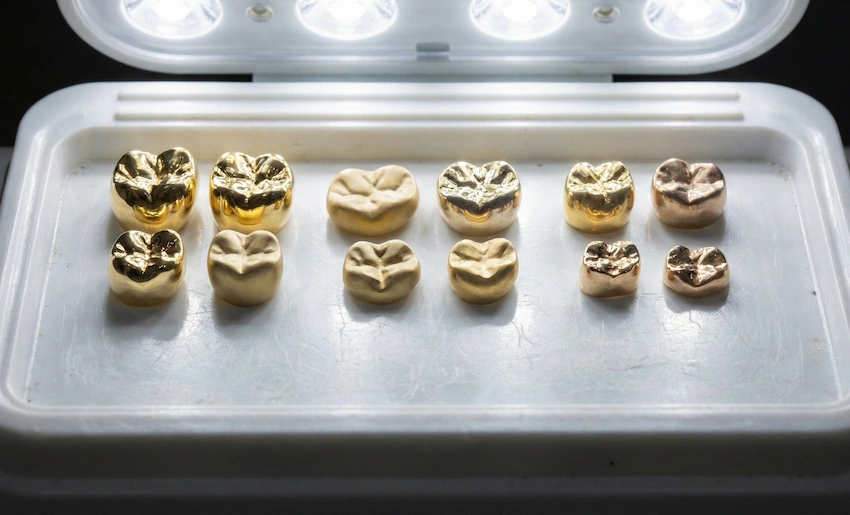
Pure 24-karat gold is magnificent, but it is far too soft for the mouth. Using gold that is pure, your teeth would literally cave in to the pressure of chewing a steak. That is why we mix gold with other noble metals such as platinum, palladium, and silver to come up with a material that is strong, friendly to the biological environment, and accurate.
At Lema Dental Clinic, Dentist Polen Akkılıç and her team divide dental gold into three major “classes” according to the types and quantities of noble metals
1. High-Noble Alloys (The Premium Tier)
This is considered the “gold standard” among the gold standards. To be called high-noble, the alloy has to be made of 60% noble metals (gold, platinum, palladium), out of which 40% should be pure gold.
Why we use it: These are the gentlest on the gums. In case you have particularly sensitive tissues, high-noble gold will be like a truce between your restoration and the body.
The Fit: High-noble gold may be polished to a molecular edge, thus it will fit your tooth like a tailor-made suit.
2. Noble Alloys (The Balanced Choice)
With a minimum of 25% noble metal, they have a slightly higher hardness than high-noble alloys and are typically employed when we require extra strength for long-span bridges. They offer a very good durability which is combined with a more affordable price in comparison to that of a high-gold content.
3. Base-Metal Alloys (The Industrial Strength)
Less than 25% noble metal is present in them and mostly consist of nickel, chrome, or cobalt. Although they are highly strong and wear-resistant, their gold-like “soft touch” is missing. Also, some patients might have a sensitivity to the nickel element in these mixtures.
Comparing the Alloys: A Clinical Overview
Here is what we see in the clinic when we compare these materials side-by-side:
| Feature | High-Noble Gold | Noble Alloys | Base-Metal Alloys |
| Gold Content | > 40% | > 0% (but < 40%) | 0% |
| Biocompatibility | Excellent (Best for gums) | Good | Variable (Risk of allergy) |
| Durability | 20–40+ Years | 15–25 Years | 10–20 Years |
| Fit Precision | Extremely High | High | Moderate |
| Color | Rich Yellow/White Gold | Pale Yellow/Silver | Silver/Grey |
The Concept of “Wear and Tear”: A Figurative Expression
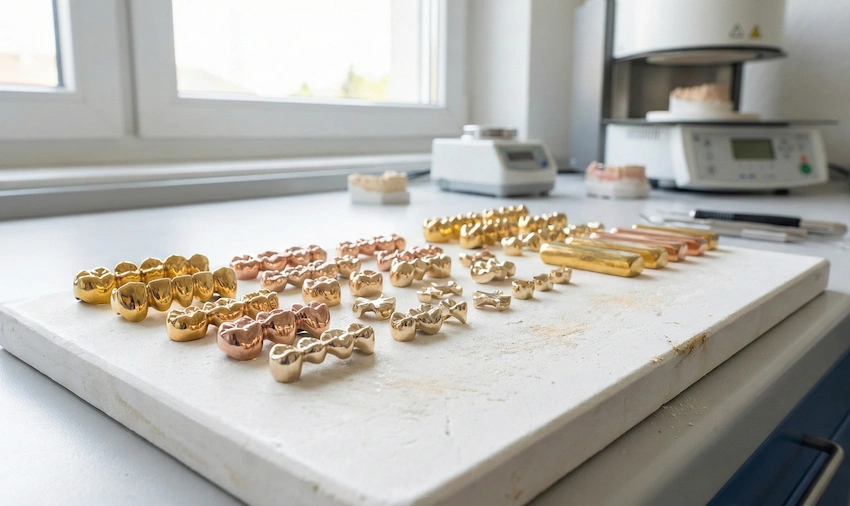
If you would, imagine your regularly used teeth being just like the tires on a car. When tires are too hard (like the base metals), they may last forever but will cause the car’s suspension to be damaged due to the vibrations. When tires are simply too soft, they will wear out in a month.
Gold’s “wear coefficient” is very close to that of the tooth enamel of a real, natural tooth. Professor Doctor Coşkun Yıldız picks gold because it wears down at approximately the same rate as your nearby teeth. That is a very neat relationship; the gold doesn’t “dominate” or “terrorize” the teeth it comes in contact with.
Yellow Gold vs. White Gold
There remains the question: can “white gold” be found in dentistry? There is such a thing. By adding more palladium or platinum into the mix, you neutralize the discoloration of gold to yellow. You have all the mechanical advantages of a high-noble gold restoration combined with a silver-colored finish. This is usually a patient’s preferred option who wants gold’s durability but does not want the “yellow flash” when they smile.
Why Should You Have Your Gold Restorations Done in Turkey?
Gold, undeniably, has quite a high price. Thus, in many Western countries, the lab costs alone for a top-quality high-noble gold crown may be sky-high. Therefore, Lema Dental Clinic in Turkey helps patients gain access to the top-tier high-noble alloys and, at the same time, avail themselves of the Dentist Polen Akkılıç and her team’s skill, at a cost that’s a fraction of that in their home country and the quality of the alloy used is not compromised.
Frequently Asked Questions (FAQ)
“In general, gold remains the better choice for the back teeth when it comes to durability and wear resistance. Because the chewing forces in this area are the highest, gold restorations won’t wear as much or break. On the other hand, for the esthetic region of the mouth, we typically suggest zirconia to get the most pleasing appearance.” — Professor Doctor Coşkun Yıldız.
Allergy to pure gold is almost nonexistent. The ‘gold’ allergy cases that you hear about are in fact due to the presence of nickel or copper in the lower-quality base metal alloys. Hence, we use high-noble alloys at Lema Dental Clinic.
If you are using high-noble alloys, you should not experience a metallic taste. These are ‘inert’ metals so they don’t interact with your saliva and therefore do not corrode.
Gold restorations topped with good oral care can easily be expected to last up to 30 or 40 years. They are by far the longest-lasting restorations in dental history.
The ‘gold surcharge’ might vary a little piece with the fluctuations of the global market, yet our policy is to offer fixed, transparent pricing to our international patients coming to Turkey.
- Anusavice, K. J., Shen, C., & Rawls, H. R. (2012). Phillips’ Science of Dental Materials. Elsevier Health Sciences.
- Donovan, T. E., & Anderson, M. (2016). The selection of alloys for restorative dentistry. Journal of the California Dental Association.
- Kelly, J. R., & Nishimura, I. (2014). Science of dental materials: Clinical implications of alloy composition. Dental Clinics of North America.
- Manappallil, J. J. (2016). Basic Dental Materials. Jaypee Brothers Medical Publishers.
- Wataha, J. C. (2002). Alloys for prosthodontic restorations. The Journal of Prosthetic Dentistry.

