


Gold teeth are heavier and precisely made for durability.
Gold has a charm that goes beyond jewelry. It suggests things like eternity, value, and a kind of glory. However, when patients come to our offices in Turkey and talk about “gold teeth,” the discussion quickly changes from beauty to physics and anatomy.
In fact, putting gold in your mouth is a big move in terms of medical care. It affects how you bite. At Lema Dental Clinic, we commit to absolute honesty. If you fancy wearing gold or just want a gold restoration, knowing the “weight” and metallurgy of your smile is very important.
The “Heavy” Truth: How Dense is Gold
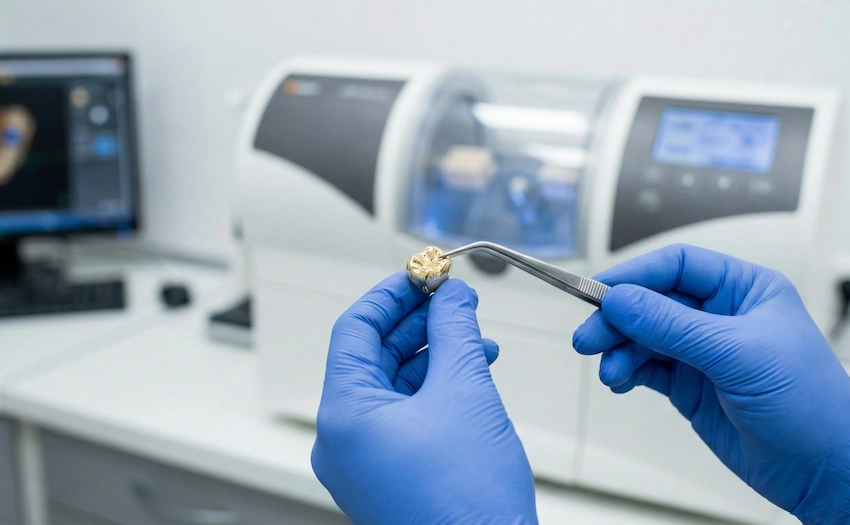
We should be very accurate here. Gold is a very heavy metal. Actually, it weighs almost double of the silver-colored metals commonly used in dental work (such as chrome-cobalt) and is many times heavier than the zirconia or porcelain materials we generally apply for Hollywood Smiles.
Put it like this: a ceramic crown is a pebble in your hand; a gold crown is a lead fishing sinker of the same size.
Professor Doctor Coşkun Yıldız is always very precise when considering the weight for a gold restoration. A single gold crown may have a weight of 2 to 3 grams depending on the alloy, while a natural tooth or ceramic equivalent would only be a fraction of it. 3 grams may seem like a trivial matter, but your jaw muscles and the periodontal ligament (tooth area shock absorber) will definitely notice the difference.
Gold is Usually Not Pure (And That’s a Good Thing)
Crown Pure gold of 24 karats would be very soft and thus unsuitable for a crown. Gold inside the crown would bend under biting force, which is approximately equal to the force of a stiletto heel on the floor.
Therefore, we work with “dental gold,” which is a high-noble alloy. This type of alloy typically contains:
- Gold (Au): a component ensuring biocompatibility and providing a warm luster.
- Platinum (Pt) or Palladium (Pd): as a means of increasing the melting point and hardness.
- Silver (Ag) or Copper (Cu): for tweaking the color and strength.
The Making Process: The Combination of Craft and Metal
Making a gold tooth is probably less like regular dental work and more like making fine jewelry with a touch of heavy industry. The whole thing is a lengthy procedure that just cannot be rushed.
Dentist Polen Akkılıç and her crew have been running the factory entirely with their hands. This is the process that took place in our Istanbul lab:
- The Impression: We take the digital impression of your mouth.
- The Wax Pattern: Tooth replica is made of wax before metal ever touches it. It must be flawless. If the wax is inaccurate by a hair’s width, then the gold will be.
- Spruing and Investing: We put a wax channel (sprue) in the pattern and then enclose it inside a heat-proof plaster (investment).
- Burnout: Within the furnace, mold is heated until wax is vaporized completely—the “Lost Wax” method is thus used.
- Casting: Molten gold alloy heated to over 1000°C is poured into the mold by centrifuging.
Why We Still Use Gold?
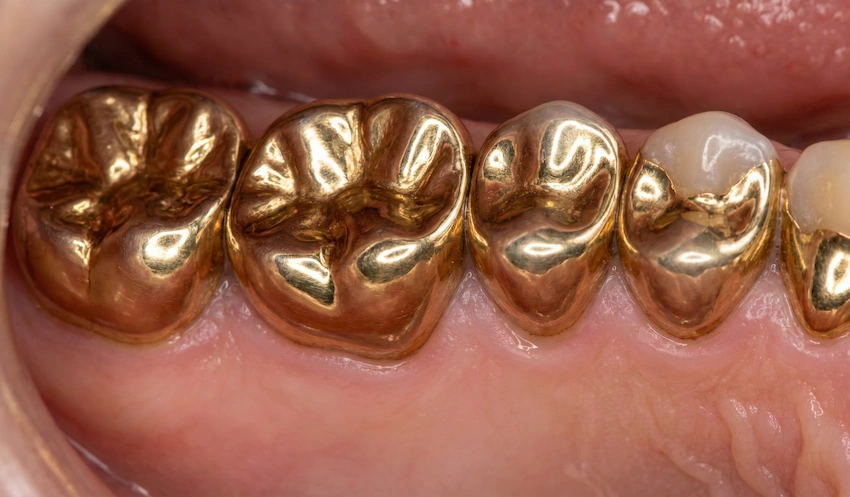
Modern ceramics can be so lifelike that you might wonder why there’s a place for gold.
The main reason is that they imitate the wear of natural teeth. Imagine you are rubbing two stones against each other and one will eventually break or get ground down. Porcelain is a harder material than enamel. If you are someone who grinds your teeth, then your porcelain crown will operate like sandpaper, and your natural teeth will get worn down.
Gold is contrary to all that. It is regarded as the “gentle giant” among dental materials. Its wear coefficient is very close to that of natural enamel. Thus, it ages with you instead of making your life harder.
Material Showdown: Gold vs. Modern Alternatives
We have summarized the main differences we see in the dental office to help you understand where the gold stands in today’s dental world.
| Feature | High-Noble Gold Alloy | Zirconia (Solid) | Porcelain Fused to Metal (PFM) |
| Weight (Density) | High (heavy feel) | Medium (solid but lighter) | Medium–high (metal substructure adds weight) |
| Aesthetics | Visible metal (yellow/silver) | Tooth-colored (natural) | Tooth-colored (opaque look) |
| Wear on Opposing Teeth | Extremely low (gentle) | Low to moderate (polished) | High (can be abrasive) |
| Durability | Unbreakable (malleable) | Very high (rigid) | High (porcelain can chip) |
| Biocompatibility | Excellent (bacteriostatic) | Excellent (inert) | Good (some metal sensitivities) |
Frequently Asked Questions
To be honest, it is not likely that it will happen. While gold is heavier, the actual weight of a single crown in grams is so small that your jaw muscles will adapt immediately. However, if you opt for a large bridge made of multiple gold units, then you might feel the difference in the first few days by the increased “heft,” but it will soon feel natural.
That is an extremely important question. A high-noble gold (more than 75% gold) is very unlikely to cause an allergy. On the other hand, base metal mixtures (sometimes are inexpensive “gold tone” products) might contain nickel, which is a main cause of allergies. At Lema Dental Clinic, we only use certified high-noble alloys to guarantee safety.
Because casting and polishing require extra steps, the duration can be slightly extended. However, unlike milling a zirconia block which is a machine process, finishing through gold is purely accomplished by hand. We aim for a surface that is as smooth as glass to avoid any plaque accumulation.
Gold has bacteriostatic properties that make it less likely for bacteria to adhere to gold surfaces as compared to textured natural teeth or some resins. Clinical observations corroborate this property. If the crown margin is well cleaned and cared for, the margin (where the crown meets the tooth) is kept extremely clean due to this property.
Sure thing. The root and surrounding area are prepared the same way in either case. If, on the other hand, you decide to have a porcelain appearance later on, we can remove the gold crown by cutting it and then replace it with Zirconia or E.max. In fact, it is an aesthetically reversible choice, even though the gold is lost in the process of removal.
- Anusavice, K. J., Shen, C., & Rawls, H. R. (2013). Phillips’ Science of Dental Materials (12th ed.). Elsevier Saunders.
- Knosp, H., Holliday, R. J., & Corti, C. W. (2003). Gold in dentistry: Alloys, uses and performance. Gold Bulletin, 36(3), 93-102.
- Donovan, T. E., & Marzola, R. (2010). The role of gold alloys in contemporary dentistry. Journal of the California Dental Association, 38(11), 793-800.
- Wataha, J. C. (2002). Biocompatibility of dental casting alloys: A review. The Journal of Prosthetic Dentistry, 87(2), 205-214.
- McCabe, J. F., & Walls, A. W. (2008). Applied Dental Materials (9th ed.). Blackwell Publishing.

