


Yes, gold canine teeth are safe and long-lasting, but they look bold and non-natural.
Can I Get Gold Canine Teeth?
That question crosses the line between ancient tradition and modern dental science. Whether it is to make a bold beauty statement or to pay homage to the historical status of gold as a healing metal, many patients come to our clinic in Istanbul asking, “Can I safely get gold canine teeth?”
In brief, the answer is yes. However, as with any change that you make to your smile, you should consider “how” and “why” almost as much as “can.” At Lema Dental Clinic, we think of every treatment from two perspectives: the patient’s creative desire and the tooth’s biological durability.
Why the Golden Canine is so Appealing?
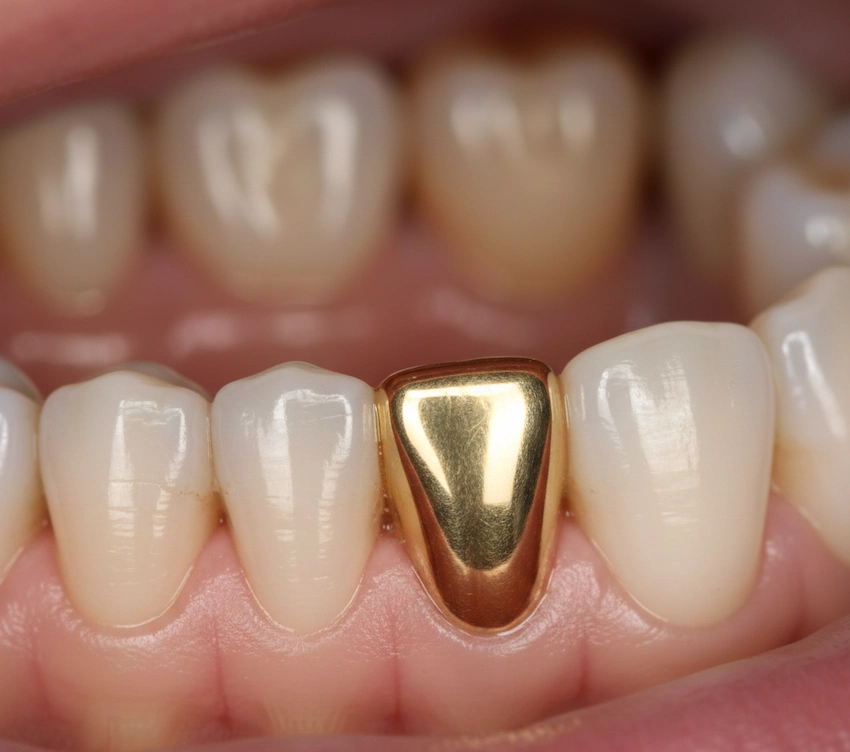
Gold has been commonly used in dentistry for a long time, and the reasons are numerous. Compared to many other metals, gold is very friendly to human tissue. It doesn’t rust, it hampers plaque less than many other metals, and its ability to wear down matches almost perfectly with natural tooth enamel. Gold can be thought of as a fancy shock absorber powering your mouth; it’s soft enough not to destroy the teeth in the opposite jaw, but strong enough to endure for a very long time.
Professor Doctor Coşkun Yıldız frequently emphasizes that while porcelain dentists try to imitate nature, gold brings out a different kind of strength. It’s the “wise old” dental material.
Permanent Crowns vs. Wearable Grills
You first need to be aware of the choices and the consequences of the different routes. Most of the time, we hear about two kinds of requests:
- Permanent Gold Crowns: Getting your canine filed down and then a gold alloy crown made in accordance with your anatomy is fitted.
- Gold “Grills” or Fronts: These are the pieces you can put on and take off, and your natural teeth are simply covered.
Initially, there are permanent crowns that are a big commitment in terms of clinical seriousness. We are talking here about replacing natural enamel with a metal structure. However, it is a lifetime statement.
Advantages, Disadvantages, and the Clinical “Fine Print”
Going for gold is not only a matter of beauty and glamour. Practically, it is a rather functional call. We often notice the following in our patients who want to have gold on their canines:
| Feature | Gold Canine Crown | Porcelain-Fused-to-Metal (PFM) |
| Durability | Extremely high; almost no chipping or breaking | High, but porcelain can chip |
| Biocompatibility | Excellent; very gentle on gums | Good, but some metals may cause allergies |
| Aesthetic | Intense, metallic, unnatural | Mimics natural tooth color |
| Preparation | Requires less tooth reduction | Requires more tooth removal |
| Longevity | 20+ years with proper care | 10–15 years |
Safety and the “Lema Standard” in Turkey
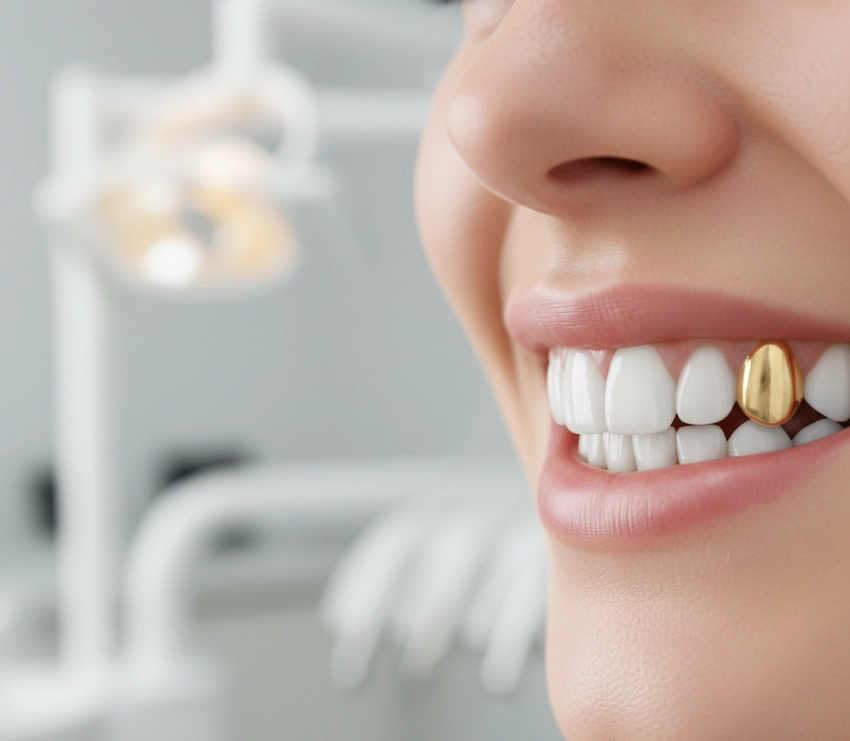
Safety is more than just considering the materials; it’s also about the finish. If a gold crown is not slickly sealed, it is only like a house roof with a small window open to the rain—eventually, the wood underneath will rot. Dentist Polen Akkılıç and her team utilize cutting-edge digital scanning technology to ensure that the “margin” (the border where gold meets the gum) is flawless.
However, let’s discuss the hazards a little. The most concerning threat is not the metal – it’s the “DIY” or unprofessional “grillz” culture. The usage of base metals such as nickel can cause the onset of a severe allergic reaction, gum recession, and bone loss. Because of this, we only use high-karat dental gold alloys.
The issue stands: Is this the right solution for you? The canines are the “locators” of the mouth. They direct the bite. If the crown of gold is not designed with the precision of a master, then it will entirely disrupt your jaw’s order.
Frequently Asked Questions
We carry out the treatment much like when we do a standard crown. It is painless because local anesthetics are used. You might feel a little bit of cold sensitivity in the prepared tooth after a few days, but this disappears when the tooth gets used to the new “armor.”
For dental use, in order to increase the mechanical strength, gold is alloyed with silver, copper or platinum. The color of gold becomes more and more vivid and ‘yellow’ as its proportion increases (dental gold is usually 18k or over). You may view our samples in person to be sure that it matches your concept.
The best dental gold, the one that satisfies the gold dental alloy requirements, simply does not tarnish. It stays shiny. Yet, if you don’t regularly clean the crown, it will lose its brightness. A professional polish during your visit to Lema Dental Clinic will restore that “first-day” gloss.
Because we need to cut the natural tooth to make a crown fit, it is not possible to “undo” a permanent gold crown and get your old tooth back by simply “taking it off.” A porcelain or zirconia crown will be necessary for you if you decide to go natural in appearance once again.
As if it were any other tooth in the mouth! Brush twice daily and floss regularly. Gold is fabulous at plaque resistance, but the crown-gum margin is still susceptible to bacteria.
- Anusavice, K. J., Shen, C., & Rawls, H. R. (2012). Phillips’ Science of Dental Materials. Elsevier Health Sciences.
- Donovan, T. E., & Cho, G. C. (2004). Materials for conservative posterior restorations. Journal of the California Dental Association, 32(6), 465-471.
- Katz, R. V. (2011). The safety and efficacy of gold alloys in clinical dentistry. International Journal of Prosthodontics, 24(2), 112-118.
- Messer, R. L., & Lucas, L. C. (1999). Cytotoxicity of single-phase gold-copper-silver alloys. Journal of Dental Research, 78(11), 1706-1712.
- Wataha, J. C. (2002). Alloys for prosthodontic restorations. The Journal of Prosthetic Dentistry, 87(2), 216-263.

