


Gold crowns are very durable, but zirconia crowns offer strength, beauty, and a more natural smile.
Nearly all the patients who come to us experience that typical initial fear when it comes to dentistry. Restoring a lost tooth is a serious matter, and the decision to choose a solid/proper downloadable/non-sketch material isn’t quite like merely going through a typical medical examination.
Going back through the times, gold was the number one go-to material for dentists. Now, thanks to the aesthetic becoming a priority and new technologies, here we are with a new kid on the block: zirconia.
Truth be told, each of these materials has its own remarkable qualities. Although to better understand them, we should dive into the scientific facts as well as the practical daily use of these materials. Based on our experience at Lema Dental Clinic in Turkey, the choice between gold and zirconia is not only a matter of which one feels better when chewing. It is a matter of how much you trust them and your health well into the future.
Gold – Dentistry’s Equivalent of a Tailored Suit
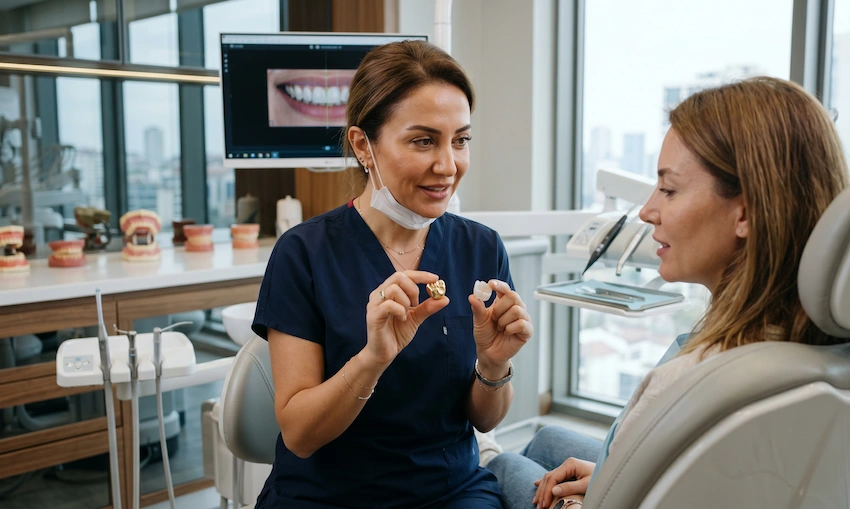
For over a century, gold has played a leading role in dental care. However, pure gold is not suitable for use because it is too soft. What we actually use are high-noble alloys, mixing gold with metals like platinum.
One way to think about a gold crown is to liken it to a perfectly made, bespoke suit.
- Gold is a very malleable metal.
- It allows for crown margins to fit incredibly close to the natural tooth with a microscopic level of accuracy.
- A tight, well-sealed joint is formed that doesn’t leave any fissures where bacteria can find refuge.
Professor Doctor Coşkun Yıldız frequently states that, from a mechanical standpoint, there is simply no equivalent to gold. It is known to wear down at the same pace as natural dental enamel. This means that, in case of a nighttime tooth grinding habit, a gold crown can be considered as a form of shock absorber that won’t break. Moreover, it will not cause harm to your other teeth.
The major downside of gold is its appearance. It is visibly metallic. While many people are okay with this on their molars, a gold crown just doesn’t meet the aesthetic standards of today’s society if it is in the smile zone.
Zirconia – Modern Restorations’ White Steel
In the same way that gold is a tailored suit, zirconia is modern dentistry’s structural steel. And the cherry on top? It is a beautiful white color.
Zirconium dioxide is not only extremely strong but also highly aesthetic as a white ceramic. We make it using a sophisticated digitally-controlled process to cut it from a large, single crystal block.
In the dental office, we meet patients who want to have the strength of metal but cannot stand the bright and glaring look of it. Zirconia is the material that can satisfy these two demands at the same time. In fact, your gums will also love it. Besides, if you put on a zirconia crown, you wouldn’t normally see that dark gray line at the gum edge, which is the trademark of metal-based crowns of the older generation.
Dentist Polen Akkılıç and her team are experts in tailoring these types of restorations for patients. Zirconia in its raw form is dull and heavy. However, we apply state-of-the-art surface treatments and finishing techniques to this material so that it even reproduces the light reflection of natural tooth enamel, and the result is indistinguishable from real teeth.
Clinical Performance Comparison
In order to make our best investment, it is essential to take a good look at the facts.
| Clinical Feature | High-Noble Gold Alloy | Solid Zirconia |
| Aesthetics | Poor (Metallic look) | Excellent (Tooth-colored) |
| Durability | Exceptional (Does not fracture) | Very High (Incredibly hard) |
| Opposing Wear | Very Low (Matches natural enamel) | Moderate (Requires smooth polishing) |
| Gum Health | High (Rarely causes reactions) | Excellent (Highly hypoallergenic) |
| Fit and Seal | Superior (Micro-precise fit) | Excellent (Milled digitally) |
The Lema Protocol: Making your decision

It would be no exaggeration to say that choosing to get dental treatment in Turkey means that you are up for a combination of a very knowledgeable operator and cutting-edge technology. The most crucial determinant when we work out your treatment plan will still be the location of the tooth.
Then the big question is: which one is for you?
- If it is for a back molar, gold is still a glorious, lifelong investment. It copes with heavy masticatory forces with ease.
- If it is for a front tooth, zirconia is absolutely the way to go. Not only is the material very strong, but it will also look very natural.
Frequently Asked Questions
Not at all, just as long as we make it properly. Natural dentition has a unique illumination scheme. We imitate this light-filtering. So, your new crown will harmonize perfectly with your natural teeth.
Theoretically, gold has been the most durable material for a long time came the advent of dental restorations. Many gold crowns last for 20 to 30 years. Zirconia is the latest one on the market, but clinical research results show that its survival rates are nearly equal to those of gold. Proper oral hygiene will make either option a very good investment.
Shrouding a tooth or making it inconspicuous, the better choice of material would be gold, since it is less abrasive and won’t cause the wearing down of the other teeth.On the other hand, if you desire to have the attractive appearance of zirconia, then we shall give you a night guard that can
Certainly. Lema Dental Clinic is hygienic, and digital procedures meet international standards. Therefore, you will get top-quality products provided by a highly experienced surgeon at our clinic. Such a surgeon is the one who has been carrying out these delicate treatments daily routine for years.
Such a chance is minuscule. Actually, zirconia contains no metal at all. We often find ourselves recommending it to patients who are allergic to metals or whose gums get irritated by old crowns.
- Christensen, G. J. (2009). The ‘gold standard’ for crowns: what is it now? Journal of the American Dental Association, 140(8), 1021-1023.
- Denry, I., & Kelly, J. R. (2008). State of the art of zirconia for dental applications. Dental Materials, 24(3), 299-307.
- Guess, P. C., Att, W., Strub, J. R. (2010). Zirconia in fixed implant prosthodontics. Clinical Implant Dentistry and Related Research, 12(4), 333-346.
- Raigrodski, A. J., Hillstead, M. B., Meng, G. K., & Chung, K. H. (2012). Survival and complications of zirconia-based fixed dental prostheses: a systematic review. The Journal of Prosthetic Dentistry, 107(3), 170-177.
- Sailer, I., Makarov, N. A., Thoma, D. S., Zwahlen, M., & Pjetursson, B. E. (2015). All-ceramic or metal-ceramic tooth-supported fixed dental prostheses (FDPs)? A systematic review of the survival and complication rates. Dental Materials, 31(6), 603-623.

