


Gold crowns and fillings offer unmatched, lifelong durability for back teeth.
There are high-tech ceramics and digital milling machines in today’s dental clinics. Gold, however, is still one of the strongest materials in restorative medicine. Patients who want extreme durability quite often ask about gold here at Lema Dental Clinic, the place where we practice. As it turns out, this traditional metal is so great in the human mouth that it hardly ever goes wrong. Let’s examine the reasons.
Reasons for our Confidence in Gold Use
Gold is a very biocompatible material. Enormous biting forces hit your teeth daily. So the materials fixing them should be strong and flexible. Gold has an identical natural wear rate to human enamel. And, it doesn’t cause wear of the opposite teeth during chewing at all. A gold restoration, according to Professor Doctor Coşkun Yıldız, is a perfect, custom-sealed barrier locking out harmful bacteria with absolute clinical precision.
Gold Crowns or Gold Fillings?
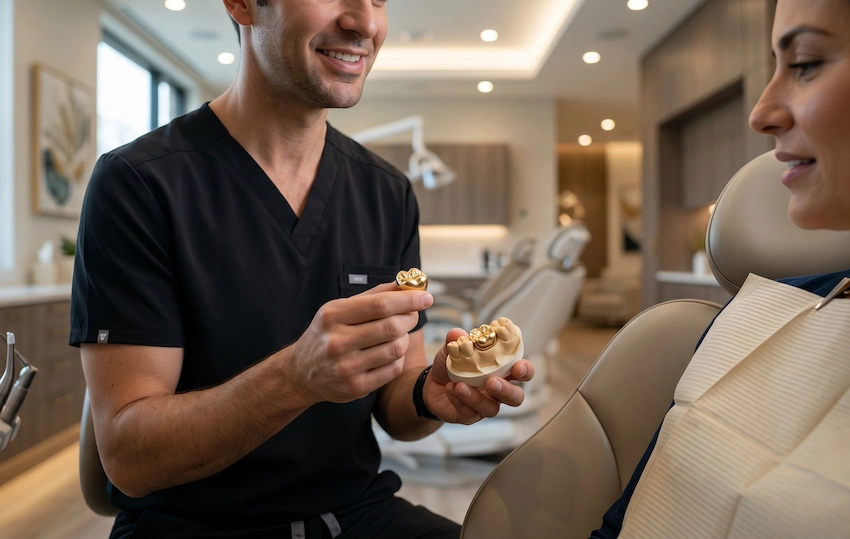
Nevertheless, these are the two big ones. A gold crown completely covers a tooth’s visible portion. It is used when the tooth has been very badly decayed or is deeply fractured.
A gold filling, or more specifically, an inlay or onlay, is fitted into the cavity after it has been thoroughly cleaned. Only the four biting surfaces that were damaged are restored. Dentist Polen Akkılıç and her team reach your final result by designing these restorations with such accuracy that your healthy, natural tooth is preserved as much as possible. People who come to us in Turkey like this very cautious technique the most.
Your Clinical Options Compared
In the clinic, this is what we witness. People also want to know why the modernization of cosmetically white options like zirconia results in the fall of gold usage. Results of scientific studies are straightforward.
| Type of Restoration | Estimated Life Span | Potential to Wear Opposing Teeth | Most Suitable Use |
| Gold Crown | 20 – 40+ years | Minimal | Back molars, heavy biters |
| Gold Filling (Inlay) | 15 – 30+ years | Minimal | Moderate decay in back teeth |
| Zirconia Crown | 10 – 20+ years | Moderate | High-stress areas needing aesthetics |
| Porcelain Crown | 10 – 15 years | Extensive | Front teeth |
The Treatment Process

Then the next query is what really goes on in the treatment process? Gold restoration is actually a goldsmith’s work, for it requires a high level of skill. It is essential that the joining line between the two, gold and tooth, should be without even the tiniest flaw. In fact, a break in such a seal is the cause of the repeated development of caries. Data is recorded in the form of digital impressions that are of very high resolution at the clinic. Thereafter, our highly skilled dental technicians manufacture the metal parts according to the very detailed instructions.
Frequently Asked Questions
Usually, no. We recommend gold specifically for your back molars. These are the teeth that handle the heavy chewing. Unless you open your mouth very wide, people will not see the gold. If you need a crown near the front, we use highly aesthetic zirconia.
No. Pure gold is too soft for heavy chewing. We use a high-noble alloy. This mixes gold with durable metals like platinum. It provides the perfect blend of clinical precision and extreme physical strength.
It is extremely rare. High-noble gold alloys are highly biocompatible. The human body accepts them very easily. We always check for specific material allergies before starting any dental treatment.
Not at all. We make sure you are completely numb and comfortable. Preparing a tooth for a gold crown feels exactly like a standard filling procedure. You might feel slight sensitivity to cold drinks for a few days, but it fades fast.
Nothing beats gold for long-term clinical performance. It does not chip or break. It protects your opposing teeth perfectly. When a patient needs a permanent fix for a back molar, a high-noble gold restoration is clinically unmatched.
- Donovan, T. E., & Simonsen, R. J. (2004). The longevity of gold restorations. Journal of Esthetic and Restorative Dentistry, 16(5), 269-271.
- Manhart, J., Chen, H., Hamm, G., & Hickel, R. (2004). Buonocore Memorial Lecture. Review of the clinical survival of direct and indirect restorations in posterior teeth of the permanent dentition. Operative Dentistry, 29(5), 481-508.
- Christensen, G. J. (2001). The coming demise of the cast gold restoration? Journal of the American Dental Association, 132(7), 947-949.
- Studervant, C. M., Roberson, T. M., Heymann, H. O., & Sturdevant, J. R. (2006). The Art and Science of Operative Dentistry (5th ed.). Mosby.
- Rosenstiel, S. F., Land, M. F., & Fujimoto, J. (2015). Contemporary Fixed Prosthodontics (5th ed.). Elsevier.

