


No, we only gently buff a microscopic layer from the front.
Scroll through TikTok or Instagram. You will find a ton of “veneer vlogs” there. In one of them, a girl is sitting on a dental chair. She smiled, showing her mouth filled with tiny, filed-down teeth that are so scary-looking.
It has also led to a great misunderstanding regarding cosmetic dentistry.
Usually, the image you are seeing represents full dental crown preparations. They are not porcelain veneers.
It is a very common scenario at our clinic in Turkey, where we hear this worried question from our patients almost every day. Everyone wants a perfect, beaming smile. But they are scared of harming their healthy, natural teeth. We want to dispel the myth and let you know the truth based on our practice.
The “Shark Teeth” Myth: Why the Internet Gets It Wrong
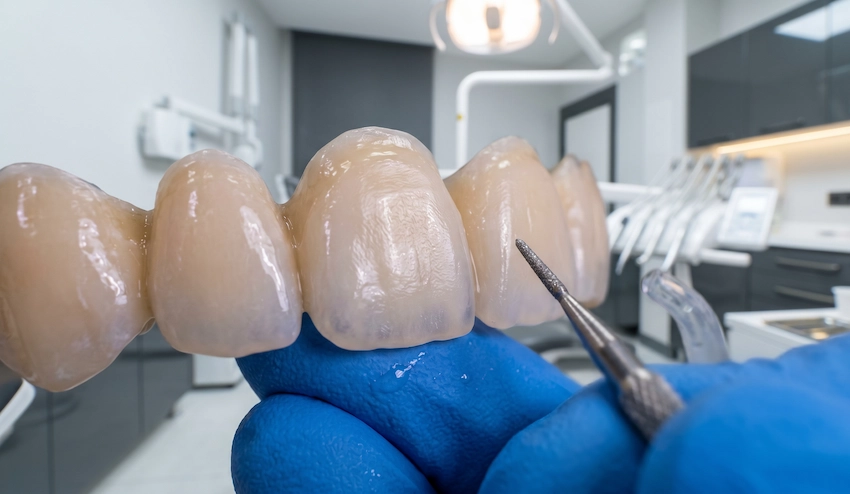
The internet often has this one wrong because it is easier to share a dramatic picture than an explanatory video.
If you think of a traditional dental crown as a thick winter coat that you wear, then when that coat is fitted to be without any looseness or extra material, then your body is reduced quite a bit. That is because a crown covers the whole tooth, so a dentist has to transform the tooth into a peg shape before placing the thick porcelain crown over it.
A veneer is totally another story. It is thin like a contact. It is like a custom-made contact lens for your eye. It is thin to the extent that it only covers the front surface of your tooth, which is the visible part only.
The minute amount of spacing we create is just enough so that the delicate porcelain fits in line with your natural gum.
Professor Doctor Coşkun Yıldız repeatedly emphasizes, “The main aim of current aesthetic dentistry is the preservation of biological maximum. Enamel of natural teeth is the most precious one for us. Only the materials that are necessary for mechanical reasons are removed with the utmost care.”
Why We Bother to Remove Any Enamel
Taking a deeper look at this icing question, let’s ponder why on earth they shave the teeth if just gluing the veneer is possible?
A porcelain shell by itself gives an addition to one’s appearance in a positive way, but if you put it over an intact tooth, it will make your tooth look bigger, which will ruin the effect in the first place. The second important side effect will be the fact that the edge of the veneer will be under the gum, and the bacteria in this place will cause inflammation in the gum.
Instead, we are only buffing your teeth by about 0.3 to 0.5 millimeters. In other words, about the thickness of the egg shell. The result of this separation of the veneers from the teeth is smooth.
It is like gently sanding a wall to give fresh paint something to grip. We do not knock the wall down completely.
The Lema Dental Clinic Way: Little to No-Prep Veneers
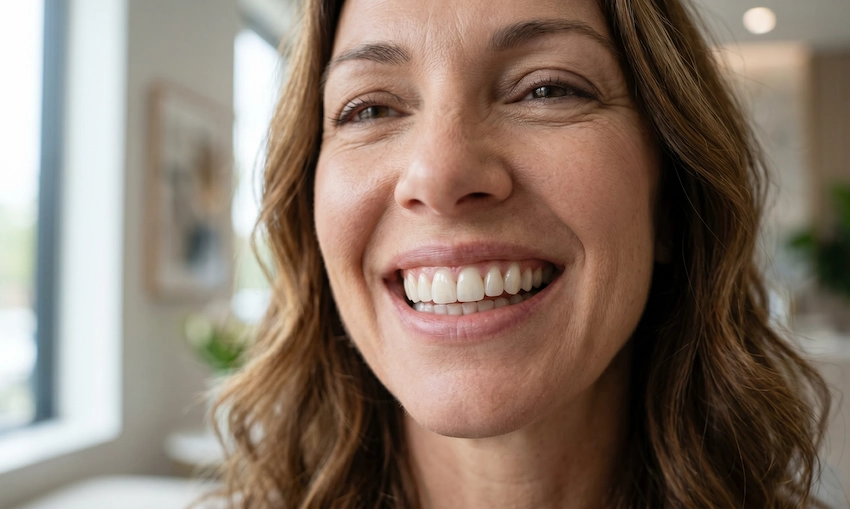
Great care is taken by Dentist Polen Akkılıç and her team in implementing our minimally invasive work.
With the help of their high-magnification loupes, as well as 3D digital smile mapping, they determine exactly how minimal the touch will be.
Thin ceramic restorations take out very little of the natural tooth structure compared to those we had ten years ago. People come to Turkey from all over the world to have the facilities and to follow this kind of tissue-saving philosophy.
Preparation vs. Preservation: A Clinical Comparison
Let’s see how the different treatment types stack up:
| Treatment Type | Average Enamel Removal | Best Suited For | The Patient Experience |
| No-Prep Veneers | 0% – 10% (Mild buffing) | Small teeth, closing gaps | Completely painless |
| Traditional Veneers | 0.3mm – 0.5mm (Front only) | Color changes, mild crowding | Very comfortable |
| Dental Crowns | 1.5mm – 2.0mm+ (360 degrees) | Severely broken or decayed teeth | Comfortable during prep |
FAQs (From the Doctor’s Desk)
No way! The clips that are going viral are showing a full crown prep. For a standard veneer, a simple buffing of the layer on the front surface of the tooth is done. The main strength of your tooth remains unchanged.
The question continues to be a big component in patients’ doubts. To cut to the chase: no. We administer deep local anesthesia before we start. You will only notice a slight vibration, but you will not experience any sharp pain.
Of course. “No-Prep” veneers are an option if you naturally have small teeth or spaces to close. We can stick the thin porcelain right onto your enamel, which is still uncut. The decision is still very dependent on your bite as it is now.
The word “destroyed” is incorrect. However, the procedure is irreversible. Since we abrade that top microscopic layer of the tooth, your tooth will always require a veneer for protection. This is one of the reasons why we put a lot of thought into your smile design.”
Let’s be honest: we see it quite often in the clinic, patients burn out due to high local prices and aggressive techniques at home. Besides that, you will be treated by globally recognized specialists if you choose Lema Dental Clinic, and you will get world-class materials in a beautiful historic city where you will recover.
- Edelhoff, D., & Sorensen, J. A. (2002). Tooth structure removal associated with various preparation designs for anterior teeth. The Journal of Prosthetic Dentistry, 87(5), 503-509.
- Magne, P., & Belser, U. (2002). Bonded Porcelain Restorations in the Anterior Dentition: A Biomimetic Approach. Quintessence Publishing.
- Peumans, M., Van Meerbeek, B., Lambrechts, P., & Vanherle, G. (2000). Porcelain veneers: a review of the literature. Journal of Dentistry, 28(3), 163-177.
- Radz, G. M. (2011). Minimum thickness anterior porcelain restorations. Dental Clinics of North America, 55(2), 353-370.
- Layton, D. M., & Walton, T. R. (2012). The up to 21-year clinical outcome and survival of feldspathic porcelain veneers: accounting for clustering. The International Journal of Prosthodontics, 25(6), 604-612.

