


Yes, they can cause lisping by reducing tongue space, especially at first.
Let’s face it, there’s really nothing quite like the gleam of a custom gold grill or diamond-encrusted caps. It certainly is a statement. Also, it’s culture. However, the one concern that keeps many patients from deciding is not the cost, nor the procedure, but the aftermath. Nobody wants to look like a star and have a lisp, being the one thing that everybody tells them about.
The question we hear most frequently from patients here at Lema Dental Clinic in Turkey is, “After getting this done, will I sound strange?”
The short answer is: Yes, probably — but only for a little while.
The detailed response concerns the intricacy of the interaction between your tongue, your teeth, and the thickness of the material that separates them. Let’s unravel the matter of why it happens and how even a slight difference with expert workmanship is the difference between a temporary adjustment and a permanent speech impediment.
The Acoustics of Your Mouth
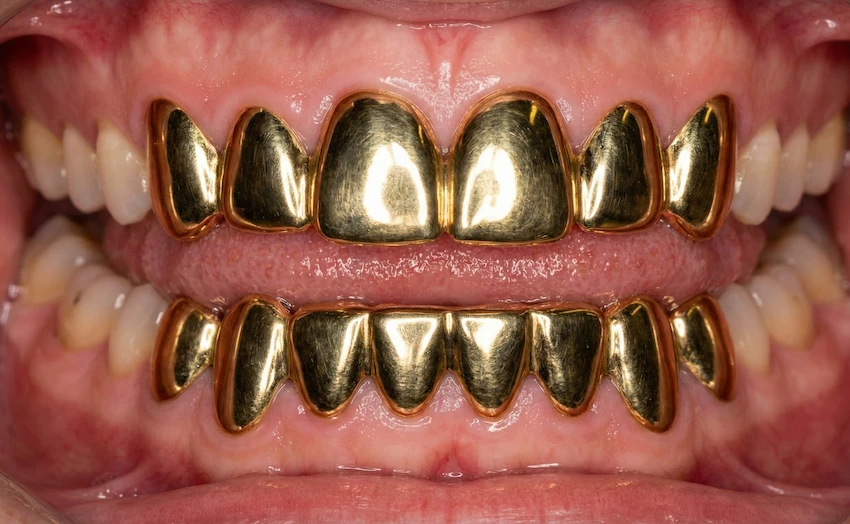
To understand how grillz change the way you speak, it is first necessary to consider the mouth as an acoustic chamber. The tongue is an extremely sensitive muscle. When producing sibilant sounds i.e., “S,” “Z,” “Th,” or “Ch,” the tongue directs the airflow against the backside of the upper front teeth (the lingual surface).
Think about this: What if your teeth were the strings of a guitar, and your tongue the fingers playing the music? Now what if those strings were covered by very thick tape? The music would have changed.
Installing a removable grill or a permanent gold crown essentially means adding another layer to the “wall” of that acoustic chamber. In case the wall is too thick or if the original shape of the tooth is radically altered, the air comes out differently, and you can hear it in a kind of whistle or a lisp.
The Adaptation Phase: It’s All in the Brain
The brain adapts remarkably in humans, a capability that we can witness clinically. This phenomenon is called neuroplasticity.
Placing a grill for the first time will cause the tongue to feel “crowded”, as it would be hitting the gold plating more quickly than it expects to hit the enamel. However, after a few days, your brain recalibrates and the brain retunes the tongue position to a spot where the sounds made are again extremely clear.
According to dentist Polen Akkılıç and her team, for most patients this “awkward phase” takes a period of between two days and two weeks. Should you still be lisping a month later, then the problem is not the tongue; it is probably the prosthetic that is at fault.
Removable Grillz Vs. Permanent Fixes
Gold teeth are not all the same. The amount of speech change that a person experiences greatly depends on the method of restoration used, among other things.
1. Removable Grillz (The “Snap-On”)
These will typically cause the most severe speech difficulty. Why? To be able to withstand the structural changes that come with taking on and off, they have to be thick enough. Plus, they add bulk not only to the front but to the back as well since they fit over the existing teeth. It is thus similar to wearing a winter coat over a suit; the outfit loses its sharpness.
2. Permanent Gold Crowns or Veneers
When we do the work here in Turkey, the preparation of the natural tooth is done first. A part of the tooth enamel is removed to the extent that the cemented gold or veneer restores the tooth to its original size and contour.
Prof. Dr. Coşkun Yıldız states very often that “Real cosmetic dentistry cannot be felt by the tongue.” In other words, if done right, permanent gold plating should be almost indistinguishable from natural teeth and therefore there should be no risk of long-term lisping.
The “Bulk” Factor: Why Expertise Matters
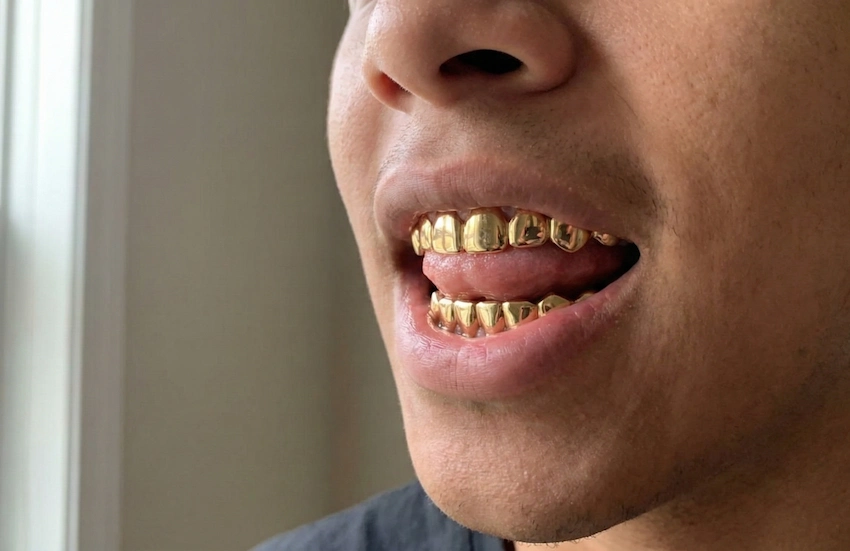
This is where the ability of the technician and the dentist to master their skills becomes important. One of the indications of a cheap grillz is that it is “over-contoured”. The surface is round and thick because of the material being of poor quality or the casting having been done in a rush.
Comparison: Speech Impact by Type
What follows is a speech adaptation analysis based on the kind of dental jewelry or restoration you have.
| Feature | Removable Grillz (Snap-On) | Permanent Gold Crowns / Veneers | Bonded Caps (No Prep) |
| Thickness | High (add-on bulk) | Low (replaces enamel) | Medium (sits on top) |
| Initial Lisp Risk | Very high | Low to moderate | Moderate |
| Adaptation Time | 1–3 weeks | 2–5 days | 1–2 weeks |
| Tongue Space | Significantly reduced | Preserved | Slightly reduced |
| Clinical Verdict | Great for photos or events, not ideal for talking | Best for day-to-day wear without being noticeable | A practical middle-ground option |
FAQ: Your Concerns, Our Solutions
No, not at all. If the restoration is carried out properly, your tongue should get used to it within a week. If you are still lisping after several months, it means the crowns are too bulky from the inside, so they will need to be adjusted or replaced.
It does so indirectly. The 24k gold turns out to be the softest of all. Thus, technicians are sometimes compelled to thicken it slightly to make it durable. With 18k oral-grade gold, one often gets the opportunity to make the casting thinner without it losing shape, which in turn is advantageous to speech clarity.
Definitely! We advise the patients to always read aloud. Concentrate on the words that have “S,” “Th,” and “Z” sounds. Daily 15 minutes of reading aloud helps the tongue “map” the new mouth much quicker as compared to reading silently.
It is merely a reflex. Actually, it is because when putting something new in one’s mouth, the brain thinks the object to be eaten and subsequently instructs the glands to produce saliva to digest food. Therefore, this surplus saliva can make the mouth sound “slushy” when speaking. The brain, however, catching on to the fact that the grill is not a snack, ceases the production of saliva after 48h.
Using digital smile design, Dentist Polen Akkılıç measures the gap between the upper and lower teeth. The “envelope of function” (the space the jaw needs to move) is never infringed on by the gold; hence, the function comes first, then the aesthetics.
- Runte, C., Lawerino, M., Dirksen, D., Bollmann, F., Lamprecht-Dinnesen, A., & Seifert, E. (2001). The influence of maxillary central incisor position in complete dentures on /s/ sound production. The Journal of Prosthetic Dentistry, 85(5), 485-495.
- Jacobs, R., & van Steenberghe, D. (2018). Neuroplasticity in the adaptive capability of the masticatory system. Journal of Oral Rehabilitation, 45(11), 890-899.
- Petrovic, A. (2020). Phonetic adaptation to fixed dental prostheses: A clinical study. International Journal of Prosthodontics, 33(4), 412-418.
- Chen, J., & Chuang, S. (2014). The effect of anterior tooth position on speech: A review. Journal of Formosan Medical Association, 113(1), 8-14.
- Tanaka, H. (2019). Material thickness in dental restorations and its impact on lingual comfort and phonetics. Journal of Dental Materials and Techniques, 8(2), 67-74.

