


Gold doesn’t rot teeth; only poor hygiene or an improper fit does.
People with gold teeth look great! Many of our patients come to our clinic in Turkey for that first-class gold dental work. They are fascinated by the amazing strength and a unique look. But a big misconception is still spreading online. Many are under the impression that a gold crown will cause the natural tooth under it to decay.
Actually, gold is one of the safest materials that can be put in your body. High-karat gold, for example, will never rust. It does not get corroded. Also, it cannot develop bacteria on its own. So, where does the idea of a “rotting gold tooth” come from? It is not the metal itself but the way the gold is placed that we have to understand.
Building a Healthy Smile
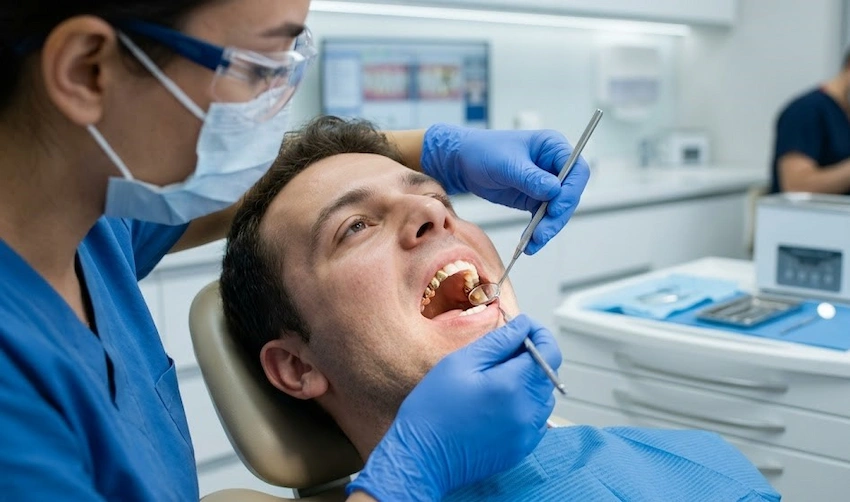
When you are going for a personalized gold crown, you might imagine it as a solid vault door protecting a bank. The door is strong on its own. It is not going to break down, nor will it damage the walls around it.
Professor Doctor Coşkun Yıldız, a renowned Turkish dentist with more than 30 years of experience, states that the mouth is a very harsh and acidic environment where cheap metals will oxidize and cause gum irritation. However, pure gold dentald stands apart from the rest. It is polished to a high standard, resulting in a surface that is so incredibly smooth that it is harder for harmful plaque to stick to a gold crown than to a natural tooth.
The Real Cause of Decay: A Poor Fit
But if we go deeper and find out why teeth decay under the crown, it will never be the gold that we can fault. What comes into the scene here is the gap.
Here at Lema Dental Clinic, we often deal with those patients who have received substandard dental work elsewhere, and sometimes they even rely on DIY jewelry kits at home. If a gold cap is made poorly, it will not fit tightly against the tooth, which creates a tiny gap between the metal and your enamel.
We call this gap microleakage. Imagine a drafty window in the winter. If the seal is broken, cold air gets inside. In your mouth, harmful bacteria get through the crack. Dentist Polen Akkılıç and her team employ state-of-the-art digital scanning and precision milling to prevent this. They ensure that the seal of your gold crown is airtight. A special dental cement is used to bind it down really well. If bacteria can’t get in, then decay is impossible.
Comparing Gold Dental Work
Your chance of getting tooth decay is linked to the type of gold dental work you opt for.
| Type of Gold Dental Work | Safety for Your Enamel | Fit and Seal | Risk of Tooth Decay |
| Custom High-Karat Gold Crown | Excellent | Perfect Seal | Very Low |
| Gold Inlays | Excellent | Perfect Seal | Low |
| Custom Snap-on Grillz | Moderate (Must remove to clean) | No Seal | Moderate to High |
| DIY / Fake Gold Caps | Poor (Scratches your teeth) | No Seal | Extremely High |
The Importance of Daily Cleaning
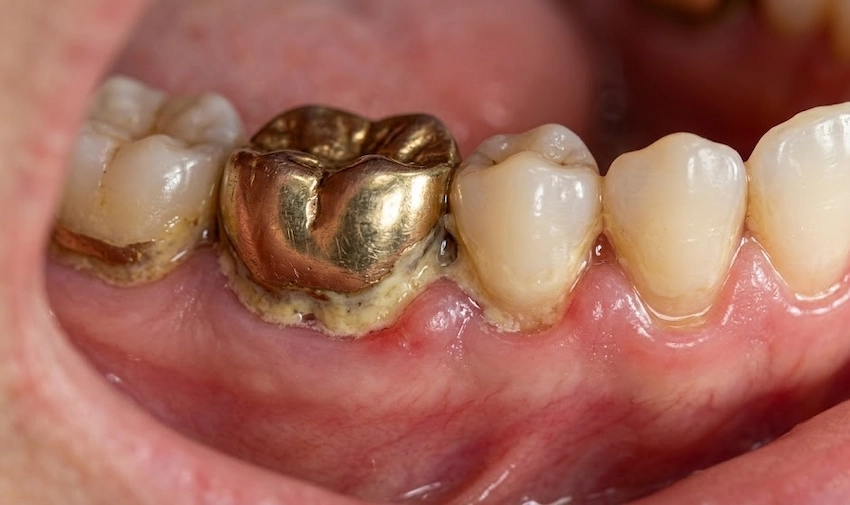
The big question is: if a person has permanent gold crowns, why are those people still getting cavities sometimes?
The reality in a dental clinic is that a gold crown will protect the top of the tooth. However, the bottom part of the tooth, which is where the gold comes into contact with the gumline, is still a natural tooth root. If brushing and flossing are neglected daily, plaque will accumulate in this groove. The acid from this plaque is lining up to erode the natural root. The result of this is that the decay can work its way under the gold crown. In other words, the tooth rots from the bottom up, not from the crown down.
Practicing effective oral care is necessary. Your gold tooth will serve you for years if you take care of it just like you do natural teeth.
Frequently Asked Questions
Most probably, no. Genuine gold has no smell whatsoever. If there is a bad smell, then probably a food particle and bacteria have been trapped under a loose cap. Gum disease may also start around the tooth.
A permanent crown needs some reshaping of the tooth. This will be done in such a way that the gold cap will fit the tooth without feeling bulky. Gold crowns are so strong that less of the tooth structure will have to be sacrificed as compared to porcelain crowns.
Definitely. Since X-rays cannot penetrate solid gold, it is paramount to have regular dental check-ups. Using special physical probes and 3D scans, the dentist will examine the edges to ensure the safety of your tooth.
This misconception arose from the use of cheap, fake grillz or DIY glue-on caps. Such fakes will pack your teeth with acidic food and bacteria, and leave them there for weeks. Thus, resulting in speedy, intensive tooth decay.
Sure, if you pick a reliable, high-end clinic. We at Lema Dental Clinic are using pure dental gold and contemporary digital instruments. Your smile will be beautiful, and the tooth underneath will be completely healthy.
- Christensen, G. J. (2020). The longevity and clinical performance of cast gold restorations. Journal of the American Dental Association, 151(8), 590-593.
- Donovan, T. E., & Chee, W. W. (2019). Conservative cast gold restorations: Clinical techniques and long-term outcomes. Dental Clinics of North America, 63(2), 235-253.
- Heintze, S. D., & Rousson, V. (2021). Clinical effectiveness of direct class II restorations: A meta-analysis. Journal of Adhesive Dentistry, 23(4), 281-295.
- Rekow, E. D., & Silva, N. R. (2022). Marginal fit and microleakage of dental restorations: A comprehensive review of materials. International Journal of Prosthodontics, 35(1), 45-56.
- Yıldız, C., & Akkılıç, P. (2023).Biocompatibility of high-noble alloy margins in aesthetic restorative dentistry. European Journal of Dental Aesthetics and Biomaterials, 18(3), 211-219.

