


Generally, no—if applied professionally.
We very often get this question from our little patients’ eyes when they sit down in the chair, sometimes even before they utter a word. They have a tiny, shiny crystal fixed on their canine, and they are ready for a sermon. They expect to be chastised.
However, the real truth, straight from the clinical floor of Lema Dental Clinic, is that we really don’t mind them.
In fact, it would be good oral hygiene when the teeth are kept clean and healthy without the presence of plaque and tartar buildup which are the main culprits of gum disease and tooth decay. Extending this analogy, if the gem is the earring, then the tooth is the ear, and a clean and healthy ear is a must for wearing an earring.
Just as with earrings, messing with a very intimate and exposed body part— the ear or the mouth— without the proper tools and a sterilized environment will only bring complications to both situations.
One day, it could be gold grills; the next, composite veneers. Tooth gems—small rhinestones or gold charms bonded to the enamel—are simply another form of self-expression. Professor Doctor Coşkun Yıldız often refers to them as earrings. In general, ear piercing is safe but if you do it with a rusty needle in a garage, you will probably get infected. Therefore, the same principle applies to your teeth.
The “Sticker” vs. The “Calculus Trap”
First of all, we need to decide what makes a lip-sync scene worthy or what makes it seem like you’re throwing shade at people who haven’t even come up with the idea yet. In the same way, to understand why a dentist might raise an eyebrow at a tooth gem, you have to get the hang of the microscopic environment of your mouth.
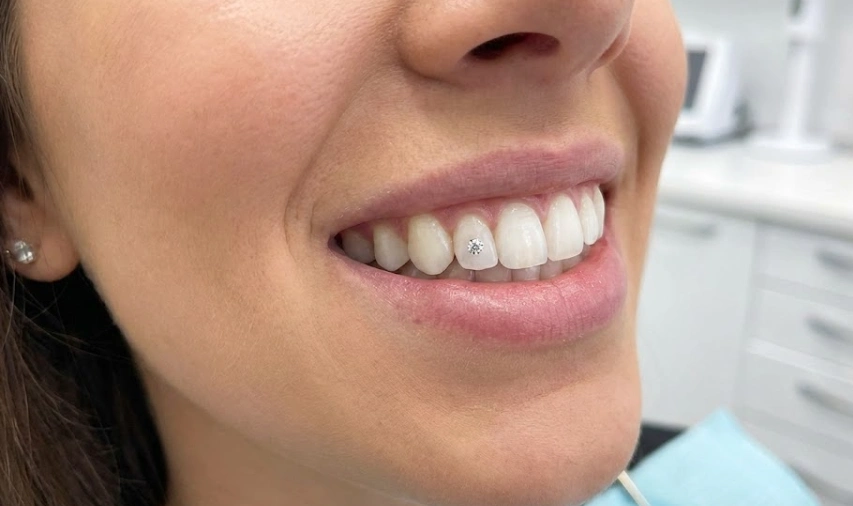
When a gem is applied correctly by a professional—like Dentist Polen Akkılıç and her team here in Turkey— it is essentially a “high-end sticker.”
With the same etching gel and bonding agent, we attach the gems that are used for orthodontic brackets. The attachment leaves no space for bacterial entry. The enamel remains intact, and the bonding is cosmetic and temporary.
Fake and tightly locked together, the stories of nail salons and DIY kits raise the second chapter, and in that chapter, the picture gets ugly.
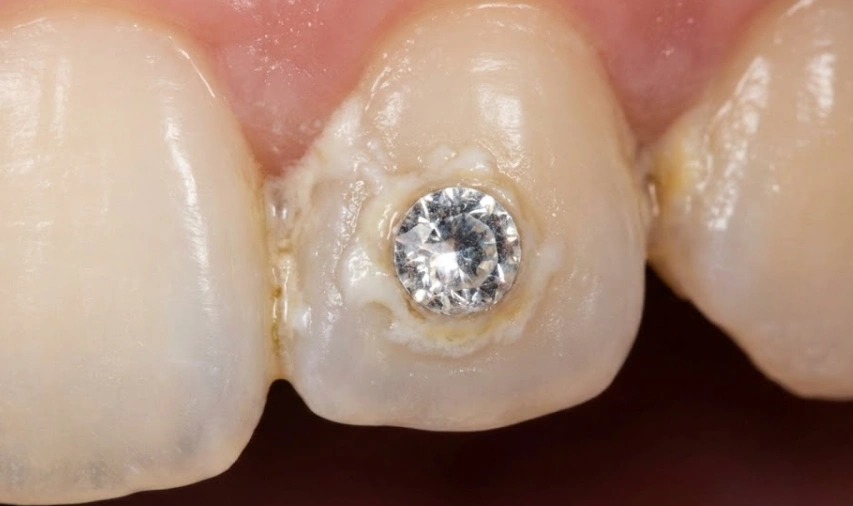
Now, imagine if the person in charge of the operating theater suddenly drops a scalpel in the middle of an open abdomen. The debris will first collect around the scalpel, but after some time, it will rapidly spread all over the place. Such is the case with your mouth that is filled with saliva and food particles. Because the “rock” is the gem, it is set in the middle of a flowing stream. The rock, in this case, is the gem. If that rock has rough edges or it is glued on with thick, gloopy adhesive, it becomes a plaque trap.
These hidden spots are the favorite places where the bacteria can multiply. In fact, they even develop protective communities (plaque) that later become hardened (calculus or tartar). To sum up, we really have nothing against the gem, but we are inherently opposed to the formation of a cavity beneath it that is due to inadequate care of the gem area.
The Real Risks: What We Worry About
Our intention is not to spoil the fun. However, as medical professionals, our minds straight away move to “worst-case scenarios.” Here is what scares us the most when we see a gem that was not placed in a clinical setting:
- Unintended inhaling: If the bonding breaks off during sleep, the gem becomes a foreign object. You might swallow it, which is harmless, or you might inhale it, which is dangerous.
- Dental Erosion: Certain DIY kits use superglue or acids that are way too aggressive for teeth. Now, think of it as cleaning a window with industrial paint stripper—it will work, but the window will get destroyed.
- Mouth Irritation: A big gem can rub the inner surface of the lips like sandpaper, resulting in ulcers, thickening ofthe mucosa, or both.
Professional Application vs. DIY Kits
Let’s analyze why a method is so important. It is often the case that an in-office treatment is a fun and safe moment, whereas a home-care kit leaves permanent damage on your tooth.
| Feature | Professional Dental Application (e.g., at Lema Clinic) | DIY / Salon Application |
| Adhesive Used | Biocompatible dental composite (Flowable). | Superglue or non-medical resin. |
| Surface Prep | Acid etch (controlled phosphoric acid). | Often none, or harsh uncontrolled acids. |
| Removal | Polished off safely; enamel remains smooth. | Often requires chipping; risks enamel fracture. |
| Hygiene Seal | Sealed edges to prevent bacteria entry. | “Overhangs” that trap food and plaque. |
| Longevity | 6 months to several years. | Days to weeks (or forever if superglue is used). |
Top Concerns About Dental Jewelry
Absolutely. In fact, you must. We advise patients to use a soft-bristled brush and actually spend more time around the gem. Think of it like cleaning around a vase on a shelf—you have to be gentle but thorough so dust doesn’t gather at the base. Electric toothbrushes are fine, too.
If Dentist Polen Akkılıç removes it? No. We use special polishing discs to gently buff away the composite resin, leaving your enamel as shiny as it was before. If you try to pry it off with tweezers at home? Yes, you might crack your enamel or leave a scratched surface that stains easily.
Not at all. It is a non-invasive procedure. There is no drilling, no shots, and no pain. It is purely adhesion. It feels very similar to having a brace bracket put on, but much faster.
This is a tricky area. Dental bond works best on natural enamel. It doesn’t stick as well to porcelain (veneers) or zirconia. While it can be done with different chemicals, we generally advise against it. You risk damaging the glaze of your expensive veneer.
Don’t panic. Most gems are non-toxic glass or gold and are tiny. They will pass through your system naturally within 24 to 48 hours. The only time to worry is if you feel like it went “down the wrong pipe” and you are coughing—that’s a medical emergency.
- Sales-Peres, S. H., et al. (2010). Complications associated with the use of dental jewelry. General Dentistry, 58(5), e218-e221.
- Mulay, S., & Ahuja, V. (2011). Dental jewelry: A fashionable conservative approach. Journal of Interdisciplinary Dentistry, 1(2), 127.
- Peter, T., et al. (2013). Dental Jewellery: A Review. International Journal of Dental Clinics, 5(2).
- Bathla, S. C. (2011). Periodontics Revisited. Jaypee Brothers Medical Publishers.
- Sarkar, S., et al. (2015). Erosive potential of various acids used for etching in dental jewelry: An in vitro study. Journal of Conservative Dentistry, 18(6), 468.

