


Flat Gems vs. Real Diamonds
We no longer live in a time when a “perfect smile” was just about having teeth that were straight and white. At Lema Dental Clinic, a dental clinic in Turkey, we are observing a tremendous trend in our everyday work that is leading to “smile jewelry“. And why not? It’s the best piece of jewelry that you will wear all the time, literally.
Before that, however, there is a big mess that we need to sort out. One of the most frequently asked questions among our patients is, “Is a tooth gem just the same as a diamond bond?” The answer in brief is no. However, your bones and your physics are involved in the long answer, which also talks about the longevity of the sparkle.
Professor Doctor Coşkun Yıldız explains the matter in the following way to our clinical team: First, let’s imagine your tooth enamel as a very smooth glass surface. So, the way in which we decorate that surface with a jewel depends on the stone’s weight and shape entirely.
The Anatomy of the Sparkle
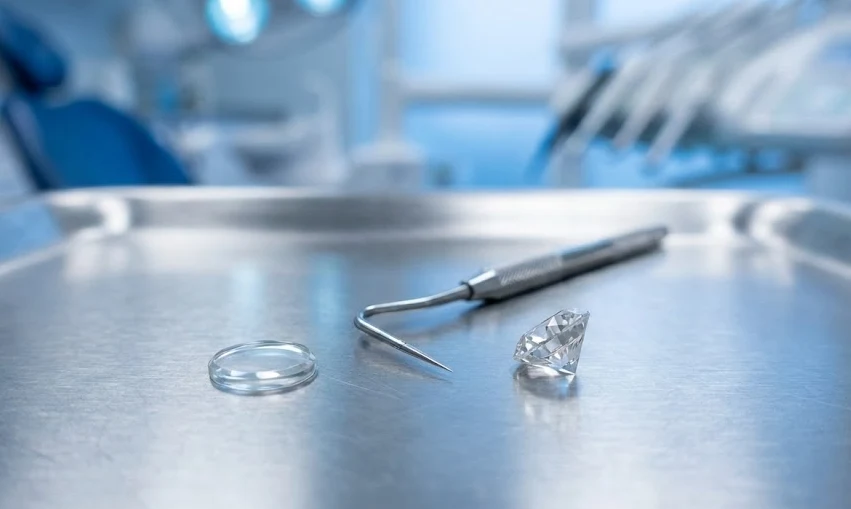
You need to see the back of the jewel to understand the difference.
1. Tooth Gems (Crystals & Strass)
Most of the “tooth gems” that you can find on social networks are actually perfect lead-free glass or pieces of Swarovski crystals. The most important feature, however, is that the jewel has a flat back.
This is why there is no necessity to drill or change the structure of your tooth. We simply use a flowable composite, which is a material similar to that for white fillings, and paste the gem on the tooth surface. It is only additive.
You may even think in terms of a sticker that is very high-tech, medical-grade and here, in the case of adhesiveness. In case you do not change your mind within six months, Dentist Polen Akkılıç and her staff will remove the gem by polishing the tooth so that the tooth will appear as if the gem never existed.
2. Diamond Bonds (Real Precious Stones)
This is when the biology gets complicated. Natural diamonds often have a pointy back (called a culet) to reflect the light. They are not flat.
Besides, when you bond a real diamond to a tooth without any preparation, the diamond will be sticking out largely, that is it will be feeling a lot bulgy at your lip, “like a pebble in your shoe,” but in this case, the pebble will be in your mouth.
Sometimes we need to create a tiny ‘nest’ in the enamel to properly place a real diamond. It will sit flush with the tooth surface after this. The sparkle of a real diamond is wonderful, but this method is a little more invasive than using a simple crystal gem.
The Procedure: What Happens in the Chair?
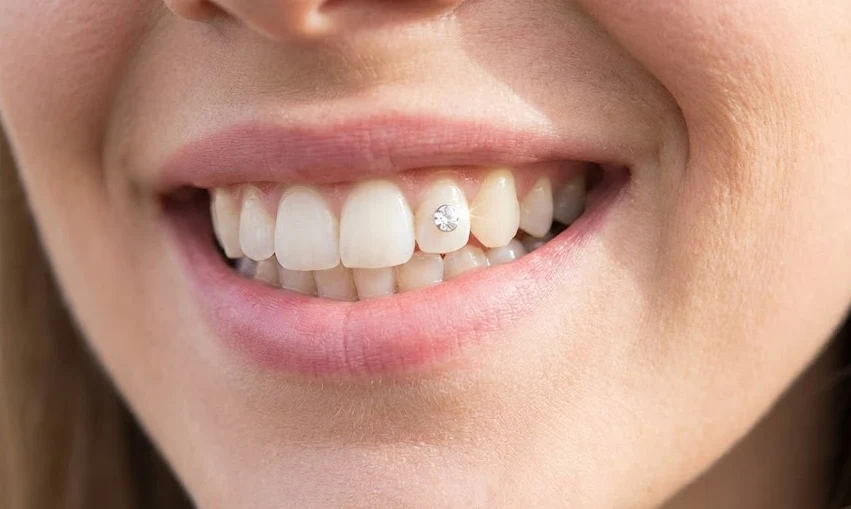
Many patients fly to Turkey expecting a long, painful surgery for these aesthetics. The reality is quite the opposite. The process for both gems and diamonds relies on Micromechanical Retention. We etch the surface of the tooth with a mild gel (creating a microscopic roughness—imagine sanding a wall before painting it so the paint sticks). Then, we apply a bonding agent and the jewel.
It is fast. Usually, you are in and out of the chair in 20 minutes. There is no drilling (for flat gems), no anesthesia, and absolutely no pain.
Comparing the Options
If you are debating which route to take, look at this breakdown based on our clinical observations.
| Feature | Tooth Gems (Crystals) | Diamond Bonds (Real Stones) |
| Material | Lead-free glass / Crystal | Natural or Lab-grown Diamond |
| Back Shape | Flat | Pointed (usually) |
| Invasiveness | Non-invasive (Surface only) | Minimally invasive (May require prep) |
| Sparkle Life | High initially, may dull over time | Permanent brilliance |
| Durability | 6 months – 2 years | Years (often until removed) |
| Reversibility | 100% Reversible | Reversible, but requires filling the “nest.” |
The Risk Factor: Why DIY Kits Are Dangerous
We have seen the horror stories. Patients come to us with damaged enamel because they bought a “DIY Tooth Gem Kit” online.
The adhesives in these kits are often harsh chemicals not meant for oral use. Worse, if the seal isn’t perfect, bacteria can get trapped between the gem and your tooth. This creates a hidden cavity that rots the tooth from the outside in. Dentist Polen Akkılıç always warns: “A jewel should highlight a healthy tooth, not hide a decaying one.” Professional bonding ensures the area is sealed tight, preventing bacteria from entering underneath.
FAQ: Your Questions Answered
Not at all. For standard tooth gems, there is no drilling and no needle. It feels very similar to having orthodontic brackets put on. You just feel the cool air and the light pressure of the tools.
Yes, and you must! You should brush around the gem just like any other part of your tooth. Electric toothbrushes are fine, but we recommend not pressing too hard directly on the stone for the first 24 hours to let the bond fully set.
The bond is strong—it’s designed to withstand chewing forces. However, we advise against biting directly into hard fruits or cracking nuts with the specific tooth that has the gem. Treat it like a piece of jewelry; handle with care.
This is a common question. Bonding to porcelain (veneers/crowns) is different from bonding to natural enamel. It is possible, but the bond strength is generally lower, and we have to use different chemical primers. We can discuss this during your consultation in Turkey.
Don’t panic. The gems are tiny and non-toxic. They will pass through your digestive system naturally without causing any harm. The only loss is the cost of the stone itself!
- Demarco, F. F., et al. (2012). Longevity of posterior composite restorations: Not only a matter of materials. Dental Materials, 28(1), 87-101.
- Gordan, V. V., et al. (2018). Repair or replacement of defective restorations by dentists in The Dental Practice-Based Research Network. Journal of the American Dental Association, 146(12), 895-903.
- Peumans, M., et al. (2020). Clinical effectiveness of contemporary adhesives: A systematic review of current clinical trials. Dental Materials, 21(9), 864-881.
- Van Meerbeek, B., et al. (2019). State of the art of self-etch adhesives. Dental Materials, 27(1), 55-69.
- Joiner, A. (2010). The bleaching of teeth: A review of the literature. Journal of Dentistry, 34(7), 412-419.

