


Protect your smile with alternatives like water flossers and interdental brushes.
Most people experience a dental visit as one filled with guilt about their flossing habits. They plunk down in the dentist’s chair as if in readiness for a lecture. Yet, there are many reasons why plain floss often fails. For one, it requires a bit of time and good technique. And for those who have had extensive dental work, regular floss might not be the right tool at all.
At Lema Dental Clinic, we are privileged to meet people who come to Turkey from different parts of the world for their major smile reconstruction. One of the things we have realized is that no single tool is the best for everyone. Tooth brushing without flossing is comparable to cleaning just the front door of the house and leaving the windows wide open. Although the exterior looks neat, the interior is still vulnerable to harm.
A great simile shared by Prof. Dr. Coşkun Yıldız is that plaque is like a wild ivy on a brick wall. Initially, it is harmlessly spread over the surface. However, if it is ignored, it sends its very small, acidic roots all the way down to the soft gums and bones. To prevent this internal decay, one must have the ideal cleaning tool.
Traditional Floss: The Classic Choice
For natural teeth that are held tightly together, traditional flossing remains the best option. However, the different categories of floss are not all the same.
PTFE (Teflon) Floss
Do you possess tightly set teeth or the most expensive dental adornments,s such as gold crowns or diamond tooth jewelry? PTFE is a very reliable option. It slides just like smooth silk over glass. It will not snag or tear your soft gums.
Spongy and Expanding Floss
Have your gums been receding slightly? Expanding floss is your best bet. In the mouth, it increases its volume, similar to a soft sponge. It nets the bad bacteria with a soft, broad net rather than a sharp wire.
The Best Flossing Alternatives
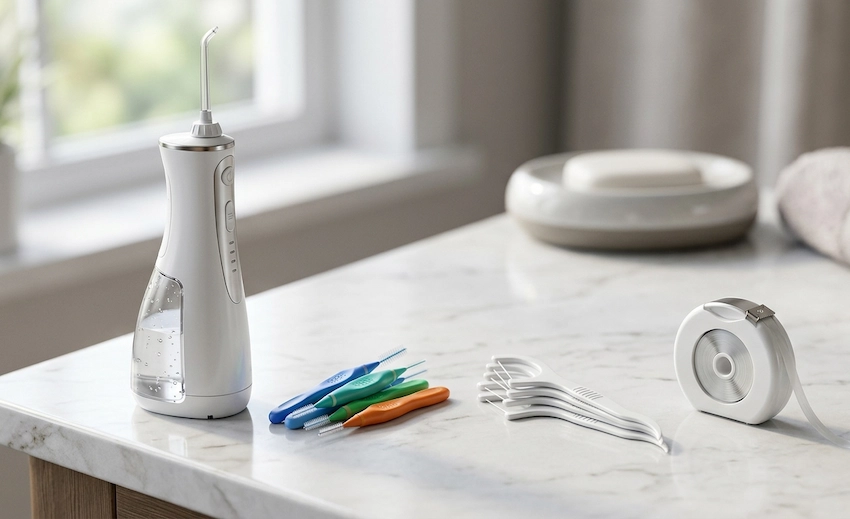
For those who can’t stand the thought of using string, there is an opportunity. These are the most common patient groups that come to the clinic: those who have new teeth and want easier solutions.
1. Water Flossers
Water flossers have a focused water jet that can easily reach that stuck piece of food. In other words, it is a tiny and extremely powerful cleaning device for your mouth.
- Where we see the necessity: Implant patients in Turkey are the main users of these devices in our dental practice with Dentist Polen Akkılıç and her team. Having not only an All-on-4 system but also those complex zygomatic implants, water can reach very deep under the bridge, where it is simply impossible for a string to reach.
2. Interdental Brushes
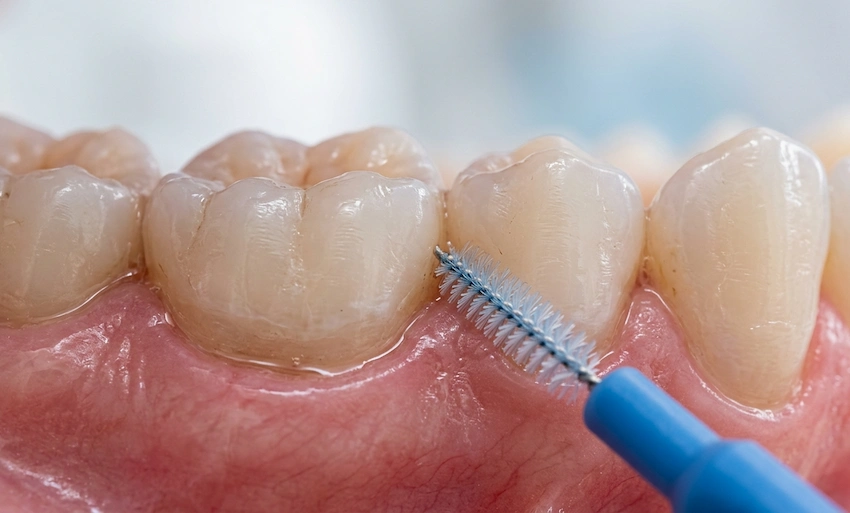
These resemble miniature, mineralized pipe cleaners. They easily slide back and forth between teeth.
- Why we rely on it: They are excellent for wider gaps. Theoretically, children with space maintainers and adults with some bone loss are capable with their use to help clean the curved tooth roots.
3. Air Flossers
These machines combine fast air jets with a liquid mist to dislodge food particles forcefully.
- Why we rely on it: Because it is very fast and simple. This is a great, simple starting point if you currently do not clean between your teeth at all.
Comparing Your Options: What Works Best?
| Cleaning Tool | Best For | Top Benefit | Things to Know |
| PTFE / Waxed Floss | Natural teeth, tight spaces | Glides easily without breaking | Needs a bit of getting used to |
| Water Flosser | All-on-4, implants, bridges | Can clean deep areas under dental hardware | More expensive than string/floss |
| Interdental Brushes | Wider gaps, sensitive gums | Cleans the curved roots really well | You have to get the right size |
| Air Flosser | Those who hate flossing | Very fast and simple | Not as effective as a water flosser |
Frequently Asked Questions
Keep them as a team. A water flosser can wash away food, no matter how big. Floss acts as a wipe to every tooth contact area, keeping it smooth and clean. For natural teeth, go for both, but in case of a full implant bridge, the water flosser is the main.
Absolutely not, they do not cause gaps. They just remove the gunk. When diseased gums get better, they shrink to their healthy size. Measure carefully with clinical help for easily sliding ones is the take-home point.
Freshen up the mouth with a mild wet after the operation. After Dentist Polen Akkılıç gives the green light for doing so, spend money on a high-quality water flosser of high quality. Nothing is better in terms of maintaining a smile worthy of a dental museum.
Not at all, veneers and teeth crowns are safe and sound with water flossers. In fact, they help keep the margins of your new teeth nice and clean. Just make sure to use the lowest and gentlest setting to avoid giving your soft gums any unnecessary pressure.
One per day is the minimum when it comes to interdental cleaning. If you are patient with full mouth implants, try to perform once after each meal a quick water rinse. This way, you will be maintaining your work of art all day long.
- Worthington, H. V., MacDonald, L., Poklepovic Pericic, T., Sambunjak, D., Johnson, T. M., Imai, P., & Clarkson, J. E. (2019). Home use of interdental cleaning devices, in addition to toothbrushing, for preventing and controlling periodontal diseases and dental caries. Cochrane Database of Systematic Reviews, (4).
- Kotsakis, A. S., French, D., & Misch, C. E. (2016). Implant cleaning methods and their effects on the titanium surface. Journal of Periodontology, 87(5), 515-520.
- Lyle, D. M., Qaqish, J. G., & Schuller, R. (2020). Efficacy of a water flosser compared to string floss on clinical signs of inflammation. Compendium of Continuing Education in Dentistry, 41(8), e1-e4.
- Slot, D. E., Dörfer, C. E., & Van der Weijden, F. A. (2008). The efficacy of interdental brushes on plaque and parameters of periodontal inflammation: a systematic review. International Journal of Dental Hygiene, 6(4), 253-264.
- Ng, E., & Lim, L. P. (2019). An Overview of Different Interdental Cleaning Aids and Their Effectiveness. Dentistry Journal, 7(2), 56.

