


Denture adhesive can be used on a soft liner only if your dentist confirms it is safe.
Adjusting physically to living with dentures is a huge leap. Your jawbone naturally shrinks with time. In such cases, wearing a hard acrylic denture is like wearing wooden shoes that are too big. It becomes loose, unstable, and gets you sore spots due to painful friction.
That is exactly when a soft liner can help. Consider a soft liner as a medical-grade memory foam insole for your gums. Besides cushioning your bite, it also compensates for bone loss, creating new gaps.
The problem is still that one. What should you do if the soft liner is getting loose? Is it okay if you add denture adhesive to secure it?
This is what we usually observe at the clinic.
Briefly: At Your Own Risk
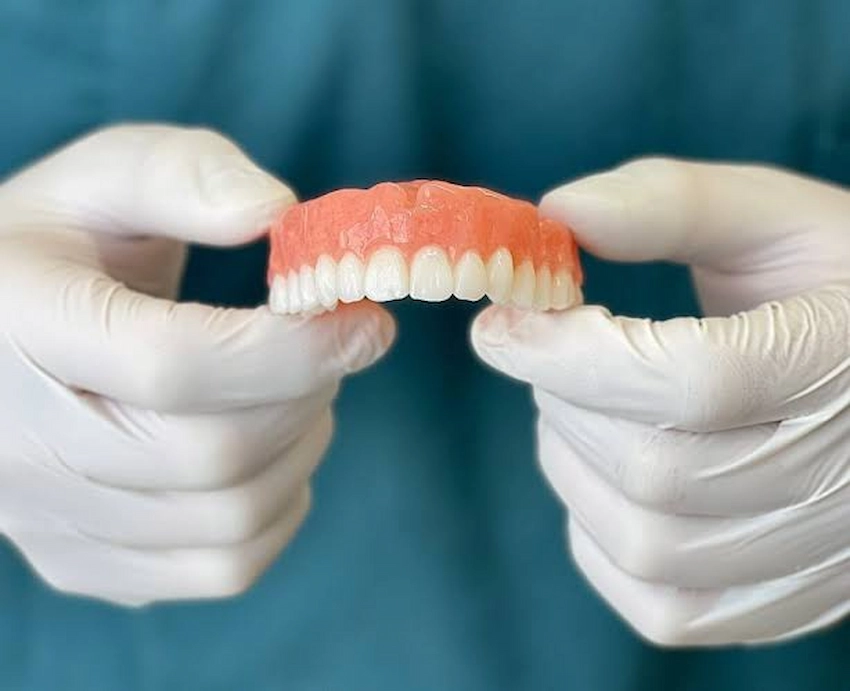
It is quite unsafe to put traditional denture adhesive directly onto a soft liner.
Here in Turkey, Professor Doctor Coşkun Yıldız often mentions to our patients that a soft liner is very porous. A standard denture has a hard, polished acrylic base. But a soft material of a temporary liner behaves just like a microscopic sponge.
After you spread a thick adhesive on such a spongy surface, three things go on:
- Chemical Degradation: Solid adhesives disintegrate the soft liner. The material will become hard, peel off, or deteriorate too soon.
- Bacterial “Hides”: The porous liner will take in the glue deeply. You are not able to wash it clean without damaging the fragile material. The trapped adhesive immediately becomes a breeding ground for bacteria & fungi such as oral thrush.
- Distorted Fit: Applying glue produces a layer that leads to uneven pressure. This totally cancels out the purpose of a customized cushion.
When Soft Liners Meet Adhesives
Yet, let’s analyze your situation more accurately. If you are looking for the adhesive tube, your soft liner is definitely at the end of its life.
Dentist Polen Akkılıç and her assistants continually meet these cases. Patients use over-the-counter pastes to prolong the life of a worn-out soft liner. The consequence is almost invariably damaged gum tissue.
A soft liner can only be a temporary measure. Usually, it is effective for a few weeks to a few months. It is the soft buffer that keeps your gums safe as they are recovering after tooth extraction or during waiting time for a permanent hard reline.
Using adhesive on a deteriorating soft liner is similar to covering a leaky pipe with a piece of duct tape. It might work for a brief moment, but the real issue is not resolved,d and the system will eventually break down.
Comparing Your Options for Denture Stability
We wish to assist you in identifying your long-lasting treatment strategy. Below is a breakdown of the methods we usually resort to for stabilization at Lema Dental Clinic.
| Stabilization Method | Tissue Comfort | Stability Level | Expected Lifespan |
| Soft Liner (No Adhesive) | Very High | Moderate | 2 to 6 months |
| Soft Liner + Adhesive | Low (Causes irritation) | Poor (Breaks down liner) | Not recommended |
| Hard Reline | Moderate | High | 1 to 2 years |
| Implant-Supported Denture | High | Ultimate | Decades to Lifetime |
Frequently Asked Questions
A properly fitting soft liner will fit you comfortably anywhere from two to six months. But this also depends on the rate at which your gums shrink. Do not glue it when you find it loose after two weeks; rather, call a dentist to get it safely adjusted.
In case of emergency, an extremely light application of an adhesive powder is somewhat better than applying a thick paste. Powders can be rinsed off more easily. However, this should never be a regular practice, but just a temporary trick.
Think of it as a piece of delicate fabric. Do not press with a hard brush or use harsh toothpaste on the soft material,l as in most cases. Wash with warm water. Use a very soft brush or your fingers only to remove food particles.
The stimulation of natural tooth roots is required by the jawbone for it to stay strong. When you lose your teeth, the body starts absorbing the bone. This will change the shape of your mouth entirely, and in the end, your denture loses its fit.
Of course, a soft liner is a step only. After the healing of your gums, the soft material is replaced with a hard acrylic resin. A slip-free, non-permanent, bone-loss-stopping solution is a dental implant, and it is a gold standard.
- Carlsson, G. E., & Omar, R. (2010). The future of complete dentures in oral rehabilitation. A critical review. Journal of Oral Rehabilitation, 37(2), 143-156.
- Garcia, L. T., & Jones, J. D. (2004). Soft liners: A review of the literature. Journal of Prosthodontics, 13(1), 38-46.
- Murata, H., Taguchi, N., Hamada, T., & McCabe, J. F. (2002). Dynamic viscoelastic properties and the age changes of long-term soft denture liners. Biomaterials, 23(17), 3587-3592.
- Zarb, G. A., Hobkirk, J. A., Eckert, S., & Jacob, R. (2012). Prosthodontic Treatment for Edentulous Patients: Complete Dentures and Implant-Supported Prostheses (13th ed.). Elsevier Mosby.
- Zhao, K., Cheng, X. R., Chao, Y. L., & Li, Z. P. (2004). Laboratory evaluation of a new cephalosporin-containing soft denture liner. The Journal of Prosthetic Dentistry, 91(4), 333-338.

