


Partial dentures may need dental adhesive for extra hold, but a proper fit is more important.
First time getting dentures is a big step in life. It’s not as simple as replacing natural teeth with an acrylic plate you can take out, and it takes a certain amount of patience and grace.
Some patients get quite worried about their upper plate being loose and falling during a joke or a meal. Let’s see how the mechanics of a good fit work … and how you can secure your smile in the right way.
Lema Dental Clinic in Turkey has a lot of clinical experience. That is why we know that a well-made upper denture should be so close to the palate that it will almost create a vacuum seal. Consider a suction cup firmly pressed against a wet glass. If it fits well, your natural saliva will do the rest, as the surface tension will be such that the plate will be locked in place.
Of course, the human anatomy is not static. With age, the bones of the jaw get smaller. That is when a good adhesive will become your best friend. It will act like the insulation tape around a drafty window to make that important seal even more solid.
Correct Method: Less is Always More
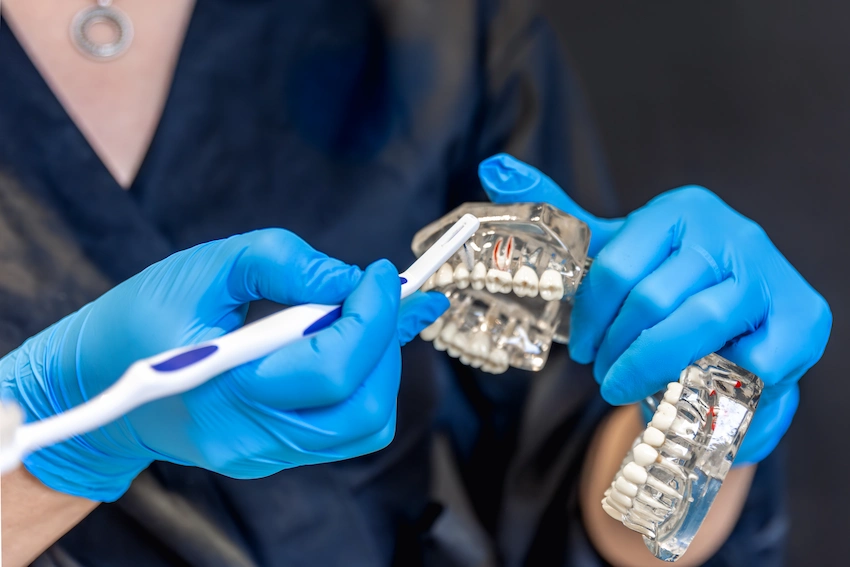
Professor Doctor Coşkun Yıldız says that a very common patient mistake is … treating the adhesive as if it were a toothbrush. Many people squeeze a thick line along the whole plate. Overfilling the acrylic channel actually kills the suction. It spoils your natural bite and makes a messy, stressful experience.
This is what we witness in the clinic. Patients present us with dentures smothered with thick layers of dried paste. They are complaining of a weak hold and painful gums. The very secret of an immovable upper denture is strict accuracy.
Step 1: Prepare the Surface
Your denture and your mucosa should be totally clean and dry. Adhesive compounds require moisture to get going. If the denture is already wet before you put the paste, the bonding happens momentarily and is very weak. So dry the inside of the upper plate with a tissue thoroughly.
Step 2: The Three-Point Method
Don’t apply adhesive with a continuous line, but in small spots or dots. For your maxillary denture, three small pea-sized dots are enough. One dot should be on the anterior ridge. The other two dots should be on each side towards the back. Avoid the middle of the palate. Also, don’t get near the outer edges.
Step 3: Seat and Seal
Put the denture intimately with your mouth. Bite equally for 3 to 5 seconds. The force will easily mix those three little spots into a very thin, invisible film. Dentist Polen Akkılıç and her team always encourage patients to wait 15 minutes before consuming hot beverages. This time of rest allows the adhesive to harden completely against the mucosa.
Comparing Your Adhesive Options
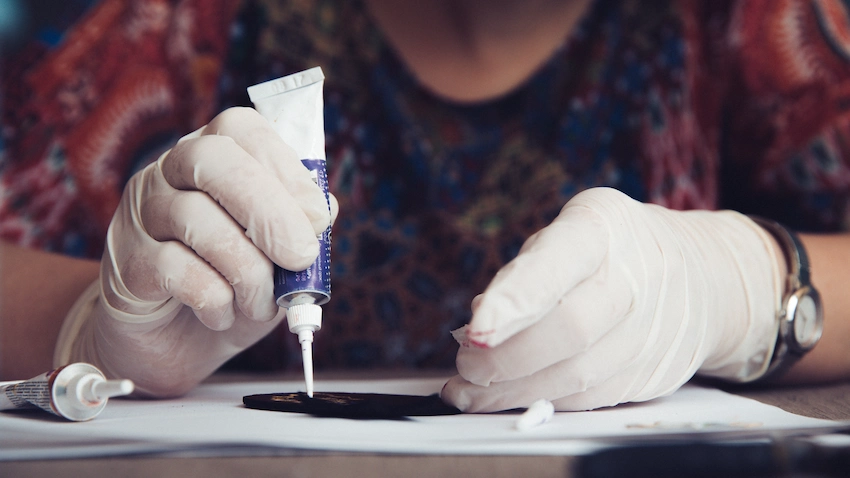
The question is still: which one is the best for my anatomy? Let’s see the pros and cons of each type.
| Adhesive Type | Hold Strength | Best Used For | Clinical Nuance |
| Creams & Pastes | Very High | Wearers of regular dentures with less bone loss. | Gives the most powerful chewing force. Requires cautious usage to prevent oozing. |
| Adhesive Powders | Moderate | Good-fitting prosthesis needing a small grip increase. | Very hygienic. Totally mixes with the natural saliva to form a very thin, tight seal. |
| Strips & Cushions | Mod. to High | Gums of sensitive patients or those with flat ridges. | Serves as both a physical buffer and an adhesive. May alter the occlusion if too thick. |
Frequently Asked Questions
You must be going overboard with the paste. Or, you might be putting it too far back on the palate. Just use a quarter of the amount. Also, keep in mind that when you apply pressure, the adhesive will turn out flat. So, if it goes into your throat, you will end up gagging.
Don’t use a hard brush and scrub your gums if you want to keep them clean. The first thing you should do is rinse your mouth with warm salt water for a full minute. This will help to break the chemical bonds. Then take a baby toothbrush and gently wipe the gums clean.
Swallowing small droplets by chance is not dangerous. However, if it regularly happens, then you are definitely applying it wrongly. The adhesives that contain zinc should be avoided. Their prolonged use over a period of years can cause nerve damage. This is why we recommend and always advise our patients to choose zinc-free products.
No, it can not. If your denture moves like a seesaw when you chew, it is an indication that the shape of your jawbone has changed. Adhesive can only be used to seal a tight space. It is useless in filling the much larger gaps due to a change in the structure. You should get a referral by contacting us, or you may want to learn about implant-supported fixed bridges.
If the application is done correctly on a denture that fits well, then 12 hours is the minimum time that one application will function. If you find yourself having to reapply 3 times per day just to be able to talk properly, then it is clear that the prosthesis does not fit your mouth, and you definitely need a professional intervention.
- Felton, D., Cooper, L., Duqum, I., Minsley, G., Guckes, A., Hage, S., … & Swelem, A. (2011). Evidence-based guidelines for the care and maintenance of complete dentures: a publication of the American College of Prosthodontists. Journal of Prosthodontics, 20(s1), S1-S12.
- Grasso, J. E. (2004). Denture adhesives: changing attitudes. The Journal of the American Dental Association, 135(1), 81-86.
- Kapur, K. K. (1967). A clinical evaluation of denture adhesives. The Journal of Prosthetic Dentistry, 18(6), 550-558.
- Polyzois, G. L., Lagouvardos, P. E., & Frangou, M. J. (2006). Efficacy of denture adhesives in complete denture wearers: a multicenter crossover trial. The International Journal of Prosthodontics, 19(4), 389-395.
- Slaughter, A. (2004). The use of denture adhesives. Journal of the American Dental Association, 135(1), 87-88.

