


Front teeth are high stakes.
The restoration of the maxillary anterior teeth is (the “front teeth”) is one of the biggest challenges that contemporary reconstructive dentistry is facing. The region is characterized by a functional requirement for incisal guidance while, at the same time, the patient’s aesthetic expectations need the highest level of satisfaction.
Posterior restorations are mainly focused on the load-bearing capacity of the materials. On the other hand, anterior restorations are made of materials that visually resemble the natural tissues of the teeth particularly translucency and light diffusion. The majority of single anterior crowns nowadays are made of either Lithium Disilicate (commonly known as the brand name IPS e.max) or Zirconium Dioxide (Zirconia).
It is not that you can choose your favorite material for a particular restoration situation. Rather, the materials that meet the requirements of the clinical situation best are the ones to be used. Factors like occlusal forces, aesthetic demands, and the condition of the substrate shall all be considered.
The Science of Anterior Aesthetics: Optics vs. Mechanics
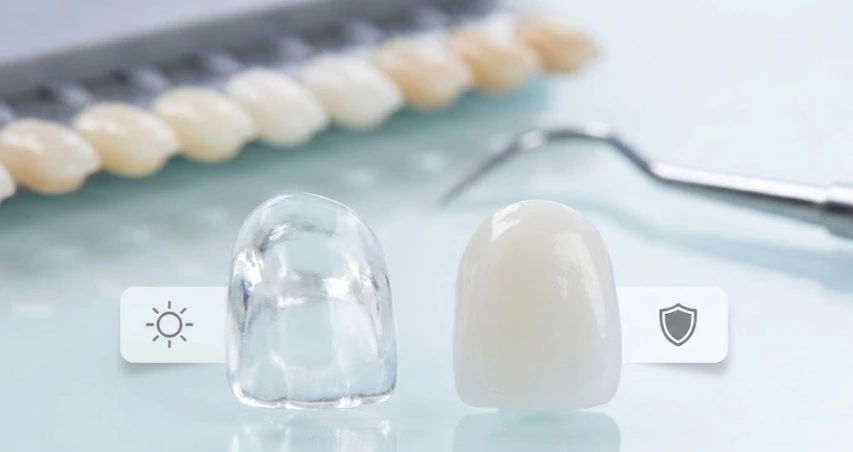
The main issue in anterior prosthodontics is that a material’s strength is usually at the expense of its translucency and vice versa.
Dental enamel, when healthy, is very translucent. It allows the light to go through to the dentin underneath from where it scatters and reflects. The light internally reflected within the tooth is what gives living teeth their “vitality”. And thus, if one wants to replicate the appearance of the tooth, the material to be used should be able to transmit light in the same way.
Nevertheless, materials that are transparent to light are generally weaker and more brittle than materials which are opaque to light and these are crystalline structures/metals. Clinical decision-making is a matter of compromise between choosing a material that is strong enough to resist functional forces and still translucent enough to have a natural appearance.
Lithium Disilicate (E-max): The Aesthetic Standard
Lithium disilicate is considered a glass-ceramic material. Its microstructure refers to the lithium disilicate crystals, which are embedded in a glassy matrix. It is this structure that determines the material’s main clinical benefit of having excellent optical properties.
Clinical advantages in the anterior zone:
- High translucency: E-max has light transmission characteristics that closely resemble natural enamel. Where it is of utmost importance that anterior teeth match the rest of the natural dentition, one can go as far as to say that it is still the gold standard when it comes to aesthetics.
- Adhesive bonding: You can etch and chemically bond E-max to tooth structure with resin cements, whereas zirconia is normally cemented. The adhesive procedure greatly increases the fracture resistance of the final restoration-tooth complex.
Clinical limitations:
- Flexural strength: E-max has a flexural strength between 360 and 500 MPa, which makes it significantly less strong than zirconia. Although it should be enough to withstand the normal biting forces in the anterior area, we should not recommend it for patients who have severe parafunctional habits such as bruxism (clenching or grinding of teeth) without further considerations.
Zirconium Dioxide (Zirconia): The Structural Alternative
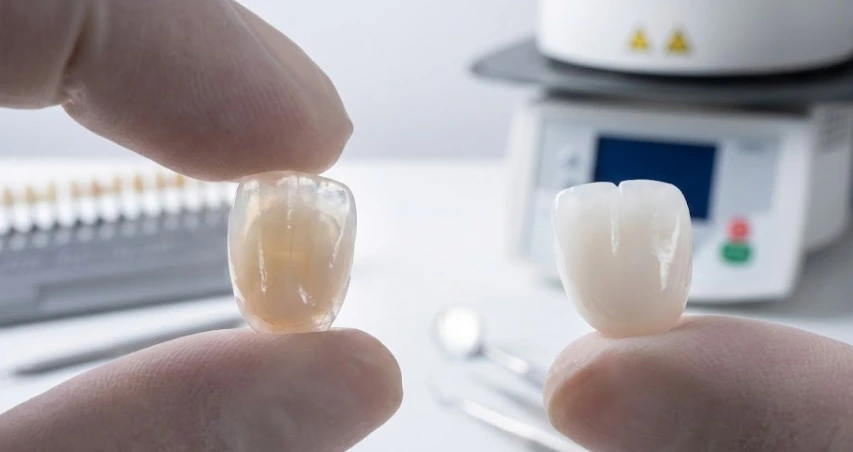
Zirconia is a polycrystalline ceramic that is often referred to as “ceramic steel” in layman’s terms. First, it does not have a glass phase which gives it nice mechanical properties but, on the other hand, it makes the material very opaque, which in the past has limited its aesthetic potential.
Clinical Advantages in the Anterior Zone:
- High Flexural Strength: Contemporary dental zirconia has flexural strengths in the range of 900 to 1200+ MPa. This makes it very resistant to crack propagation and, thus, a good alternative for heavy occlusal patients or those that frequently break ceramic restorations.
- Substrate masking: The natural high opacity of zirconia is in some cases a disadvantage aesthetically, but when the tooth underneath is heavily discolored (e.g., a dark, endodontically treated tooth or tetracycline staining), then it becomes a distinct advantage. Zirconia can cover dark-colored teeth better than a translucent E-max crown can.
Clinical Limitations:
- Aesthetic sacrifice: “High-translucency” (HT) zirconia grades have greatly improved, but, generally speaking, they cannot quite offer the depth and light-scattering features that lithium disilicate does. For a highly aesthetic anterior case, having monolithic zirconia may be slightly flatter or higher in value (brighter/more opaque) than the surrounding natural teeth.
The Decision Matrix: Substrate and Function
There may be other clinical factors outside the properties of the two materials themselves that dictate the choice between them.
1. The Condition of the Underlying Tooth (Substrate):
One of the significant factors, which are rarely considered, is the color of the tooth stump after prepping. E-max is translucent; thus, the natural underlying tooth should be light in color if you want to get a natural-looking result. If you put an E-max crown on a dark gray stump, the restored tooth will look gray. In situations where the discoloration is so severe, a Zirconia crown will be able to mask the defect and still produce a low-key good result due to its opacity.
2. Occlusal Risk Factors:
E-max material has enough strength to be used on anterior teeth in patients who have normal occlusion. It is however, not recommended for patients who have bruxism signs which are wear facets and an edge-to-edge bite, because they are more likely to cause ceramic fracture. To achieve the ideal aesthetic result may not be the most important matter in some cases if the higher fracture toughness of Zirconia would be the better decision for the exposure to be endured.
Comparative Overview: Anterior Indications
| Clinical Property | Lithium Disilicate (E-max) | Zirconium Dioxide (Zirconia) |
| Translucency/Aesthetics | Superior (Closest to natural enamel) | Good (Improving, but more opaque) |
| Flexural Strength | Moderate (360-500 MPa) | High (900-1200+ MPa) |
| Fracture Toughness | Lower (More brittle) | Higher (More resistant to cracking) |
| Cementation Protocol | Adhesive Bonding (Chemical bond) | Conventional Cementation or Bonding |
| Primary Anterior Indication | Highest aesthetic demand; light-colored substrate teeth. | Masking dark substrate teeth; patients with parafunctional habits. |
Conclusion
There is no single universally superior material for anterior dental crowns. The choice between Lithium Disilicate and Zirconia requires a comprehensive clinical evaluation. Lithium Disilicate remains the preferred choice for maximum aesthetic integration in patients with favorable occlusal conditions and light underlying tooth structure. Zirconium Dioxide offers a necessary alternative for cases requiring high strength or the masking of significant underlying discoloration.
FAQ: Straight Talk from the Lema Team
Because strength isn’t the only metric for success in the front,” says Dentist Polen Akkılıç. “A crown that lasts 50 years but looks fake is a failure in our eyes. E-max is strong enough for front teeth biting forces, but its beauty is superior.
To an untrained eye, maybe not immediately. But in certain lighting conditions, or in photographs, E-max usually has that “sparkle” that living teeth have, whereas zirconia can sometimes look a bit more uniform.
It comes down to volume and technology. Clinics like Lema Dental do hundreds of these restorations a month. We invest in the absolute latest CAD/CAM milling machines and genuine Ivoclar (E-max) materials. You get high-volume expertise at a lower operational cost.
No, but you are forbidden from sleeping without protection,” the team notes. “If we place beautiful E-max crowns on your front teeth and you are a bruxer, a custom-made night guard is mandatory to protect that investment.
- Guess, P. C., et al. (2011). All-ceramic systems: laboratory and clinical performance. Dental Clinics of North America.
- Spitznagel, F. A., et al. (2018). Clinical performance of monolithic versus veneered zirconia restorations: A systematic review. Journal of Prosthetic Dentistry.
- Edelhoff, D., et al. (2019). Clinical performance of all-ceramic crowns. Current Oral Health Reports.
- Magne, P., & Belser, U. (2002). Bonded Porcelain Restorations in the Anterior Dentition: A Biomimetic Approach. Quintessence Publishing.

