


Your dental crown falls out because the underlying tooth foundation has failed.
Imagine you are at a nice dinner party, you have just taken a bite of something delicious, and suddenly you hear a dreaded crunch in your mouth! To your horror, your crown has come loose. While a falling dental crown may initially seem only mildly irritating, it is actually a pretty serious indicator of structural breakdown going on. The fact is, a properly made and fitted dental crown should never come loose and fall out. If it does, then it means that there is an underlying problem that is causing the failure of the crown and possibly even the natural tooth underneath.
This is something that we have seen quite a lot at Lema Dental Clinic over the years. We have patients from all over the world who regularly fly into Turkey just to have their teeth treated by us. They get tired of all the temporary and superficial fix-up work and eventually come in with their dental crowns that have been re-cemented three or four times by the local dentists. Their main wish is to get a permanent solution.
So why does this cycle continue? And how can modern dental technology put an end to it once and for all? Let’s dig deep into it.
Understanding Why Crowns Fail
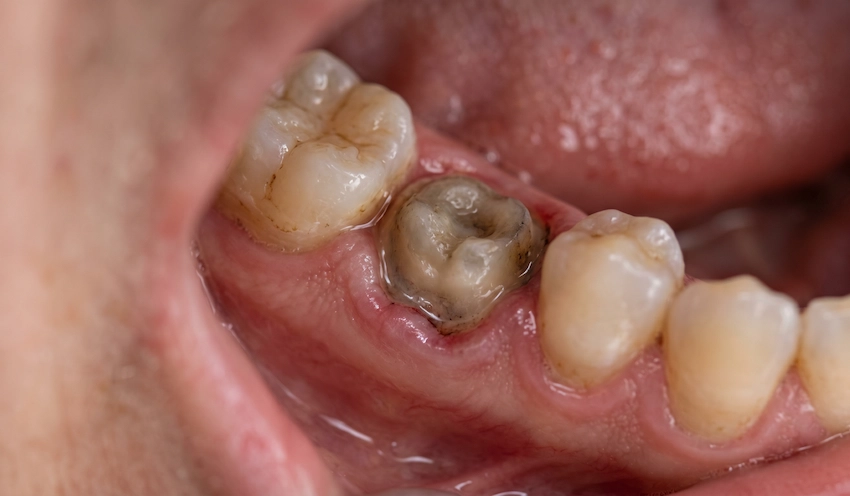
Professor Doctor Coşkun Yıldız is a big fan of pattern recognition. He believes that a falling crown is a sign of improper tooth preparation, unexposed tooth pathology, or incorrect fit. Our usual finding when investigating these failures is that one or more of the following conditions are present:
- Hidden Decay: Bacteria manage to find their way just under the edge of the crown. Now they go about their work of silently destroying the tooth. Soon, there is no good tooth structure left to which the crown can be bonded.
- Insufficient Tooth Structure: It might be the case that the previous dentist decided to overdo the crown preparation and quite drastically reduce the tooth. In such a situation, the crown will not have enough tooth surface and height to hold on to the tooth well. Even moderate chewing loads can be a problem for such a crown.
- Interference in Occlusion: If your bite is not well-balanced, then you might be hitting that one crown much more forcefully than usual each time you are chewing. This kind of intense and repeated pressure will eventually break the seal of the crown.
What We Have Found

This is how things are at our dental office. Most of the old dental crowns in the U.S. that we see have a metal frame, which is then covered with porcelain. In the industry, this is called PFM. The problem is that after some years, the metal edges are exposed due to gum recession. At this point, bacteria can get in, and the tooth supporting the crown starts to decay, and the crown finally comes loose.
To resolve this situation once and for all, Dentist Polen Akkılıç and her team take advantage of the latest HD 3D scanning techniques. Our dental crowns are designed in monolithic zirconia. Besides being aesthetically pleasing, zirconia is a superb bonding partner on the microscopic level. We believe that just sticking the crown to a weak tooth is not enough. We are, in fact, placing a biologically safe barrier over an ideally prepared tooth.
But what if the tooth is beyond repair? We don’t hold a failing crown hostage on the tooth. It is simply extracted, and a reliable dental implant is placed in Turkey in its place. Thus, a dead root is substituted with a strong titanium.
What Is the Difference Between These Two Options?
| Feature | The “Quick Fix” Method | The Lema Dental Clinic Method |
| Scanning Tool | Old-fashioned dental putty | 3D Digital Scanners |
| Material Used | Metal-based porcelain (PFM) | Solid Zirconia or E-Max |
| The Fit | Loose edges, traps bacteria | Perfect, micron-level tight seal |
| Bite Balance | Basic visual checks | Digital bite tracking |
| Lifespan | Short-term (falls out often) | Permanent, highly secure |
5 FAQs about Crowns
A crown falling out is not normal at all. In fact, a well-made crown can behave like a natural tooth for a lifetime if it is properly cared for. On the other hand, if it does fall out, then you are definitely looking at the clinical sign of your tooth inside being unwell or damaged.
Absolutely no! Cement or glue bought from the store might just keep a crown in for a short period, say a day or two. On the other hand, it will not have the capability of sealing out the harmful bacteria. If left untreated, the quickly progressing decay will soon lead to the destruction of the remaining tooth.
Before anything else, it is crucial to understand the root cause of a crown coming off. If the decay has been so deep that it has reached the nerve, then yes. The root canal is required for the removal of infection. It is old wisdom that it is always better to consolidate the foundation first.
Patients come to Lema Dental Clinic in Istanbul because they want to be treated with the best possible dental services and equipment. We sell premium quality dental zirconia and have highly skilled doctors, while the price is significantly lower than in Europe or the US. Besides, we always resort to dealing effectively with the root cause leading to the problem.
Firstly, the exact bite of the patient is recorded with the use of 3D digital technology. This results in a crown that fits the tooth perfectly. And because of that, there is no room at all for bacteria. If the natural tooth is short, the gum line can be reshaped safely to create a firm and permanent grip.
- Goodacre, C. J., Bernal, G., Rungcharassaeng, K., & Kan, J. Y. (2003). Clinical complications in fixed prosthodontics. The Journal of Prosthetic Dentistry, 90(1), 31-41.
- Sailer, I., Makarov, N. A., Thoma, D. S., Zwahlen, M., & Pjetursson, B. E. (2015). All-ceramic or metal-ceramic tooth-supported fixed dental prostheses (FDPs)? A systematic review of the survival and complication rates. Part I: Single crowns (SCs). Dental Materials, 31(6), 603-623.
- Rekow, E. D., Silva, N. R., Coelho, P. G., Zhang, Y., Guess, P., & Thompson, V. P. (2011). Performance of dental ceramics: challenges for improvements. Journal of Dental Research, 90(8), 937-952.
- Pjetursson, B. E., Valente, N. A., Strasding, M., Zwahlen, M., & Liu, S. (2018). A systematic review of the survival and complication rates of zirconia-ceramic and metal-ceramic single crowns. Clinical Oral Implants Research, 29(S16), 102-114.
- Rosenstiel, S. F., Land, M. F., & Fujimoto, J. (2022). Contemporary Fixed Prosthodontics (6th ed.). Elsevier.

