


Too much zinc in denture adhesive can cause nerve problems, numbness, and weakness.
A mild tingling sensation is how it all begins. You may only notice a slight numbness in your extremities. Most people simply dismiss it as aging. However, that slight feeling will soon be the first sign of nerve damage. Applying denture adhesive is one such innocuous morning activity that can bring about the change.
Millions of people have depended on pastes to hold their loose dentures in place for decades. The changing shape of your jawbone causes dentures to become loose and slip. The go-to solution is to put on more paste. However, it is more worthwhile to find out precisely what that tube actually contains.
The Hidden Chemistry of Denture Creams
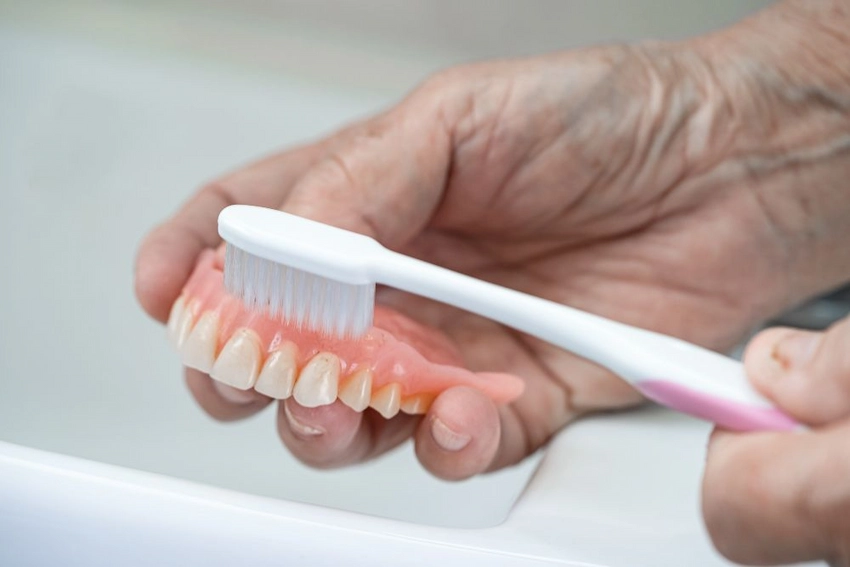
Many denture topical treatments feature zinc as the component responsible for gum-strong adhesion. Zinc in trace quantities is a nutrient and a mineral that is good for your health. It boosts the immune system and helps with the repair of damaged cells. The case is quite the opposite,e though, when you are using denture paste in abundance every day. To cover your daily intake of extra zinc, you ingest it constantly.
Visualize a seesaw to understand what is meant by mineral homeostasis. On one side, copper is on the other side, and zinc is balancing them. While taking enormous doses of zinc in the form of denture cream, you are heavy-weighting the zinc end of the seesaw with heavy bricks, causing the copper end to fly!
It is a fact that copper is of the essence. It is indispensable for the production of myelin sheaths. These sheaths wrap around the nerve fibers, like rubber insulation for electric wires. The nerve may lose the insulation without copper. Neuromuscular disorders and neuropathies come as a consequence of this scenario. This condition is known as zinc-induced hypocupremia. It is characterized by severe nerve injury, which may be irreversible in certain cases.
A Better Standard of Care in Turkey
Here’s the story from the field: Patients arrive at Lema Dental Clinic, Istanbul, Turkey, weary beyond measure, according to Professor Doctor Coşkun Yıldız. Besides the inconvenience of dentures slipping, they have health issues they have never related to their oral health; normally, symptoms such as poor balance, profound fatigue, and numbness in hands are present.
To put the issue with denture fixing in context, the misuse of a zinc-based denture cream is similar to fixing a broken foundation with a roll of duct tape.
Rather than continuously using harmful pastes, Dentist Polen Akkılıç and her clinical team dissuade patients from removable plastic. We plan, design, and implement permanent, secure solutions. Cutting-edge treatments such as Zygomatic implants, All-on-4, and All-on-6 create a solid foundation. You can enjoy the comfort of having secure teeth without any use of adhesives.
The Clinical Comparison
The issue to be addressed is: Does the health hazard associated with the temporary dosage of the denture cream justify the risk? The following table is a comparison of a standard denture adhesive application and a full structural restoration.
| Feature | Zinc-Based Denture Adhesive | Permanent Implants (All-on-4/All-on-6) |
| Toxicity Risk | Very high in case of daily over-use | None whatsoever |
| Bone Health | It causes continuous bone loss | It triggers and maintains the formation of bone |
| Bite Power | Approximately 20% of the force of natural teeth | As much as 95% of the power of natural teeth |
| Daily Care | Applying the paste and soaking the dentures is a mess | You can simply brush and floss your teeth regularly |
| Mouth Feel | The roof of the mouth is covered with the paste | The roof of the mouth is left exposed |
Frequently Asked Questions
How do I know if my denture cream is making me sick?
Doctor’s Answer: “Pay attention to how your body is reacting. Usually, the nervous system is where the copper deficiency will first become visible. Numbness and tingling as well as imbalance are signs to look out for. Stop the product immediately and then talk to your doctor about some blood work.”
Is a zinc-free adhesive completely safe?
Doctor’s Answer: “The zinc-free products will definitely be a safer choice as far as the regulation of your nervous system is concerned. However, they are merely temporary solutions. When you need an adhesive to keep your teeth in place, it means your jawbone has undergone atrophy. Your denture is not fitting properly any longer. At this point, you are treating a symptom and not an actual disease.”
Are dental implants really a safer choice?
Doctor’s Answer: “That is a certainty. To be exact, dental implants are made out of titanium, which is a safe, biocompatible material. This metal is fused directly to your natural bone only. No toxic chemicals, no messy pastes, and no slipping plastics will be involved in this procedure. It is the most natural way to get your real teeth back.”
What happens during treatment at your clinic?
Doctor’s Answer: “We will be your companions on this journey from start to finish. Our first encounter will involve an introduction to the latest scanning technology. The proceeding to placement of implants and the fabrication of the patient’s Zirconium fixed bridge. Our record is filled with patients who had loose dentures, and a few days after, they have a permanent and beautiful smile.”
Will I ever need to buy adhesive again?
Doctor’s Answer: “Absolutely not. That is the main advantage of the All-on-4 system. Your new teeth will be tightly anchored to your implants. You can handle crisp apples with total confidence and no need for denture adhesive at the same time. In other words, the days of purchasing denture paste are long gone for you.”
Academic References
- Nations, S. P., Boyer, P. J., Love, L. A., Burritt, M. F., Butz, J. A., Wolfe, G. I., … & Trivedi, J. R. (2008). Denture cream: an unusual source of excess zinc, leading to hypocupremia and neurologic disease. Neurology, 71(9), 639-643.
- Willis, M. S., Monaghan, S. A., Miller, M. L., Holmes, R. W., Huffines, A. K., King, R. M., … & Kroft, S. H. (2005). Zinc-induced copper deficiency: a report of three cases initially recognized on bone marrow examination. American Journal of Clinical Pathology, 123(1), 125-131.
- Spinazzi, M., De Lazzari, F., Tavolato, B., Angelini, C., Manara, R., & Armani, M. (2007). Myeloneuropathy after prolonged exposure to zinc-based denture adhesive. Archives of Neurology, 64(7), 1030-1033.
- Hedera, P., Peltier, A., Fink, J. K., Wilcock, S., London, Z., & Brewer, G. J. (2009). Myelopolyneuropathy and pancytopenia due to copper deficiency and high zinc levels of unknown origin II. The denture cream anomaly. Medical Hypotheses, 73(6), 901-903.
- Al-Nuaimi, Y., & O’Reilly, D. (2018). Denture adhesives: A clinical review. British Dental Journal, 225(9), 834-840.

