


Because gold absorbs chewing forces and lasts for decades.
Why Gold Remains the Top Option for Back Teeth to This Day?
Usually, when patients come to the clinic at Lema Dental Clinic with the aim of having a smile makeover, the focus is almost always on the “Hollywood White” look of zirconia or E-max. However, if we talk about the back of the mouth—the very hard-working molars—the discussion goes more in the direction of a classic.
The truth of the matter is, while beauty aspects take the lead in the front, the back gets the say on strength and the harmony of the biomechanical system. That’s why Professor Doctor Coşkun Yıldız and our clinic staff frequently suggest gold alloys for posterior restorations. It’s not just a matter of habit; it’s really about the laws of nature.
Why Gold Acts as the Shock Absorber in Dentistry?

Do you know why we call the molars your heavy-duty tires? Because every day, these teeth are put under tremendous forces. When you use a piece of material for the restoration that is too brittle, it fractures. On the other hand, if you use a material that is too hard, it will act as sandpaper and wear the natural teeth of the opposite jaw.
Gold is the “Goldilocks” of dental materials. It has a wear coefficient almost similar to that of the natural tooth enamel. According to us, it means that a gold crown will not be “the bad guy” to the tooth that it is biting against. Instead, they wear down together in a slow, beautiful dance through the years.
Why Dentists in Turkey Prefer Gold for Molars?
At Lema Dental Clinic, Dentist Polen Akkılıç, along with her team, does not just focus on a quick solution. We talk about a “lifetime” solution that gold can offer. It has many features that are still difficult for modern ceramics to match:
- Margin Precision: Gold is a very soft metal and hence our technicians can “burnish” or thin the edges so that they sit very close to the tooth. We really achieve this edge very tightly and firmly and it is the best protection against the recurrence of decay.
- Bacterial Resistance: Gold is a biocompatible material. Think that it is a green card for your gum; they are rarely irritated or inflamed if gold is a neighbor.
- Minimal Tooth Preparation: We don’t have to remove much of your healthy tooth structure to make it fit because gold is very strong even in thinness. It is the ultimate “conservative” choice.
Comparing the Contenders: Gold vs. The Rest
Here is what we see in the clinic when we compare the most common materials for back teeth:
| Feature | High-Noble Gold | Zirconia | Porcelain-Fused-to-Metal (PFM) |
| Durability | Exceptional (20–40+ years) | High (10–15 years) | Moderate (7–12 years) |
| Wear on Opposing Teeth | Low (mimics enamel) | High (abrasive) | Moderate |
| Preparation Needed | Minimal | Moderate | Significant |
| Aesthetics | Metallic (yellow/white) | Excellent (tooth-colored) | Good (opaque) |
| Risk of Chipping | Near zero | Low | Moderate to high |
The Art of the Hidden Strength
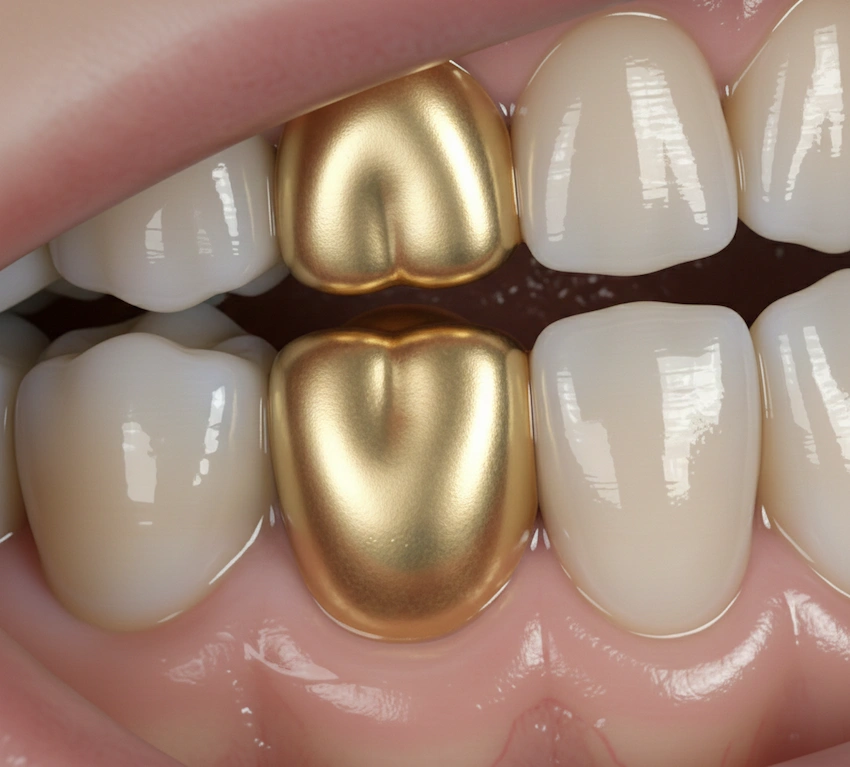
So the question is: is the appearance worth it? A lot of people are afraid of the “flash” of gold. But, in a regular conversation, a gold crown on the second or third molar is hardly noticeable. It’s like a secret engine under the hood of a luxury car – you don’t see it, but you surely feel the performance.
But let’s take a good look at durability. Many of our patients traveling to Turkey are looking for a “one and only” solution. At present, the crown made of ceramic may have a nice appearance, but when it breaks in seven years, then you are back in the chair. In most cases, a gold crown made by Lema experts is the last crown that the tooth will ever need.
FAQ: From Our Clinical Team to You
Definitely not. We use high-noble alloys, which are very stable. You cannot get a “tinny” taste or some kind of metallic interference with your favorite Turkish dishes.
Actually, the situation is quite the opposite. The reason is that gold permits an almost perfect fit at the gumline, and there are fewer microscopic spaces for bacteria to hide when compared to other materials.
Pure gold is very soft and is not suitable for biting. We use a high-noble alloy in which gold is combined with less precious metals like platinum or palladium so that it gets the “backbone” necessary to withstand the forces of your jaw’s chewing.
The price is largely determined by the market price of the precious metal and the special laboratory work required to cast it. However, if you consider that it may never need replacing, it is often the most economical choice over the long term.
Yes. If you want gold benefits but cannot stand the yellow color, we can make a high-noble white alloy for you. It resembles silver but it shares all the biological gold benefits.
- Anusavice, K. J., Shen, C., & Rawls, H. R. (2012). Phillips’ Science of Dental Materials. Elsevier Health Sciences.
- Christensen, G. J. (2002). In praise of gold restorations. The Journal of the American Dental Association, 133(11), 1531-1533.
- Donovan, T., & Simonsen, R. J. (2004). Gold restorations: the best kept secret in dentistry. Journal of Esthetic and Restorative Dentistry, 16(4), 199-200.
- Kelly, J. R., & Nishimura, I. (2008). Science-based guidelines for maximizing the service life of crowns. Journal of Prosthodontics, 17(7), 540-551.
- Richter, W. A., & Ueno, H. (1973). Relationship of crown margin placement to gingival inflammation. The Journal of Prosthetic Dentistry, 30(2), 156-161.

