


DIY dental diamond kits can damage enamel and cause tooth decay.
We all want a smile that captures the light. During the social media era of beauty, tooth ornaments have become fashionable again. But a local trend that worries us deeply here at Lema Dental Clinic is the increase in the usage of home kits for dental diamond insertion.
On a smartphone screen, it looks so easy. A little glue, a small stone, and a UV light. However, these kits never tell you about the microscopic level of destruction that is taking place right under the surface. The truth is your enamel isn’t a craft project; it is a protective shield of your teeth that is living and non-regenerative.
Why the “Easy” Application is a Lie?
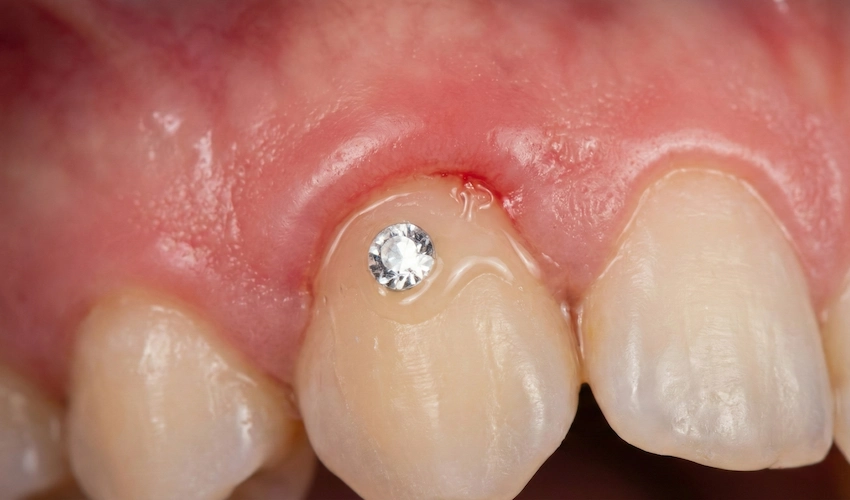
If you order a kit from the internet, you are not only buying jewelry but you are attempting a clinical procedure without clinical tools. Most of these kits contain industrial-grade adhesives. Just imagine the equivalent of using superglue on a delicate silk dress—the damage is immediate and most of the time it is permanent.
Professor Doctor Coşkun Yıldız points out that the biggest problem is not actually with the stone but with the “etching” that accompanies it. If you want a diamond to stay on, these kits use acidic solutions to roughen the tooth surface. At the dentist’s, we limit this to the micron level. If you do it at home? You are literally drilling a permanent “pothole” in your enamel which bacteria will quickly take advantage of.
Why is Getting a Professional to Do the Job So Important?
When you come to our clinic in Turkey, the whole procedure is executed in a completely different way. Dentist Polen Akkılıç and her team treat a tooth with the same care that a jeweler would give to a very precious gem. We apply medically-approved bonding agents which are both reversible and compatible with the human body.
However, let’s analyze the dangers to your body if you take the “do-it-yourself” path.
Hidden Clinical Risks
The question is: What exactly goes wrong when a DIY kit is used illegally? It’s not only a fallen stone situation. It’s a chain reaction of biological disorders:
- Enamel Decalcification: The area around a diamond gem with improper bonding turns into a “plaque trap”. If there is not a flawless clinical seal, particles of food and bacteria first exploit the space under the diamond and later they cause either white spots or deep cavities.
- Aspiration Risks: Since these kits employ cheap stones and low-quality adhesives, we have had a few cases where patients have swallowed or even worse, inhaled the diamond during their sleep because the glue didn’t hold.
- Permanent Scars: If the sparkle is no longer desired, there is a high possibility that removing the DIY gem will in fact leave a rough and yellowish spot where the industrial glue has stripped off the tooth’s natural shine.
Comparing the Approaches: DIY vs. Lema Dental Clinic
| Feature | At-Home DIY Kits | Lema Dental Clinic (Turkey) |
| Adhesive Type | Industrial/Craft Grade | Biocompatible Medical Resin |
| Enamel Impact | Uncontrolled Acid Erosion | Precision Micro-Etching |
| Longevity | Days to Weeks (Unstable) | Months to Years (Controlled) |
| Removal | High Risk of Fractures | Professional Polishing & Refinement |
| Health Check | None | Full Oral Screening Included |
The Art of the Safe Glow in Turkey
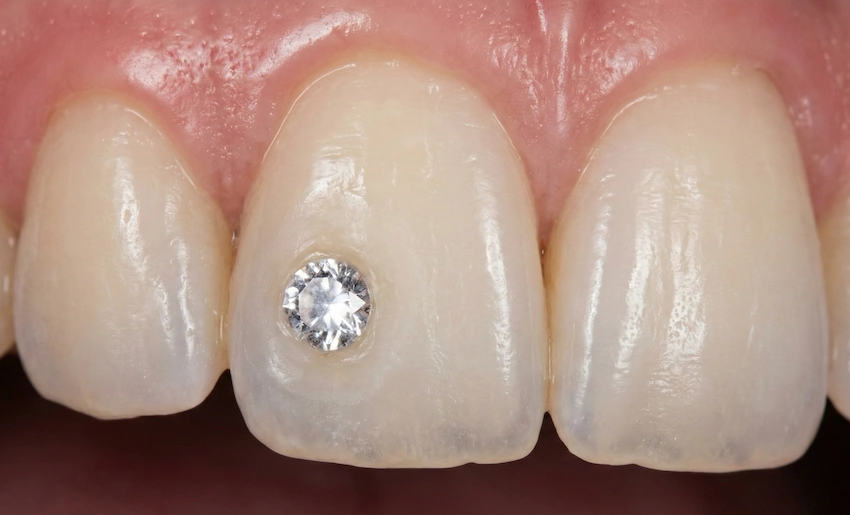
Hardly ever is there a “DIY” pack that delivers the best dental aesthetics to your doorstep. Instead, specialists who know inside out the anatomy of a smile hold the real keys. Once a patient comes to us in Turkey, we don’t simply “stick” a diamond on. We check thoroughly how the tooth (teeth) of the affected and opposite sides meet (occlusion) to prevent the wear or damage of the gem or the opposing teeth.
Dentist Polen Akkılıç highlights that a tooth gem should be something to boast about, not a health risk. Opting for a clinic to get the tooth gem you take the risk that the sparkle will last only a few days, but the good state of your teeth will be everlasting.
Frequently Asked Questions
Surely not. Nail glues have chemicals like cyanoacrylate that are very dangerous if ingested and can burn gums, and even the pulp that is still alive in a tooth can be damaged. We use only resins that are specifically designed for the oral environment.
Absolutely no! Imagine it as putting a contact lens on your eye but here, on your tooth. No drilling is necessary when the work is carried out by our team. It is a pain-free, non-invasive treatment that saves the structure of your tooth.
From our experience at Lema Dental Clinic, a properly-installed gem can last anywhere between six months and a few years. It mainly depends on your dental care and where the stone has been set. The coolest thing? We can take it off safely if you want a new look.
You should keep brushing as usual! Actually, we advise our patients to be more careful and thorough. Because the gem is a little bump, you have to make sure that no plaque is hiding around the edges. A professional bond makes this much easier than a messy DIY job.
As much as we offer top-quality service, a lot of patients consider the option of aesthetic treatments at Lema Dental Clinic to be very reasonable compared with getting them in the UK or the US. In addition to this, you can rest assured that the safety of Professor Doctor Coşkun Yıldız and our experts is guaranteed.
- Featherstone, J. D. (2008). Dental caries: a dynamic disease process. Australian Dental Journal, 53(3), 286-291.
- Pini, N. P., et al. (2009). Advances in dental adhesive technology. Journal of Applied Oral Science, 17(1), 9-17.
- Walsh, L. J. (2003). Clinical aspects of salivary biology for the dental clinician. International Dentistry South Africa, 7(2), 22-38.
- Terry, D. A. (2004). Adhesive restorative dentistry: A changing paradigm. Journal of Esthetic and Restorative Dentistry, 16(6), 335-336.
- Donly, K. J., & Godoy, F. G. (2002). The use of resin-based composites in contemporary dentistry. Dental Clinics of North America, 46(2), 299-311.

