


Tooth diamonds typically last several months to a few years with proper care.
How Long Do Tooth Diamonds Really Last?
At Lema Dental Clinic, this is what we witness daily: a patient comes in with the desire to add a little extra “brilliance” to their smile.
Tooth diamonds, also known as dental crystals, have evolved from a trend limited to a few to being a common feature in modern cosmetic dentistry. However, the most frequent question that we get asked in our consultation rooms in Istanbul is not “how,” but “how long?”
Actually, a tooth diamond is not just a piece of jewelry; it is an assurance to your dental surface. Understanding the duration of these gems is the first step to a successful change, whether you want a barely visible flicker or a very strong surface.
The Short Answer: What Is the Lifespan?
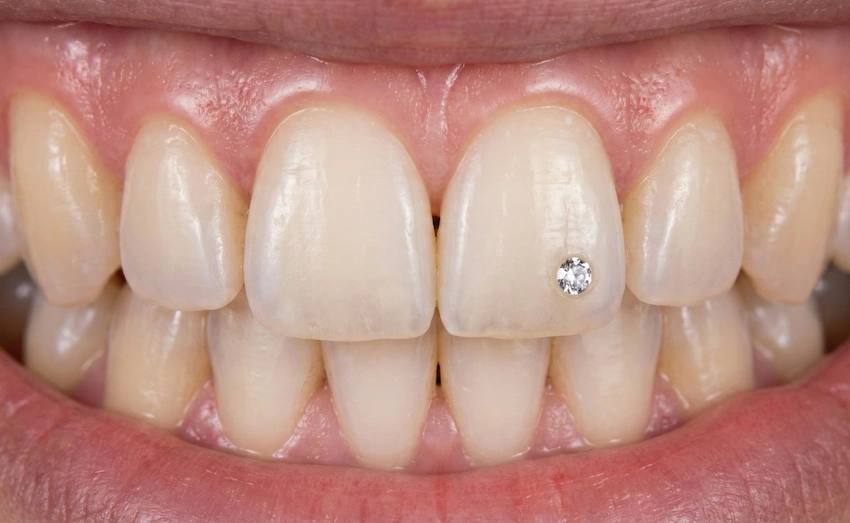
Our clinical experience suggests that a tooth diamond which is applied professionally can last from 6 months, to even a few years.
Why such a wide range? Simply because a tooth diamond is not cut into your tooth (at least not in the case of a good clinic). It is attached to the enamel, very much like an orthodontic bracket. Professor Doctor Coşkun Yıldız, among other things, points out that the durability of the attachment depends more on the “biological environment” of the patient’s mouth and their lifestyle, rather than the diamond itself.
What Determines the “Stay” Power?
There are quite a few variables that toss a rope of war against the glue securing your diamond:
- Method of Bonding: It is essential to use only top-quality dental composite for this purpose.
- Location: When the diamond is positioned very close to the biting edge of the tooth, the mechanical force of chewing will definitely make it come off.
- Oral Chemistry: It is the case with some people that their saliva is naturally more acidic, which can gradually wear out the bonding agent.
- Eating Habits: Directly biting into a hard apple or crusty bread may cause your diamond to have a shorter life.
The Lema Approach: Quality Over Everything
At Lema Dental Clinic in Turkey, Dentist Polen Akkılıç and her team treat tooth jewelry with the same precision as a porcelain veneer. We don’t believe in “quick fixes.” We use medical-grade primers and light-cured composites to ensure that your sparkle survives the test of time (and your morning coffee).
Understanding the Options
Not all tooth “bling” is created equal. Here is how the different options stack up:
| Type of Jewelry | Average Longevity | Attachment Method | Impact on Enamel |
| Swarovski Crystal | 6 – 12 Months | Surface Bonding | Zero (Reversible) |
| Real Diamond (Flat Back) | 1 – 3 Years | Professional Dental Bond | Zero (Reversible) |
| Gold Charms | 1 – 2 Years | High-Strength Composite | Zero (Reversible) |
| DIY Home Kits | 2 Weeks – 1 Month | Basic Glue | High Risk of Decay |
The Procedure: Like Hanging a Picture on a Wall
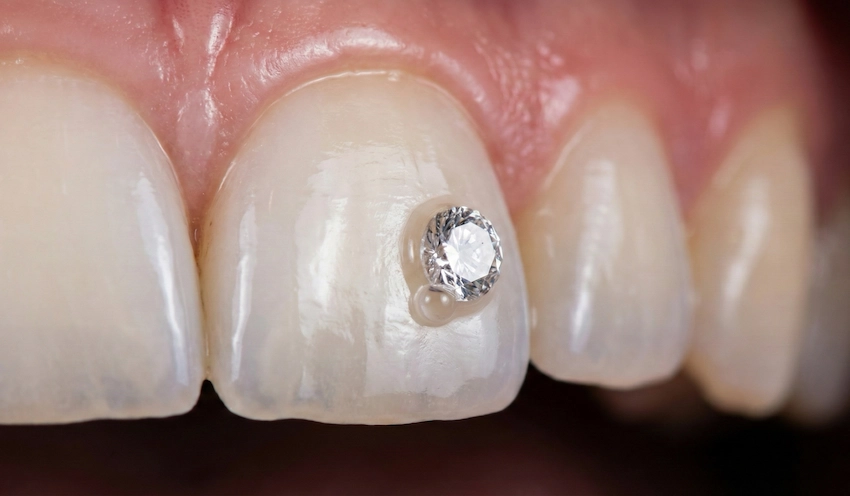
Imagine your tooth enamel being as beautifully polished marble wall. You certainly wouldn’t take a sledgehammer to hang a tiny photo. Similarly, we don’t drill holes in your healthy teeth.
We don’t do anything that could cause harm. We slightly “etch” the surface—just like very fine sandpaper is used to make the surface “grippy”—then we lay the medical adhesive, set the stone, and harden it with a special UV light. It’s no pain, quick, and, most importantly, it can be changed back to how it was.
Should next year come around and you feel like a change, all we do is polish off the stone, and no one will ever know.
Maintaining Your Sparkle: Expert Tips
However, if we dive into the details of how exactly you can increase the longevity of your diamond, the dentist Polen Akkılıç always gives three simple rules to our patients:
- Electric Toothbrushes Are Fine, But Don’t Be Rough: There’s no need to treat the diamond like a floor and scrub hard. Soft, circular motions are more than enough.
- Stay Away from “The Crunch”: Try not to use the tooth with a diamond to bite into hard candies or ice.
- Dental Cleaning by Professionals: Don’t avoid your dental exams. Besides checking the diamond’s integrity, we can also verify the bond in our Istanbul clinic during your regular cleaning.
FAQ: Direct Answers from Our Experts
No, not at all. We don’t drill or come near the nerve, so the level of discomfort is simply nil. I guess it can be compared to the small “sticker” you have on your finger that you barely notice.
Certainly! Formally trained, our hygienists know how to clean even tough spots around diamonds. In fact, it’s a good thing because sometimes plaque might hover around the edges of the gem.
Many people are still getting worried about this question but to be honest, it is an unfounded one. The diamonds we use are microscopic and 100% lead-free. A loose diamond that you end up swallowing will simply go through your body without causing any damage.
Definitely not. Immediately after a diamond falls off or gets removed, any leftover bonding material is carefully polished off so that the tooth surface is completely restored to its original state.
Sure, it can be done but the bonding technique that is suitable for porcelain is quite different from that for natural enamel. Inform us about your veneers to make sure that we can follow the correct porcelain etching procedure.
- Featherstone, J. D. (2008). Dental caries: A dynamic disease process. Australian Dental Journal, 53(3), 286-291.
- Horn, B. A., & Bloom, K. (2015). The evolution of cosmetic dentistry: From function to fashion. Journal of Aesthetic and Restorative Dentistry.
- Pini, N. P., et al. (2012). Advances in dental adhesion: A review. Journal of Applied Oral Science.
- Swift, E. J. (2011). Critical appraisal: Tooth jewelry. Journal of Esthetic and Restorative Dentistry, 23(6), 350-353.
- Walsh, L. J. (2003). Lifestyle dentistry: The shift toward cosmetic enhancement. International Dental Journal.

