


An orthodontic elastic is a small rubber band that helps guide your teeth and jaw into a better bite.
Braces move teeth that are placed incorrectly into a better position. Crooked teeth are aligned by them. If you have a crowded mouth, braces can bring order to it. Actually, braces can even close the unsightly gaps that you have tried to hide for years.
But if we think about a really healthy smile, it is more than just straight teeth. Having teeth that are straight doesn’t necessarily mean that your bite is functional. Your upper and lower jaws need to fit together perfectly. If they don’t, you still have an orthodontic problem.
That is why orthodontic elastics really matter.
Imagine your braces being the car’s steering wheel. They direct your teeth to the correct lanes. Elastics are the car’s engine. They give the constant, focused pulling power. This power moves the whole jaw into the ideal position.
The Engine of Your Smile
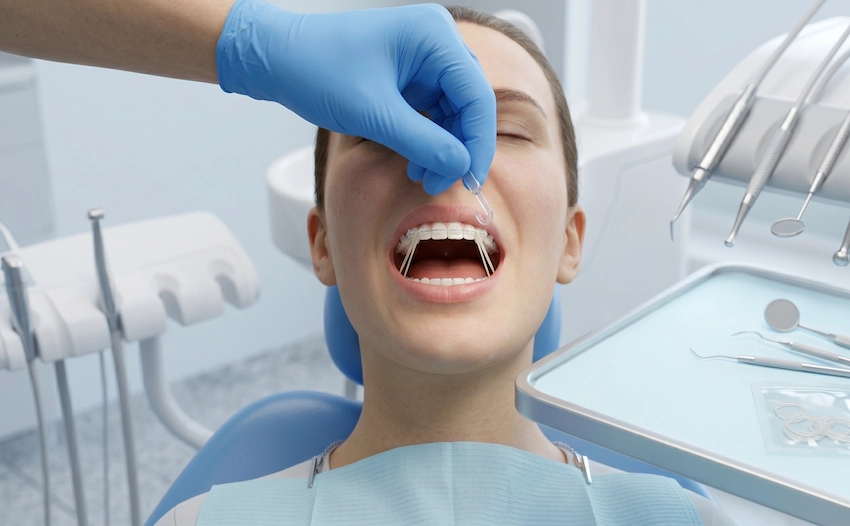
Generally speaking, quite a few of our patients seem to be quite taken aback when they are handed a very small packet of rubber bands. These bands are not the usual ones you find in an office. They are medical-grade bands. Very carefully and precisely, we use them to deliver exact pressure.
Working at the Lema Dental Clinic, our clinical practice experience shows that elastics constitute the critical moment in your treatment. Professor Doctor Coşkun Yıldız, a big part of our team, has just recently reminded us of an elementary fact. The extent to which patients follow instructions about using these tiny bands is the single largest determinant of their success. They make the difference between a “good enough” result and a perfect, lifelong smile.
Why Do We Use Them?
The first question that prompts is what the function of using orthodontic elastics is in the first place? When the upper and lower jaws are healthy, they are perfectly formed to interlock with each other,r just like two pieces of a puzzle fitting together. A lot of problems may arise if there is a mismatch. The teeth could become excessively worn over time. Jaw pain may be experienced not only at night but also in the daytime. Speaking or eating difficulties may also be experienced.
This is what usually happens at the clinic. Dentist Polen Akkılıç and her team, when they perform an analysis of the patients who will be traveling to Turkey to have an orthodontic treatment, make a bite classification the initial point of their discussion. Elastics are the ones that will correct these problematic bites. They do this by just pulling the jaw in the direction it needs to work.
Common Types of Elastic Wear
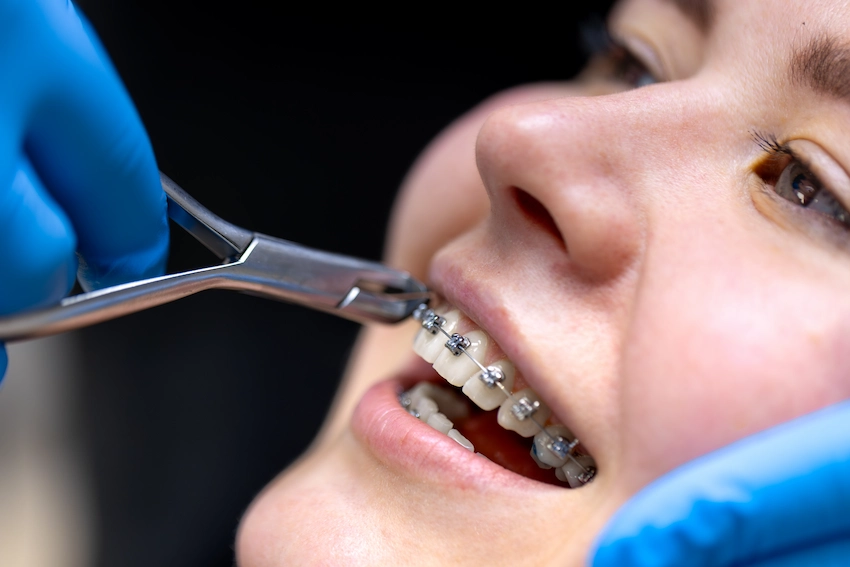
Various types of bite issues require diverse shapes of elastics. Your clinical team will teach you exactly at which points you should attach your elastics/bands.
| Elastic Type | Primary Goal | Force Direction | Daily Wear Time |
| Class II | Corrects Overbites | Pulls the lower jaw forward | 12-24 hours |
| Class III | Corrects Underbites | Pulls the upper jaw forward | 12-24 hours |
| Vertical | Closes Open Bites | Pulls upper/lower teeth together | 12-24 hours |
| Crossbite | Shifts Midline | Pulls jaw sideways | 12-24 hours |
Frequently Asked Questions
It is quite normal to notice a dull pressure the very first time when a band is put on. It’s just a sign that elastics are effective. The discomfort should be minimal and subside in a couple of days as the pressure is adjusted to the jaw.
To maintain the pulling power of elastics, you must replace them every 3-4 hours,s since with each usage the band loses its force. You should therefore change them after you have eaten and right before bedtime to provide a strong force.
Well, it’s always a matter of personal preference when choosing what to do with your bands during meal time. We firmly suggest that you should not have them on while eating. Chewing will stretch them, potentially causing snapping or a change in shape. Remove them, have your meal, brush your teeth, and put fresh bands on.
Please try to stay calm. Elastics are tiny and made from safe, non-toxic materials. Thus, if you happen to swallow one,ne it will simply pass naturally through your digestive system. Just get a new one and put it back on your teeth.
The answer is no. It is extremely dangerous to apply extra force. Excessive force can actually cause damage to the roots of teeth and the bone, resulting in slower progress. So, only use the force that has been prescribed to you.
- Proffit, W. R., Fields, H. W., & Sarver, D. M. (2018). Contemporary Orthodontics (6th ed.). Elsevier.
- Nanda, R. (2015). Biomechanics and Esthetic Strategies in Clinical Orthodontics. Saunders.
- Jones, M. L., & Oliver, R. G. (2000). Walther and Houston’s Orthodontic Notes (6th ed.). Wright.
- Uribe, F., & Nanda, R. (2003). Treatment of Class II, Division 2 malocclusion in adults: biomechanical considerations. Journal of Clinical Orthodontics, 37(11), 599-606.
- Graber, T. M., Vanarsdall, R. L., & Vig, K. W. L. (2016). Orthodontics: Current Principles and Techniques (6th ed.). Elsevier.

