


If a tooth gem falls out, see a dentist to clean and rebond it safely.
That’s a very specific type of panic. Maybe you’re having dinner, or brushing your teeth, and all of a sudden, your tongue moves over a tooth and feels a hole there. The sparkle is no longer present. What was a smooth surface has now changed into a rough area of adhesive.
At Lema Dental Clinic in Turkey, we experience this situation quite frequently. Even though tooth gems, which are technically dental jewelry, are a wonderful, non-invasive way to brighten up the smile, they are not permanent like veneers or implants. They are attached to the enamel, just like an orthodontic bracket. Similarly to a bracket, if you apply enough force, you can detach it.
Therefore, the gem is off. What now? Let’s analyze the situation from a medical perspective and distinguish the myths from the clinical facts that we encounter daily.
Scenario 1: You Swallowed It (The Most Common Outcome)
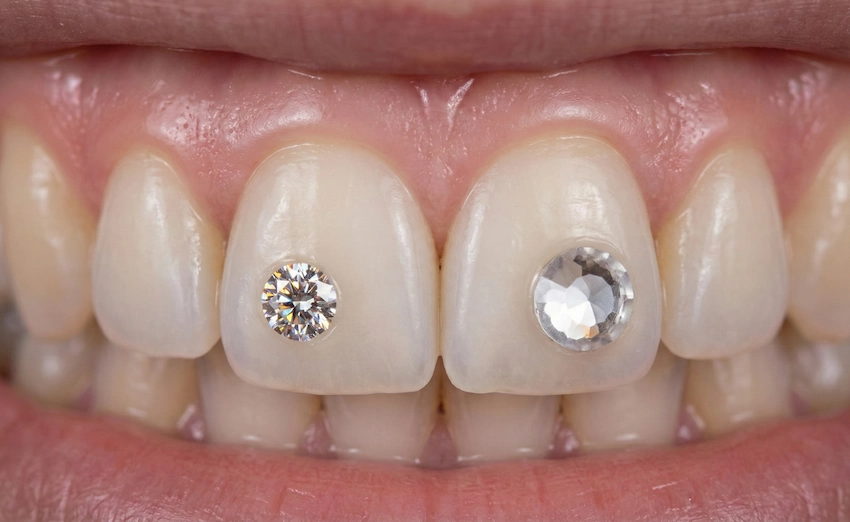
Most of the time when a gem ccomesoff hhile eating, you end up swallowing it unconsciously. The first reaction is usually fear. What if it is poisonous? What if it hurts my insides? But the truth is less heroic.
Dental jewels, especially the good quality crystals or 22k gold ones which we use, are very tiny. Their edges, although well defined, are hardly ever sharp enough to cause a hole in the digestive tract. Think of it as if you are swallowing a cherry seed or a tiny seed. Your digestive system is very strong. Practically, without exception, the gem will be eliminated naturally through your intestine within a day or two without any symptoms or harm. However, there is a “Red Flag” exception.
You might have a serious problem if the gem was inhaled by you (aspirated). If suddenly coughing, shortness of breath or wheezing occur contact the doctor immediately after the disappearance of the gem. This means that the object is in the airway not in the stomach. Luckily, this is extremely rare.
Scenario 2: The Leftover “Rough Patch”
After the initial shock of “where did it go” fades away, you are left with the real consequences on your tooth.
Dentist Polen Akkılıç and her colleagues frequently tell the patients that the gem generally gets separated from the adhesive, not the tooth itself. So, there would be a little, uneven, composite resin spot left on your enamel. It isn’t painful but definitely feels uncomfortable—like a piece of food which is permanently stuck on the tooth or a pebble in the shoe which you can’t get rid of.
Here is the important rule: Don’t try to scrape it off with metal instruments, tweezers, or nail files.
We have witnessed people injuring their tooth surface because of trying to “clean up” the place in the comfort of their home. Even though enamel is the hardest material in the human body, it is just as brittle. Making scratches on it with non-dental tools can lead to micro-fractures resulting in hypersensitivity and caries.
The “Superglue” Trap: A Warning from Prof. Dr. Coşkun Yıldız
When it comes to a scenario where you have managed to keep the gem, your brain will likely be tempted to think about gluing it again by yourself. And you might consider the thought to be like, “It’s only a tiny spot of super glue, so what’s the damage?”
Professor Doctor Coşkun Yıldız states without hesitation: Don’t get household adhesives anywhere near your mouth, especially if they’re not made for it.
Cyanoacrylate (superglue) is not only toxic when ingested in liquid form but it isn’t formulated for the mouth’s moist, bacteria-laden environment. It can result in the death of pulp tissues if the enamel is thin, cause gum necrosis and spell major trouble for the removal later by a professional. What used to be a simple 5-minute task of polishing would turn into a complicated restoration.
The Fix: Professional Replacement in Turkey
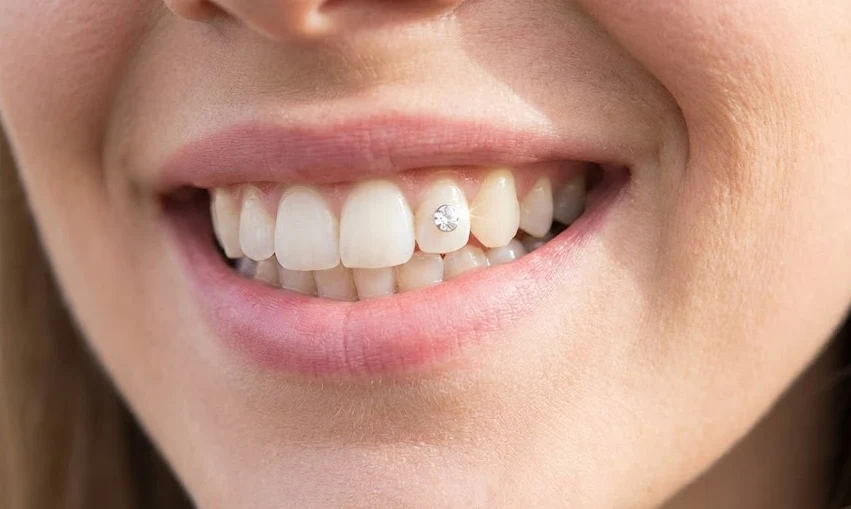
When a gem comes off unexpectedly, your best and safest option is a dental chair.
At Lema Dental Clinic, re-bonding a lost gem is a simple and painless procedure:
- Removal: We employ a special polishing bur to carefully remove the old adhesive residue without damaging the natural enamel layer.
- Etching: The surface is once more prepared with a mild acid gel to let the new bond create microscopic ‘hooks’ for the adhesive.
- Bonding: We place a new gem or the one which is high-value diamond or gold piece again (if it happens to be the old one), using a flowable composite (which is the same material as fillings) as the adhesive.
When our international patients come to Turkey for major treatments, they sometimes introduce this service as a finishing touch. It’s fast, secure, and instantly restores the look.
Comparison: DIY vs. Professional Repair
| Feature | DIY Fix (Superglue / Home Kit) | Lema Dental Clinic Professional Fix |
| Adhesive Used | Toxic cyanoacrylate (superglue) | Biocompatible dental composite |
| Risk to Enamel | High risk of chemical burns and surface damage | No risk; protective bonding protocol used |
| Longevity | Lasts days to weeks | Lasts 6 months to 1+ year |
| Hygiene | Traps bacteria; increases decay risk | Sealed margins; easy to clean |
| Outcome | Cloudy, uneven appearance | Clear, sparkling, seamless finish |
FAQ: Advice Directly from the Clinic
Absolutely, if the gem is a valuable one like genuine gold or a diamond. In such a case, we can re-bond it after sterilization in an autoclave. But it was only a simple crystal or glass stone, the backing will certainly be broken. Then, you should take a new one to ensure its adherence.
Not necessarily. Imagine a tooth gem as an acrylic nail—it’s a temporary adhesion. Biting into a hard apple, chewing ice, or even the natural acidity of your saliva over time can weaken the bond. Those things are the cons that come with the benefit of not getting a hole in your tooth to be able to set it.
The answer is no. No drilling is done here. There is a similarity in the sensation atothat of when an electric toothbrush vibrates. We are only polishing the surface to be smooth again.
Sure, not only is it good. Plaque loves to accumulate around rough surfaces. And so, before a trip to our clinic in Turkey or the local dentist, it is critical that this spot receives your extra attention in terms of oral hygiene to avoid decay from starting under the old adhesive.
Based on our experience in Lema Dental Clinic, usually, a gem properly attached is expected to stay on for 6 to 12 months, sometimes even more. If it fell out within a couple of days, it might have been a problem with the bonding or bite alignment.
- Al‐Jandan, B. A. (2020). Dental jewelry: A review. The Saudi Dental Journal, 32(3), 109-115.
- Guron, S., & Chandorkar, S. (2021). Tooth Jewellery: A Sparkle of Smile. International Journal of Science and Healthcare Research, 6(2), 25-29.
- Kupietzky, A., & Waggoner, W. F. (2002). Parental knowledge and attitudes regarding dental jewelry. Pediatric Dentistry, 24(5), 405-408.
- Mondal, S., & Bhowmick, S. (2019). Dental Jewelry: A Review. International Journal of Advanced Research, 7(5), 62-65.
- Ramison, J. (2018). Foreign Body Ingestion and Aspiration in Dentistry: Prevention and Management. Journal of the California Dental Association, 46(10), 653-657.

