


Gray, black, or dark yellow.
Our teeth are generally thought to be unchanging, hard substances – similar to pearls that are embedded in our jaw. However, this is a misunderstanding. A healthy tooth is a complex, living organ, teeming with nerves and a dedicated blood supply in its core, known as the pulp. In our clinical experience at Lema Dental Clinic, patients are often alarmed when they notice one tooth standing out from the rest, not because of its shape, but because of its color.
A shift in tooth shade is rarely just cosmetic; it is usually a biological distress signal. When a patient arrives at our clinic in Turkey with a discolored tooth, we don’t just look at the surface; we investigate the life force within.
The Mechanism of a “Power Outage”
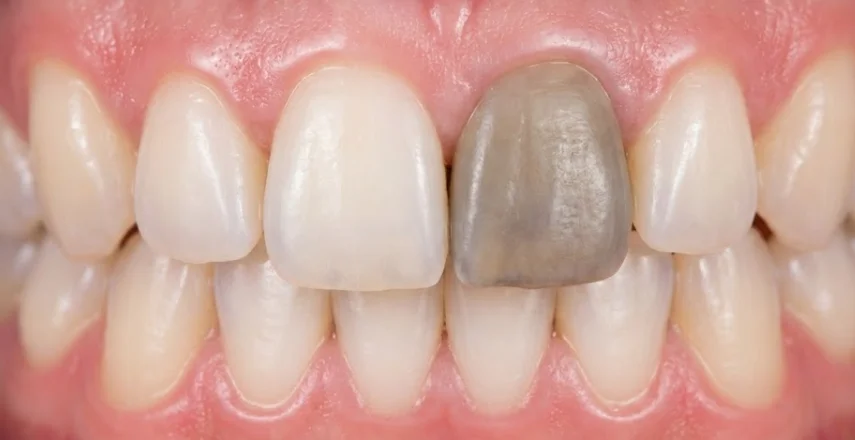
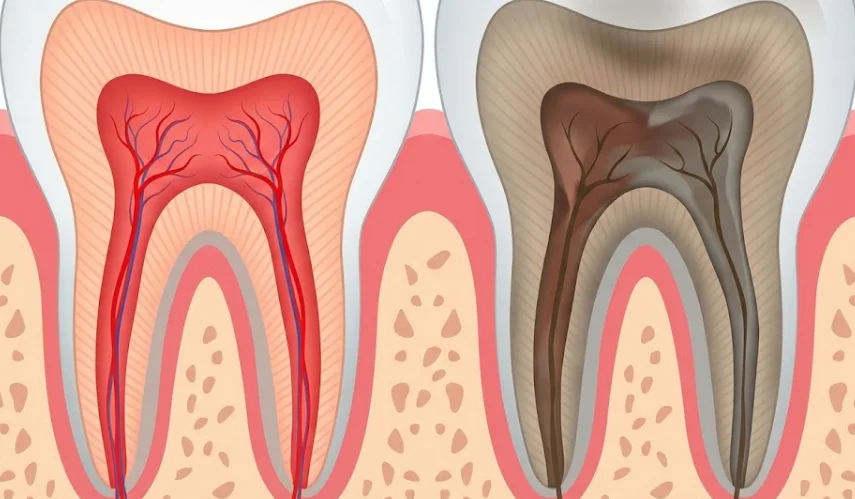
To understand the changes in tooth color, a figure for tooth vitality is required. A healthy tooth may be compared to a well-lit house where active blood circulation is responsible for the warm glow. When the light goes out in a house, the “dying” or necrotic tooth is the one that has lost its life support system.
One of the things Professor Doctor Coşkun Yıldız regularly points out is that the pulp of a tooth can be damaged in several ways: deep decay, a strong impact to the mouth, or chronic grinding. As a result, the blood vessels will either burst or be cut off. A tooth is deprived of the body’s resources in the same way as a person being “cut off” from the world by having no contact with it. The blood is no longer coming from outside, so the innermost layer of the tooth dries up and dies.
The Spectrum of Decay: Why Color Shifts Happen
The color a dying tooth turns is not random. It tells us a story about what is happening internally. The change happens because red blood cells inside the pulp break down, releasing iron and other pigments that seep into the surrounding dentin (the layer beneath your enamel), permanently staining it from the inside out.
The “Bruised” Phase (Pink or Reddish)
Sometimes, immediately after a traumatic injury, a tooth may appear slightly pink. This is essentially internal bleeding, similar to a bruise under a fingernail. In some rare cases, if the trauma wasn’t severe, this can reverse. However, it is often the first stage of the tooth losing its vitality.
The Necrotic Phase (Gray, Dark Yellow, or Black)
This is the most definitive sign we see. As the nerve tissue decomposes, the tooth will begin to look duller than its neighbors. Over weeks or months, this dullness progresses into distinct shades of gray, slate blue, or deep, muddy yellow.
The reality is, the darker the tooth gets, the longer the nerve has likely been dead. In advanced cases where infection has set in for a long time, the tooth can appear nearly black.
Beyond the Color: Other Red Flags
While color is a primary indicator, a dying tooth often provides other warnings. Yet, this is where it gets tricky. Dentist Polen Akkılıç and her team frequently diagnose necrotic teeth during routine examinations in patients who feel absolutely no pain.
A tooth can die slowly and silently. The nerve may wither away without ever sending a strong pain signal. However, you should also watch for:
- Lingering Sensitivity to Heat: If drinking hot coffee causes a deep ache that lasts for minutes after you swallow, it suggests the nerve is irreversibly damaged.
- The “Dental Pimple”: A small, sometimes recurring bump on the gums near the tooth root. This is an abscess, indicating the dead nerve has caused a chronic infection in the jawbone.
- Pain on Biting: Pressure makes the tooth feel “taller” or sore compared to others.
Comparison: Healthy vs. Dying vs. Dead Tooth Signs
| Feature | Healthy Tooth | Dying Tooth (Pulpitis) | Dead Tooth (Necrosis) |
| Color | Consistent, creamy white/translucent hues | Normal or slight pink/gray tint | Distinct gray, dark yellow, or black |
| Temperature Response | Brief, mild sensation to extreme cold | Sharp, lingering pain (esp. to heat) | No sensation at all (cold test negative) |
| Pain Level | None | Intermittent to severe, throbbing | Often none, unless abscess forms |
| Infection Risk | None | Moderate | High (spreads to jawbone) |
Treatment Options in Turkey: Saving Structure vs. Removal
One that has changed color to gray will be impossible for a tooth to become natural again, and it will not “heal” either.”
The decayed pulp in the tooth serves as a source of bacteria that could eventually infect the bone of the jaw through the bacteria’s spread.
At Lema Dental Clinic, our priority is always to save the natural tooth structure when feasible. If the root structure is sound, Root Canal Therapy is the gold standard. We clean out the dead tissue, sterilize the inside of the tooth, and seal it. Because a root-canaled tooth is brittle and still discolored, we almost always cap it with a high-esthetic Zirconia or E.max Crown to restore both strength and a natural white appearance.
If the tooth is fractured or the infection is too extensive, extraction followed by a Dental Implant is the best long-term solution to protect your oral health.
FAQ: Expert Answers to Patient Questions
Dentist Polen Akkılıç: Absolutely. A gray tooth means the nerve is dead. Just because you don’t feel pain right now doesn’t mean there isn’t an active infection brewing at the root tip in your jawbone. Silent infections can become dental emergencies very suddenly.
The Lema Clinical Team: Unfortunately, no. External whitening works on surface stains on the enamel. The gray color of a dying tooth comes from inside the tooth structure (the dentin). External bleaching will make the enamel more translucent, which might actually make the gray, dead center look even more prominent.
Professor Doctor Coşkun Yıldız: It varies significantly. Sometimes it happens within a few weeks of a trauma. Other times, it’s a very slow, gradual process over many years. You might not notice the daily change until you look at an old photograph and realize how much darker the tooth has become.
The Lema Clinical Team: This used to be common decades ago due to the materials used. However, modern root canal techniques used in our clinic in Turkey utilize materials that do not stain the teeth. Furthermore, we typically place a crown afterward, ensuring a perfectly white aesthetic.
Dentist Polen Akkılıç: Trauma isn’t always a baseball to the face. It can be subtle. Chronic teeth grinding (bruxism) puts immense pressure on the nerves over time. Sometimes, a tooth that had a deep filling years ago may eventually succumb to the past irritation. The nerve simply “gives up” years later.
- Abbott, P. V., & Yu, C. (2007). A clinical classification of the status of the pulp and the root canal system. Australian Dental Journal, 52(s1), S17-S31.
- Bocognano, F. (2021). Discoloration of Teeth Following Traumatic Dental Injuries: A Review of Mechanisms and Clinical Management. Dentistry Journal, 9(9), 103.
- Garg, N., & Garg, A. (2013). Textbook of Endodontics. Jaypee Brothers Medical Publishers.
- Ingle, J. I., Bakland, L. K., & Baumgartner, J. C. (2008). Ingle’s Endodontics 6. BC Decker.
- Plotino, G., Buono, L., Grande, N. M., Pameijer, C. H., & Somma, F. (2008). Nonvital tooth bleaching: a review of the literature and clinical procedures. Journal of Endodontics, 34(4), 394-407.

