


The three types of dental handpieces are high-speed, low-speed, and surgical handpieces.
Understanding the Three Main Dental Handpieces
What attracts your attention first when you take a seat in the dental chair at Lema Dental Clinic in Turkey is probably not the decoration or the beautiful view of Istanbul but the very sound.
That familiar “whirr” is what you hear when a dental handpiece is running. To an untrained ear, it is just the noise of a machine. To us, on the other hand, it is the sound of precision.
Professor Doctor Coşkun Yıldız constantly reminds people that a surgeon’s performance depends on the quality of the tools he uses. A handpiece in the area of an advanced restorative dental treatment is considered the main tool of the dentist’s hand. Our decisiononf an instrument plays a crucial role in the success of a treatment whether a tooth is prepared for a veneer or a complex oral surgical procedure is done.
Essentially “the drill” is not just one tool. It is a sophisticated family of instruments designed for very specific purposes. Here we will talk about dental handpieces that have become indispensable in clinical practice today.
1. High-Speed Air-Driven Handpieces: The Speed Demons
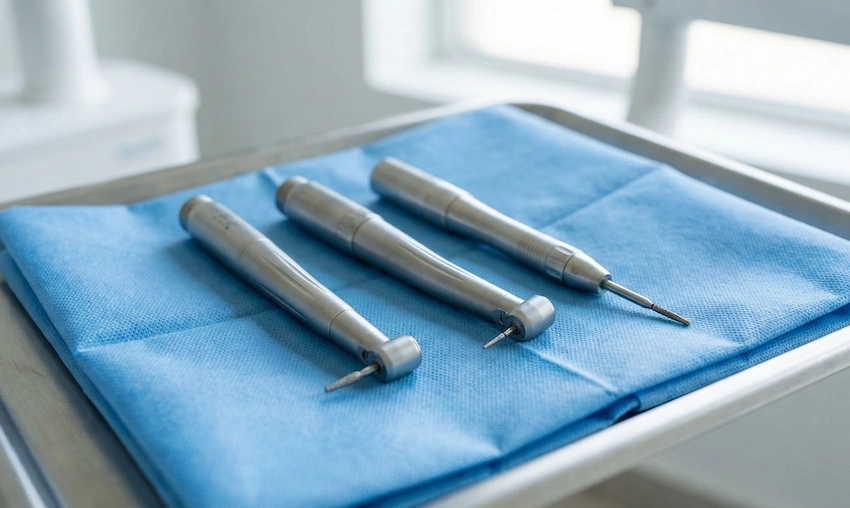
Imagine high-speed air-driven handpieces compared to a high-performance sports car. These handpieces can run at amazing speeds, over 400,000 RPM (revolutions per minute).
It is because of the capability of the high-speed air-driven handpieces that we mostly use them at Lema Dental Clinic for the major destructive work. Such work requires power and water besides a bulk of energy to remove, for example, old, hardened enamel, or cut through a failing metal crown. These tools rotate at such a high speed that they produce a lot of heat; this is why during the treatment you constantly experience water mist. Water in this case does not only serve as a cleaning agent but more basically it functions as a radiator to prevent the pulp inside the tooth from being damaged by the heat created.
Close-up, high-resolution image of a high-speed dental handpiece made of stainless steel. From the head of the instrument the water spray forms a fine mist that illuminates the diamond-tipped bur while it is rotating at very high speeds.
2. Low-Speed (Slow-Speed) Handpieces: The Sculptor’s Chisel
So a high-speed handpiece would stand for a sports car and a low-speed handpiece for a skilled craftsman. Normally, such a tool will rotate at 5,000-40,000 RPM.
Lowering the speed instead of going fast, why so? It is all about feeling the texture of the stuff you are working with. For example, when Dentist Polen Akkılıç and her team decide to get rid of soft decayed tissue (caries) or polish a completed composite resin, they must be able to discern the resistance of the tooth structure. A high-speed tool would be too aggressive; it may cause the removal of healthy bone or enamel.
Among the uses of low-speed handpieces are the following:
- Finishing the crown prep margins.
- Polishing your new smile to the highest level.
- Prophylaxis procedures.
3. Electric Handpieces: The Modern Powerhouse
Air-driven tools have been the most popular ones in the market for years and years but the question remains: can the peripherals be more in harmony? In this case, electric handpieces can be very helpful.
The difference between air-driven and electric handpieces is that the former can lose momentum when running into a hard surface (just as a car loses momentum when it goes uphill and the speed decreases), whereas the electric motors produce the same torque all the time. This results in the speed being constant no matter what the material is. The patient experiences less vibration and the sensation is quieter, “smoother”.
Electric handpieces have, in fact, been our clinical tool choice, when it comes to delivering the highest marginal integrity.
We have found that the rotation of an electric motor, which is consistent and does not waver, facilitates the transition between the tooth and the ceramic bridge; thus, the fit of the restoration is perfect.
Comparing the Technology: At a Glance
| Feature | High-Speed (Air) | Low-Speed (Air) | Electric Handpiece |
| Speed Range | 250,000 – 400,000+ RPM | 5,000 – 40,000 RPM | Up to 200,000 RPM (High Torque) |
| Primary Use | Enamel removal, crown cutting | Decay removal, polishing | Precision prepping, heavy cutting |
| Noise Level | High (Whistling sound) | Low (Grinding sound) | Very Low (Humming sound) |
| Precision | High for bulk work | High for finishing | Highest overall accuracy |
| Heat Control | Critical (Water spray) | Low heat generation | Controlled via internal cooling |
Why Is This Technology Important for You in Turkey?
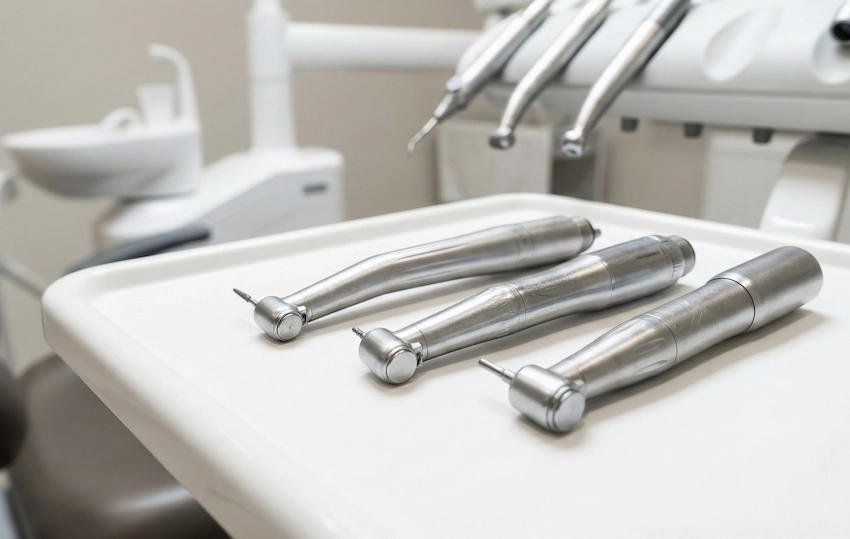
Is it a patient’s concern to understand what goes into a drill? Here is what we witness in the clinic: improved instruments result in quicker operations, reduced post-operative pain, and longer-lasting dental restorations. At Lema Dental Clinic, we have invested in the most recent electric and high-speed technologies to not only shorten your time in the chair but also enhance the quality of the “seal” on your dental work.
Common Questions About Dental Handpieces
The main reason for this sound is the air turbine rotation of the dental drill at hundreds of thousands of revolutions per minute. It is the movement of air that is producing the noise, similar to a small jet engine. The high volume can be alarming, but it is the turbine that enables us to work on your tooth with very little pressure.” — Dentist Polen Akkılıç.
No way! To be precise, by using high-speed and electric handpieces, we hardly exert any pressure on the tooth. We let the diamond-coated tips perform the job. While the vibration may feel strange, it is actually a very gentle treatment.
The water is being used as a coolant for your tooth. The instruments are rotating at such a high speed that they generate friction. The water bathes the tooth and keeps the heat from rising, so your tooth nerve stays healthy and unharmed during the operation.
Not really, it is more of a distinction. For precision I go for electric mainly because it is less vibratory. It makes the whole situation calmer for you and more precise for me.
Here at Lema we don’t start any work on the tooth before you are totally numb. You will experience the ‘sensation’ of the movement and water spray but you should not get any sharp pain. We walk with your steps.”
- Al-Zubidi, M. I., & Al-Hashimi, A. (2022). A Comparative Study of Air-Driven vs. Electric Handpieces in Fixed Prosthodontics. Journal of Clinical Dentistry & Research.
- American Dental Association (ADA). (2024). Dental Units and Handpieces: Safety and Efficacy Standards.
- Brockhurst, P. J. (2021). The Mechanics of High-Speed Dental Cutting. International Journal of Prosthodontics.
- Siegel, S. C., & von Fraunhofer, J. A. (2023). Torque and Speed Stability in Modern Electric Dental Motors. Clinical Oral Investigations.
- Yıldız, C. (2025). Advanced Instrumentation in Turkish Dental Clinics: A Case Study on Patient Comfort. Istanbul Medical Journal.

