


Fixed full arch dental implants replace all teeth with a fixed, implant-supported bridge.
Fixed Full Arch Dental Implants: Your Guide to a New Smile
Tooth loss is not only a matter of a missing part of your smile, but also a gradual decline in self-esteem and the loss of a great meal. For a long time, the only real solution was a removable denture—a lot of times it was more of a give-up than a real solution.
The truth is, conventional dentures are prone to slipping and clicking, and they can also restrict your diet. This is the point where fixed full-arch dental implants re-establish the story. At Lema Dental Clinic in Turkey, we believe this treatment is where highly advanced technology meets the art of biology. It is not just “getting new teeth.” It is bringing back your facial aesthetics.
What Exactly Is a Fixed Full-Arch System?
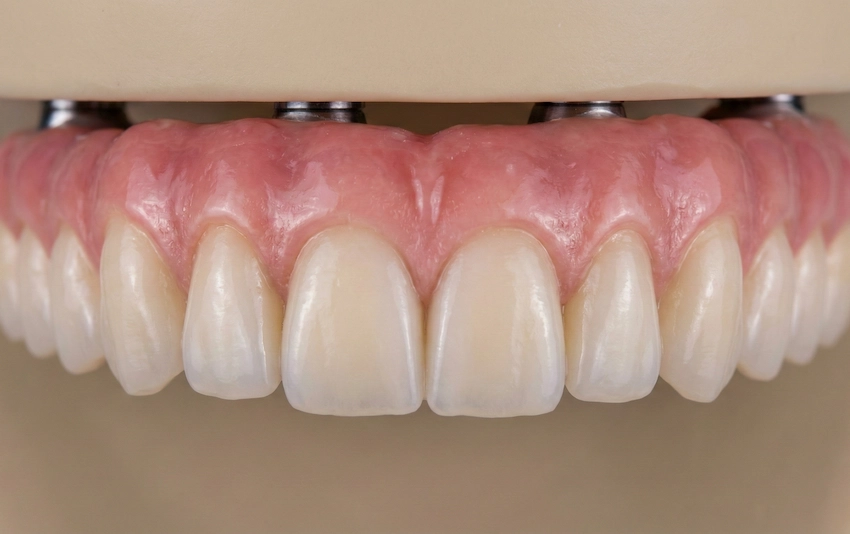
Imagine your jawbone as the base of a house. As soon as you lose your teeth, that base starts becoming frail since it doesn’t have any more “roots” to keep it stimulated. A fixed full-arch restoration inserts four to six titanium “pillars” (implants) in the bone at the right spots.
The implants serve as an anchor for a tailor-made permanent bridge which replaces an entire set of teeth. Unlike dentures, these are fixed. They are not removable at night and are put in a glass of water; they stay in the mouth operating just like natural teeth.
Professor Doctor Coşkun Yıldız frequently reminds our patients that the ambition is not just to have beautiful teeth but also have the biting force correctly spread so that the jaw remains healthy for many years.
The Advantages of a Fixed Over a Removable One
The question is still there: why make an operation out of it since a removable plate is quicker? The truth is in the enjoyment of living.
At Lema, Dentist Polen Akkılıç and her team do not simply focus on a mold when designing a full-arch bridge. They consider your way of speaking, your lip support, and how you smile. Since the bridge is attached to the implants, it is less bulky than a denture. It does not cover the roof of your mouth which means that you can enjoy the taste of your food again.
But let’s look closer at the technical differences:
| Feature | Removable Dentures | Fixed Full-Arch Implants |
| Stability | May slip or shift while speaking | Fully anchored; zero movement |
| Bone Health | Accelerates bone loss due to pressure | Stimulates bone, preventing recession |
| Taste & Sensation | The palate is covered; reduced taste | Open palate; natural sensation |
| Maintenance | Daily removal and soaking | Brush and floss like natural teeth |
| Durability | Needs replacement every 5-7 years | Can last a lifetime with proper care |
The Lema Experience in Turkey
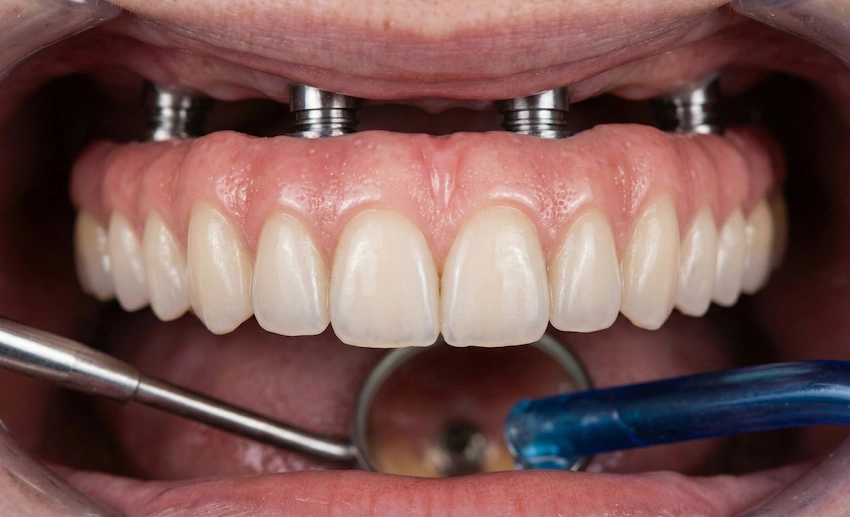
Planning dental treatment in Turkey from abroad is an important choice. We witness at the clinic that patients are initially doubtful and completely changed at the end. With the help of sophisticated digital scanning and 3D imaging, our specialists make sure that each implant is set accurately to the nearest millimeter.
It is a teamwork procedure. Professor Doctor Coşkun Yıldız, who is a top surgeon, handles the surgical aspect of the implant placement whereas Dentist Polen Akkılıç works on the aesthetic aspect of the teeth and makes them look like the real ones. We get used to high-quality zirconia or porcelain, the characteristics of which are the same as those of real enamel in terms of translucency.
Frequently Asked Questions
This is something we hear quite regularly. You will not feel pain during the operation as local anesthesia or sedation is used. The pain after the operation is similar to a normal tooth extraction and most patients find that pain killers bought over the counter are enough for them. At the same time we make sure you are relaxed and attended to.
Generally, the process includes two visits. The first visit suffices for the insertion of the implant as well as the setting of a temporary bridge, which is of good quality, so that you will leave the clinic with teeth. You will then come for your final set of “permanent” teeth. The duration of these two visits usually amounts to 5 to 7 days each.
Health, rather than age, is usually the deciding factor. If you are good enough healthwise for a routine tooth extraction, you are most probably a good candidate for implants. There is no shortage of examples of us giving new smiles to patients who are over 80 years of age.
You will be surprised how easy it really is! You simply don’t take them out. Twice a day, you brush them just as if they were your natural teeth. In addition to this, we suggest that you use something like a Waterpik (water flosser) to disinfect the portion between the bridge and the gum line.
Many people wrongly believe that a lower price naturally indicates cheaper quality. However, it is the truth that the low prices allowable by the low standard of living, low operating expenses, and exchange rates going in your favor enable Lema Dental Clinic to provide you with high-tech equipment and top-quality materials at a cost that is only a small fraction of what it would be if you compare it with those in London or New York.
- Malo, P., de Araújo Nobre, M., Lopes, A., Moss, S. M., & Molina, G. J. (2011). A longitudinal study of the survival of All-on-4 implants in the mandible and maxilla: up to 10 years of follow-up. Journal of the American Dental Association.
- Babbush, C. A., Kutskut, A., & Brokloff, P. (2011). The All-on-Four immediate function treatment concept with Brånemark System TiUnite implants. Implant Dentistry.
- Gallucci, G. O., Ducharme, P., Adam, R. M., & Weber, H. P. (2014). Clinical outcomes of fixed full-arch implant-supported prostheses. International Journal of Oral & Maxillofacial Implants.
- Yılmaz, B., & McGlumphy, E. A. (2011). A comparison of direct and indirect impression techniques for fixed full-arch implant-supported prostheses. Journal of Prosthetic Dentistry.
- Agliardi, E., Clericò, M., Ciancio, P., & Romeo, D. (2010). Immediate loading of full-arch fixed prostheses supported by axial and tilted implants for the treatment of edentulous maxillae. Journal of Oral and Maxillofacial Surgery.

