


Bottom gold teeth are gold restorations on lower teeth, chosen for durability or bold style.
What Are Bottom Gold Teeth?
Gold was never merely one among other metals. Even in the field of dentistry, it has been the standard for other materials for an extended time. We are presently witnessing a revival of interest in golden teeth at the bottom as the world gets fixated on whitening their teeth with ceramics. Whether it is a single restorative crown or a full set of “Grillz” fashion, gold combines exceptional high fashion and supreme biological compatibility.
We at Lema Dental Clinic in Istanbul welcome people from every corner of the world who wish to combine the toughness of this “old-world” concept with the precision of today. But what are they exactly, and are they the right choice for your bottom arch?
The Anatomy of Choice: What Exactly Are “Bottom Gold Teeth”?
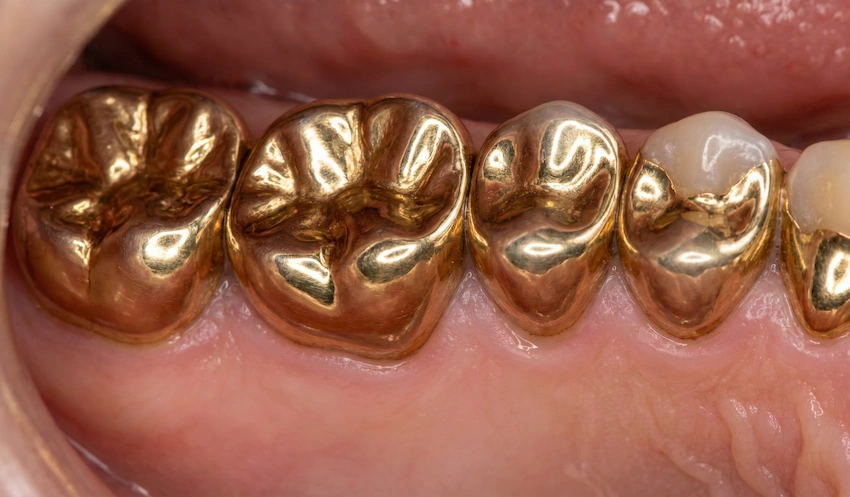
Gold in the bottom teeth often rrefersto two very different things: Permanent Restorations and Removable Grillz.
Your lower teeth, actually, bear a lot of pressure. They are the hard-working “horses” of the jaw, continuously grinding and moving against the upper teeth. This is the main advantage of gold. Gold unlike porcelain, which can be harsh to the opposing teeth, is “gentle.” It wears at a pace almost identical to natural tooth enamel.
Professor Doctor Coşkun Yıldız states in one of his lectures that gold is probably the thing that comes most closely to “living metal” that we have in a clinical setting. Just like your natural teeth, it expands and contracts with temperature changes thus it does not get the micro-cracks that are common with other materials.
Comparing Gold Options for the Lower Arch
| Feature | Gold Crowns (Permanent) | Gold Grillz (Removable) | Gold Inlays / Onlays |
| Primary Purpose | Restoration & longevity | Aesthetic & fashion | Structural repair |
| Longevity | 20–30+ years | Variable (wear-dependent) | 15–20 years |
| Durability Level | Highest | Medium | Highest |
| Oral Care | Standard brushing & flossing | Requires specialized cleaning | Standard brushing & flossing |
| Cost Range | Affordable high-luxury | Varies by gold karat | Moderate |
Who Is This For?
So, the question is: who really wants to have gold in their oral cavity? In fact, we divide our patients into two groups.
1. The Functionalist
It is just a matter of biology for some. If you have bruxism (severe teeth grinding), the ceramic crown may break if you put it on the bottom molar. Gold will not. Gold is a metal that can be shaped. We have seen that patients coming to Lema Dental Clinic, who have faced difficulties with other products, mostly find their final solution with a high-noble gold alloy.
2. The Style Icon
During speaking, the lower teeth are often more visible than the upper ones. If speakers wish to attract attention, the gold in the bottom teeth gives a discreet but very recognizable sign of luxury. It is a signature.
The Lema Touch: Why Choose Turkey for Gold Restorations?
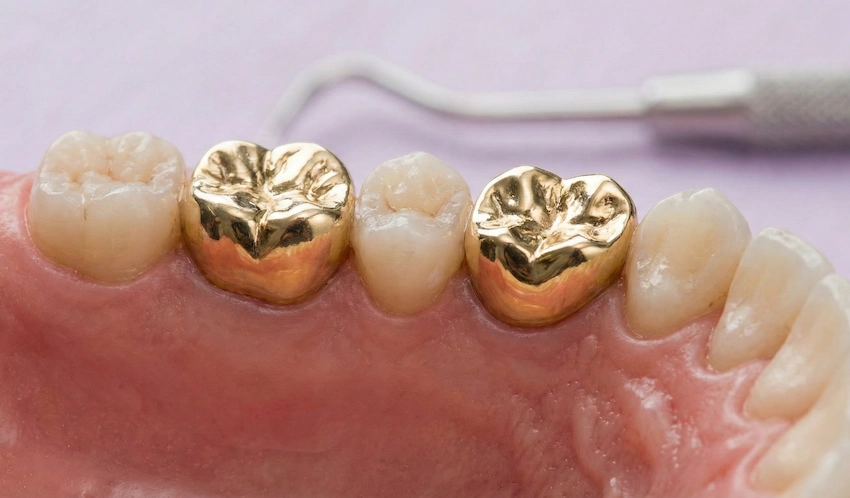
In various parts of the world, the art of working with gold is disappearing; however, this is not the case in Turkey. At Lema Dental Clinic, Dentist Polen Akkılıç and her team treat each restoration as a custom-made piece of jewelry.
Since we operate in Istanbul, we can offer the top-quality 22k and 24k gold alloys at very reasonable prices compared to London or New York. It should never be your dilemma to pick either your health or your wallet when going for gold; both of them should be upgraded at the same time.
One can compare the jawbone to the foundation of a house. It is very unlikely that you would cover a work of art with a cheap and fragile roof. Gold plays the role of a buffer that shields the foundation and also keeps the neighbouring teeth healthy for a long time.
Frequently Asked Questions (From the Doctor’s Desk)
Actually, high-karat gold is a chemically inactive element. This means that it does not chemically change when it contacts your saliva or food. If there is a “metallic” taste, it is attributable to the use of a poor-quality base metal alloy. At Lema, to give you a natural feeling of your mouth including the taste, we employ high-noble alloys.
Preparation for a gold crown is far less painful than that for a porcelain one. A thinner crown can be made as gold is so strong; thus, less of the natural tooth is taken away to accommodate it. The patient is certainly the winner in this situation.
Gold in its purest form does not oxidize. In contrast, the gold used in the process of making dental prosthetics is a combination (with metals such as platinum or silver for greater strength). If you observe appropriate oral hygiene and have your regular cleaning sessions with Dentist Polen Akkılıç, then your gold will remain as shiny as on the day of the fitting.
We will need to evaluate your periodontal health thoroughly before proceeding. Gold is very bio-compatible and “gum-friendly,” but we never build a house on shaky ground. We will first solve the problems in the gums and then proceed to the gold.
Typically, the whole process is done in 5 to 7 days. This time frame covers: consultation with Professor Doctor Coşkun Yıldız, digital scanning, lab work, and fitting.
- Anusavice, K. J., Shen, C., & Rawls, H. R. (2012). Phillips’ Science of Dental Materials. Elsevier Health Sciences.
- Donovan, T. E., & Cho, G. C. (2004). Materials for conservative posterior restorations. Journal of the California Dental Association, 32(6), 465–471.
- Kelly, J. R., & Nishimura, I. (2008). Science-based guidelines for maximizing outcomes through gold-based restorations. Journal of Prosthodontics, 17(7), 514–520.
- Knosp, H., Holliday, R. J., & Corti, C. W. (2003). Gold in dentistry: Alloys, uses and performance. Gold Bulletin, 36(3), 93–102.
- Wataha, J. C. (2002). Alloys for prosthodontics. Dental Clinics of North America, 46(3), 433–460.

