


No—medically approved gold teeth do not cause cancer.
Wear a gold smile, and people will always remember you. Gold has been the “gold standard” in dental restoration for ages—if the puns are okay. But, as patients are getting more health awareness and digging into the biocompatibility of materials, a very dark question somehow comes up: Can gold teeth cause cancer?
It makes sense. We are so used to distrusting everything, especially what we put inside our bodies. But let’s check the science, the history, and what’s actually happening here in Istanbul in our clinics.
Biocompatibility: What Makes Gold a Surgeon’s Favorite?
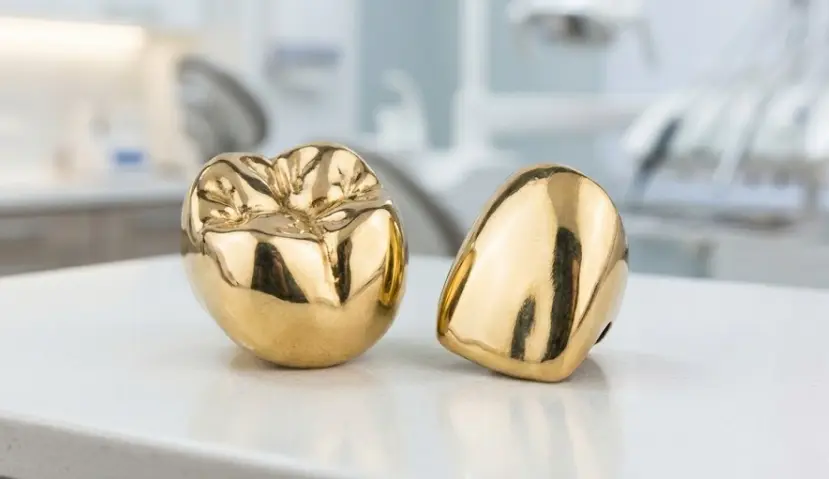
We label gold as ‘noble’. In chemistry, it means that a substance is very stable. It doesn’t react with moisture and acids in your mouth. So, think about gold as an expensive raincoat: it keeps you completely dry no matter how heavy the rain is.
On our side at Lema Dental Clinic, we have seen thathigh-noble gold alloys are among the closest-tissue materials possible. Dr. Coşkun Yıldız points out that gingival tissue (gums) almost always reacts better to well-polished gold than any other metal alloy.
The Difference Between Pure Gold and Gold Alloys
It is a fact that “gold teeth” are hardly ever 24k pure gold. Because pure gold is too soft, it would be like trying to chew on a piece of lead. So, we use alloys instead.
- The Noble Alloys: Have at least 60% of noble metals (gold, platinum, palladium) in them.
- The Base-Metal Alloys: Have nickel, chrome, or cobalt.
The “cancer scare” normally comes from a slight misinterpretation of galvanism or irritation. It is, of course, possible for chronic inflammation induced by a badly fitted crown to result in tissue changes over a long period, but gold itself is not a carcinogen.
Comparing Dental Materials: Safety and Longevity
| Material Type | Biocompatibility | Cancer Risk | Longevity | Usage |
| High-Noble Gold | Excellent | None | 20+ Years | Molars (Heavy Chewing) |
| Zirconia | Excellent | None | 15+ Years | Aesthetics & Strength |
| Porcelain-Fused-to-Metal | Good | None* | 10–15 Years | General Crowns |
| Base Metal Alloys | Fair (Potential Allergy) | None | ~10 Years | Budget Options |
What Research Says?
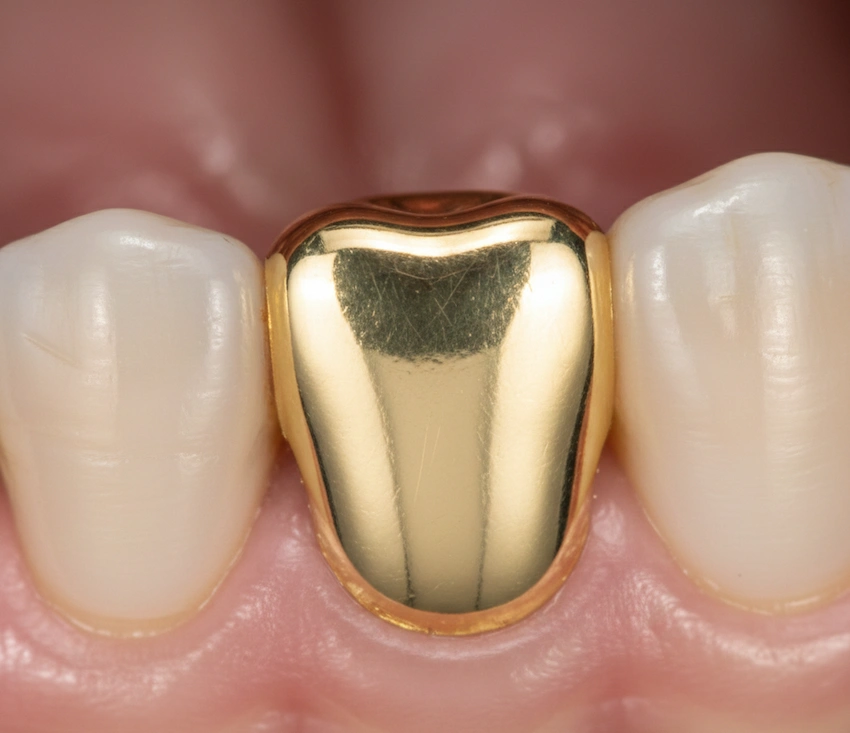
So, how about the proof? Is there one? Even the most broadly based clinical research in oncology has not revealed any oral cancer cases where the major causative factor was gold dental work. The stability of gold is so high that among medical implants there are even eyelid weights and some cancer treatments that use gold (chime-therapy).
Dentist Polen Akkılıç and her team stress the point that the source of danger is not the gold but the issue of fit. A crown with “bad” material-wise or otherwise will always be the biggest health threat as it will be a nest for bacteria and cause chronic infections. The same way your body doesn’t like getting splinters time and time again, it doesn’t like constant irritation either.
Why Should You Trust Turkey With Your Restorations?
Turkey has become the world’s leading center for advanced prosthodontics, and while the price is one reason, another big factor is precision. At Lema Dental Clinic, we use digital scanning to make sure that your restorations, whether gold or zirconia, fit like a glove. Besides a perfect match, a crown that almost feels like a second skin means that there will be no chronic irritation, no inflammation, and one less thing to worry about. Left here are the long-term cellular changes.
FAQ: Direct Answers from Our Experts
It is an extremely rare case, but yes it can happen. Most of the time, it is not the gold that causes the allergy but the other metals mixed with it such as nickel. If you have certain metal allergies, a biocompatibility test can be performed or you can choose Zirconia.
Because gold is a noble metal, it does not “disintegrate” or “leach” as other base metals might. In addition, it remains chemically unchanged. The chances are that you will obtain more minerals from a multivitamin than from a gold dental crown.
Very often we hear this one and it is quite a good one too. No, one single crown or even a bridge is not enough to provoke a standard metal detector to react. You are good to go with your lovely Istanbul smile.
Usually, the answer is no. A metallic taste is a sign of “oral galvanism,” which is when two different metals (examples could be an old silver amalgam filling and a gold crown) generate a tiny electrical current. We look for it when you are in the planning phase.
Gold is very “soft” to your opposing teeth. The enamel is worn down very close to the rate of natural enamel. If you are a “grinder,” gold might actually be the safest choice for your overall jaw health.
- Anusavice, K. J., Shen, C., & Rawls, H. R. (2012). Phillips’ Science of Dental Materials. Elsevier Health Sciences.
- Boutsiouki, C., & Frankenberger, R. (2022). Adverse effects of dental materials: A clinical perspective. Journal of Oral Rehabilitation, 49(6), 612-624.
- Gawkrodger, D. J. (2005). Metal sensitivities and the mouth. British Dental Journal, 199(5), 273-277.
- Schmalz, G., & Garhammer, P. (2002). Biological interactions of dental cast alloys with oral tissues. Dental Materials, 18(5), 396-406.
- Wataha, J. C. (2000). Biocompatibility of dental casting alloys: A review. The Journal of Prosthetic Dentistry, 83(2), 223-234.

