


A true Hollywood Smile is not a single product; it is a custom combination of veneers for aesthetics, crowns for protection, and implants to replace missing teeth.
A modern Hollywood Smile is, actually, a very sophisticated prosthodontic and periodontal rehabilitation plan. Instead of simply using a single cosmetic product for the entire mouth, the dentist goes down with your teeth one by one to figure out a restoration plan for a particular pathology on each individual tooth. The right combinations of different clinical treatments depend on the enamel density and structure of roots and jawbone. The results are aesthetic as well as oral health for the long time! Identifying how different the biomechanics of these three major dental restorations are is the very first move when making out your dental treatment.
E-max Veneers: Conservative Enamel Restoration
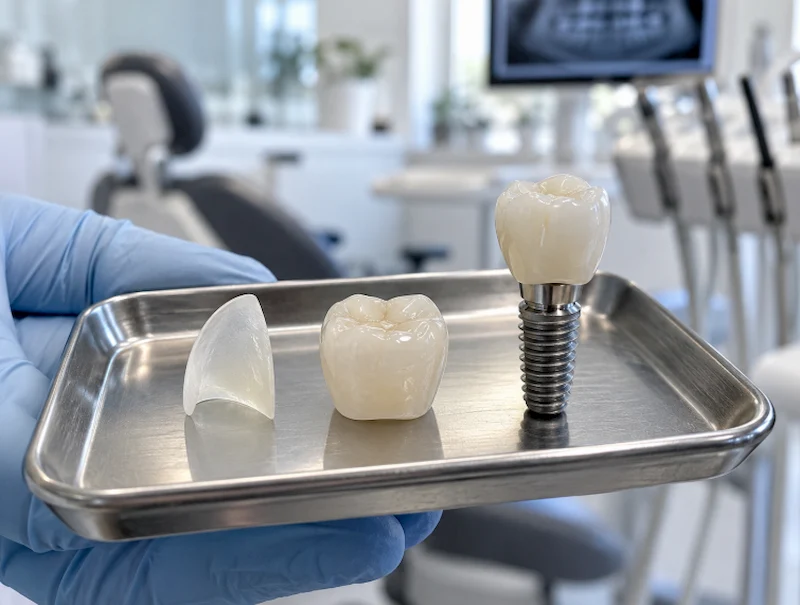
Veneers are basically thin sheets of porcelain that are permanently adhered to the outer surface of the front teeth only. Veneers are an alternative treatment to consider if you want to make very small aesthetic changes like correcting discolored teeth (that whitening cannot fix) without changing the tooth structure. A very slight reshaping (0.3mm to 0.5mm) of the porcelain that covers the tooth surface is all it takes, so the dentist’s removal of any portion of your natural enamel that is healthy enough to protect the living tissue beneath stays the same.
Zirconia Crowns: Full-Coverage Prosthodontic Protection
When the structural integrity of a tooth is so much compromised that only a very small fragment is left, veneers simply can’t be an option anymore. The dental crown is a prosthodontic restoration that covers the whole of the patient-facing side of the tooth down to the gum line. Crowns are a must where extensive dental decay, a broken tooth, or a large failing filling cannot be fixed any other way.
Also, after root canal treatment, there is no blood supply to the tooth, so the dentin is soft and, therefore, it can only withstand very slight pressures from mastication. Hence, such a teeth absolutely need a zirconium crown, the kind of which the patient can chew without the risk of fracture of the remaining structure of dentin.
Dental Implants: Treating Edentulism and Bone Resorption
Both veneers and crowns are only a way to beautify that is based upon an existing, healthy tooth root. When you lose an entire tooth (edentulism) or when a tooth has to be removed by a clinician because it is no longer suitable to be restored, it is a dental implant that is your choice.
An implant is nothing less than replacement for the whole denture of a tooth. During surgery, the alveolar bone that supports your upper or lower chewing area (maxilla or mandible ) is pierced with a drill in a precise location and a tiny titanium post (biomat) is screwed into the hole until it is flush with the bone. By osseointegration — a cellular-level process by which bone tissue literally ‘grows’ tightly together with the surface of the titanium threads — this titanium rod that has been embedded will become part of your natural bony system.
Professor Doctor Coşkun Yıldız is very fond of implants for their capacity (to which no other kind of dental prothesis can match) of generating the kind of mechanical stress that is a requirement (for keeping the jaws and thus the face from a drastic deterioration)
The Clinical Diagnostic Process
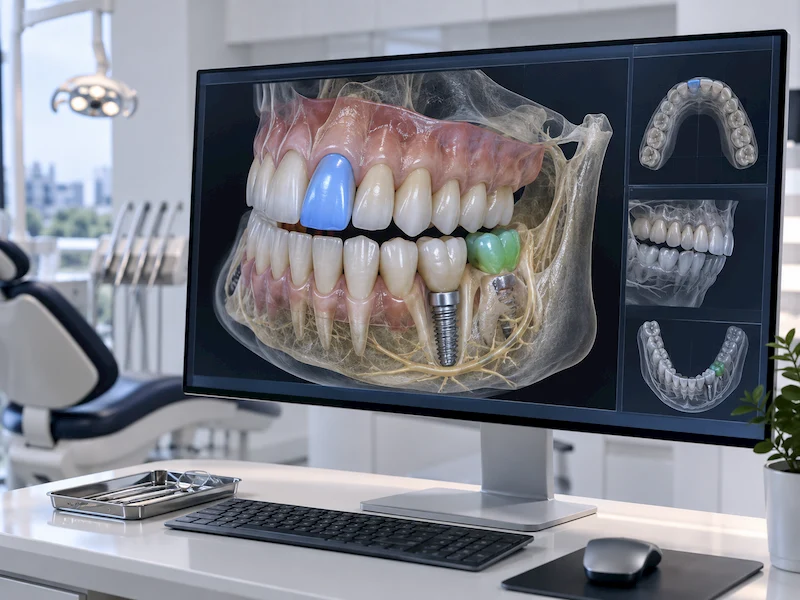
We do treatment planning at Lema Dental Clinic by very detailed jawbone imaging which is maxillofacial radiography.Dentist Polen Akkılıç is using 3D Cone Beam Computed Tomography and digital intraoral scanners to detect your gum health, level of bone density, and the occlusal bite alignment. The collected information allows us to precisely position implants, veneers or crowns so that the resulting prostheses will spread chewing forces properly and, at the same time, maintain the most desirable condition of the patient’s gingival tissue
Procedure Comparison at a Glance
| Prosthesis Type | Primary Clinical Indication | Required Enamel Preparation | Oral Health Benefit |
| Porcelain Veneer | Surface enamel defects, minor crowding, or staining. | Minimal (0.3mm – 0.5mm reduction of labial enamel). | Preserves natural tooth vitality and pulp health. |
| Zirconia Crown | Deep dental decay, root-canaled teeth, fractured cusps. | Extensive (circumferential reduction to create a seating margin). | Restores heavy bite force and seals out bacterial microleakage. |
| Dental Implant | Missing teeth, irreversible periodontal disease requiring extraction. | None to adjacent teeth (requires surgical placement in bone). | Halts alveolar bone loss and mimics periodontal ligament function. |
Frequently Asked Questions
1. Can dental caries (cavities) develop underneath a veneer or crown?
The ceramic materials (Zirconia and Lithium Disilicate/E-max) cannot decay. However, the natural tooth structure exposed at the gingival margin where the restoration meets the gum line is still highly susceptible to bacterial plaque. Maintaining strict daily oral hygiene and regular periodontal cleanings is mandatory to prevent secondary decay.
2. Why can’t I just get a veneer on a tooth that had a root canal?
Endodontic therapy removes the living neurovascular tissue from inside the root canal, leaving the remaining tooth structure dry and highly brittle. A veneer only covers the front surface and provides no structural reinforcement. A full-coverage crown is medically required to hold the brittle tooth together and prevent it from splitting down the root during normal chewing.
3. Are titanium dental implants safe for my jawbone and gums?
Yes. Titanium is a highly biocompatible material used extensively in orthopedic and maxillofacial surgery. It is completely inert, meaning the human immune system does not recognize it as a foreign body, virtually eliminating the risk of allergic rejection and allowing healthy bone cells to grow directly onto its surface.
4. Will combining implants and veneers negatively affect my bite alignment?
No, the opposite is true. Combining these treatments is often necessary to achieve correct occlusal harmony (bite alignment). Our digital CAD/CAM laboratory designs the crowns, veneers, and implant prosthetics simultaneously to ensure they interlock perfectly, preventing temporomandibular joint (TMJ) strain and muscular fatigue.
Academic References
- Albrektsson, T., Branemark, P. I., Hansson, H. A., & Lindstrom, J. (1981). Osseointegrated titanium implants: Requirements for ensuring a long-lasting, direct bone-to-implant anchorage in man. Acta Orthopaedica Scandinavica, 52(2), 155-170.
- Edelhoff, D., & Sorensen, J. A. (2002). Tooth structure removal associated with various preparation designs for anterior teeth. The Journal of Prosthetic Dentistry, 87(5), 503-509.
- Goodacre, C. J., Bernal, G., Rungcharassaeng, K., & Kan, J. Y. (2003). Clinical complications in fixed prosthodontics. The Journal of Prosthetic Dentistry, 90(1), 31-41.
- Magne, P., & Belser, U. (2002). Bonded Porcelain Restorations in the Anterior Dentition: A Biomimetic Approach. Quintessence Publishing.

