


All-on-4 implants replace missing teeth with a fixed full-arch smile using four implants per jaw.
All-on-4 dental implants are a type of implant in which the patient’s entire set of missing teeth is replaced with a denture secured by only four implants per jaw. The four implants are placed in a specific way in the jaw to support the full denture, which is not removable.
Patients usually have questions regarding bone grafting, discomfort, temporary teeth, the healing period, cost, and the upkeep requirements.
The Lema Dental Clinic experts, like Dentist Polen Akkılıç and Prof. Dr. Coşkun Yıldız, will check if the bone is healthy, the bite, the gum condition, and what you wish to change about a tooth’s shape and color, and based on these, they can decide if the All-on-4 implant is right for you.
| Question | Short Answer |
| How many implants are required? | 4 implants per treated arch |
| Is the restoration fixed? | Yes |
| Is bone grafting necessary? | Not always |
| Can temporary teeth be installed quickly? | Yes, in suitable cases |
| Is there a healing period? | Yes, usually several months |
| Is brushing essential? | Yes |
| Can implant complications happen? | Yes, as with any surgical or implant procedure |
| Is All-on-4 suitable for everyone? | No, a clinical assessment is required. |
What is the treatment of All-on-4 implants?

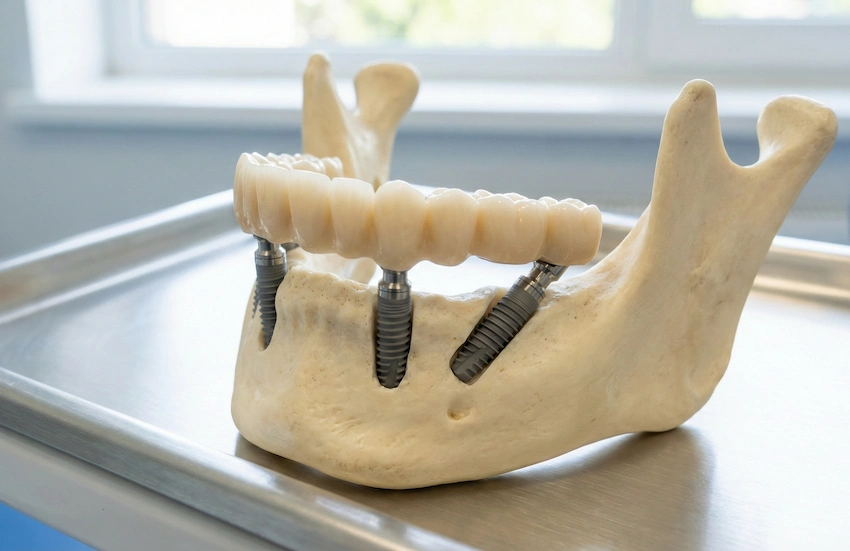
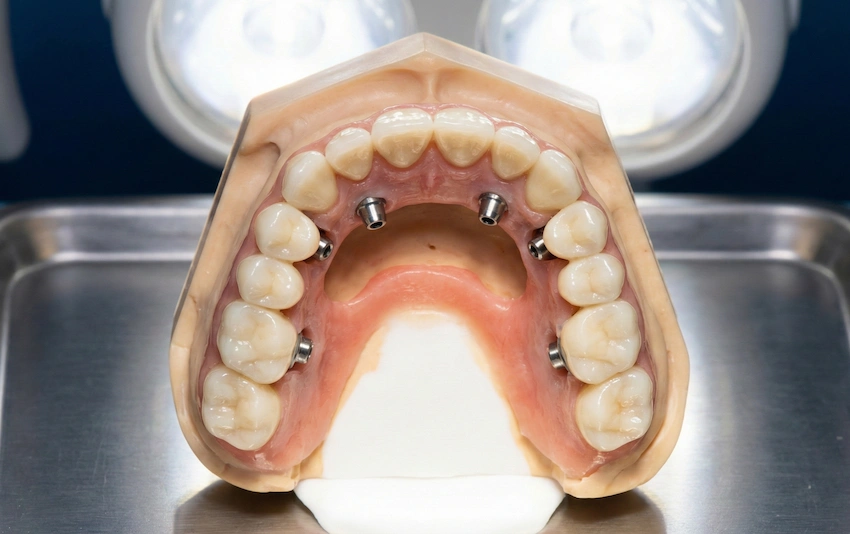
An All-on-4 implant technique is used in cases of full-arch missing teeth and is a kind of implant that is fixed with the prosthesis. Usually, two of the implants are near the front while two others, at the back, may be angled; if feasible, the posterior ones.
Such a design allows the patient to retain some of their teeth and also get dental arch support through implants.
According to a systematic review in 2026, both the All-on-4 and All-on-6 methods showed very high implant survival rates in the short, medium, and long terms. Nonetheless, the outcomes of treatment also hinge on correct treatment planning and patient selection.
How Do They Differ From Traditional Dentures?
Traditional full dentures are removable and mainly supported by the gums, whereas All-on-4 uses the implants placed in the jawbone to support a fixed prosthesis.
One of the main advantages is that the prosthetic teeth do not have to be taken out of the mouth every day by the patient.
All-on-4 can also enhance chewing and speech abilities and offer higher stability, but the restoration area should be cleaned regularly and properly as usual.
Why are just four implants used?
It is possible to support the whole mouth if the four dental implants are correctly placed in the patient’s mouth.
The two implants at the back of the jaws might be tilted at an angle so that they can utilize the remaining bone and at the same time avoid certain critical anatomical sites. Such a concept may also eliminate the requirement for extensive grafting in suitable patients.
Nonetheless, there are cases where four implants are the wrong number and such patients may require six implants or a different full-arch treatment option.
By evaluating 3D imaging and bone distribution, Dr. Poles Akkıcı and Prof. Dr. Coskun Yildız of the Lema Dental Clinic can determine the implant number and the position.
Do I Need a Bone Graft?
No one is sure to be required.
One benefit of the All-on-4 technique is that the concept can be very economicalin then utilization of remaining bone, which can reduce the requirement for bone grafting in selected patients, especially when the amount of lost bony tissue is considerable.
But on occasions there may be a necessity to perform a grafting as the bone tissue lost is a considerable amount or there isn’t sufficient stable structure for the implant placement without risk factors.
The final decision is reached after 3D imaging in combination with the doctor’s physical checkup.
Will I Get Teeth on the Same Day?
Temporarily installing fixed teeth may be feasible on the surgery day itself or very near the surgery time, provided the implants have enough initial stability.
Nonetheless, the same-day teeth are by no means the guaranteed solution for all patients.
Each patient needs to have a good quality of bone, sufficient implant stability, acceptable bite forces, and suitable conditions after surgical intervention. The academic literature is in favor of full immediate loading as a possibility when the patient conditions are properly understood and met.
A temporary tooth is replaced with or is only modified in order to be a part of the final treatment plan after the post-operative recovery period is completed.
How Long Is the Healing Process?
Normally, the tissues around the surgery sites will recover from irritation within days or weeks, but the deeper bone healing continues for months.
To a large extent, successful fusion of bone to implant depends on the implant design and the patient’s bone status. A healthy jaw is necessary for the implant to osseointegrate, and it usually takes from several months to a year.
The healing process of biological tissues takes place in phases, as a result of which patients usually get very used to the implants or do not feel any discomfort even when tissues are not fully healed.
Does One Experience Pain During the Treatment?
Besides the fact that one needs to be anesthetized with a local anesthetic during surgery to have a painless experience, one might experience either pressure or a moving sensation.
Six to eight weeks post-procedure, one can generally resume eating almost all types of food. It is a well-established fact in the professional literature that most implants integrate with bone without problems.
The amount of discomfort that a person may have is mainly dependent on a couple of different variables such as the number of teeth that were removed, the difficulty of the surgery, the kind of bone surgeries carried out, and finally, how a particular individual’s body heals.
What’s the Cost of These Implants?
We cannot determine just one single price for the All-on-4 technique that is applicable to each and every patient!
In general, the cost is mainly determined based on several elements such as the quantity of arches treated, type of implant, number of extractions, quantity and nature of bone procedures, availability and cost of temporary teeth, and finally, the kind of material that the final prosthesis will be made up of!
Lema Dental Clinic will make a diagnosis,s and the treatment plan will be prepared only after having assessed the patient’s dental condition, with the help of X-rays and other clinical means. A thorough explanation of the different stages of the procedure should be made by the doctor to thepatient, in detail before getting the treatment.
How Do I Clean and Care for Them?
All-on-4 restoration is basically artificial teeth that need your everyday attention regardless of the fact that they are not real.
You need to brush the prosthesis and clean the gum-prosthesis junction meticulously. Depending on how the dental restoration looks, your dentist may suggest:
- Using brushes for spaces between teeth
- Getting a special kind of floss for the implants
- Water flossers
- Professional cleaning for the implants
You shouldn’t neglect your check-ups with a dentist. A review study points out that continuous professional care is one crucial element in protecting the peri-implant tissues of full-arch fixed prostheses.
How Long Do They Last?
All-On-4 implants can be very durable depending on factors and proper care.
Detailed longitudinal research has demonstrated extremely high implant and prosthetic survivorship. A report with follow-up of 17 years was released. There was 97.4% implant survival at the upper jaw level and 98.9% at the lower jaw level in the study. Still, the results will depend largely on the personal circumstances of each patient.
Various habits and conditions, in addition to regular check-up visits, may shorten or extend the lifetime of the implants.
References
- PubMed – All-on-4 and All-on-6 Implant-Supported Fixed Prostheses: Systematic Review and Meta-Analysis (2026) – Current evidence on survival, bone changes, and complications.
- PubMed – The All-on-Four Treatment Concept: Systematic Review – Evidence on indications, graft reduction, survival, and complications.
- PubMed – Long-Term All-on-4 Outcomes With 3–17 Years of Follow-Up – Evidence on long-term implant survival.
- PubMed – Supportive Peri-Implant Care for Full-Arch Prostheses – Evidence on professional hygiene and long-term maintenance.

