


Healing inflammation is usually normal.
It’s quite a bitter irony. You went to the dentist mainly to get rid of a severe toothache, endured the procedure, and now, one day later, your jaw seems to be throbbing deep and continuously.
As far as we are concerned, the first cause of patient anxiety is post–endodontic pain. You panic. You think the infection is still there. You worry the treatment has failed.
The truth is that although root canal therapy kills the nerve inside the tooth, the tissues around the tooth are still alive—and often furious. Knowing the difference between “healing pain” and “failure pain” will enable you to maintain your calm during your period of convalescence in Turkey.
The “Amputation” Analogy: Why a Dead Tooth Still Hurts
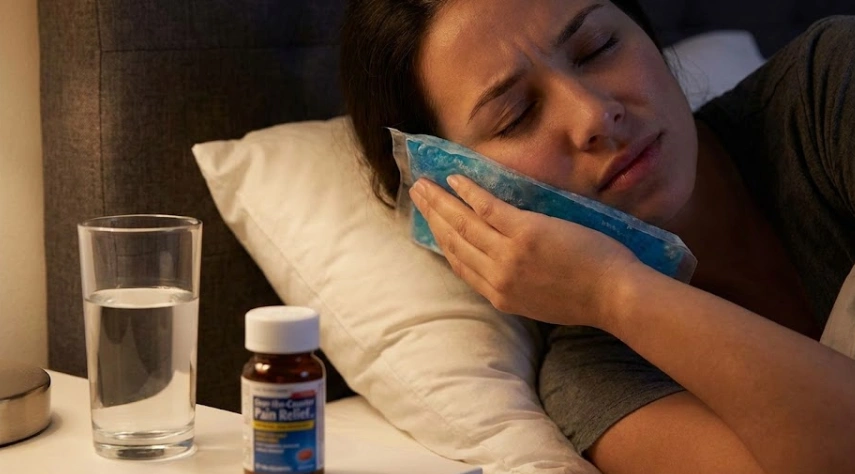
Professor Doctor Coşkun Yıldız sometimes puts it like this: A root canal is basically a very small surgical amputation. We have taken out the living tissue (the pulp) from the inside of the tooth.
Should you have an operation on your arm, you would naturally anticipate that the vicinity of the incision would be tender, swollen, and discolored for a few days, no matter how successful the operation was. The tooth that underwent the treatment is similar. The “throbbing” you notice is very seldom the tooth itself that is the cause of it (which is now empty) but the bone and the ligaments that hold the tooth inside the gum.
Nevertheless, let’s focus on the particular biological triggers. The following is a list of reasons why you are experiencing that throbbing sensation in form of a heartbeat:
- Bone “Bruise”: To reach and clean the infection, we use very thin files to the very tip of the root. Occasionally, these tools cause a little bruise at the point of the root exit in the jawbone.
- Chemical Irritation: To disinfect the root canal, the chemicals we use are very powerful and sometimes a very small amount leaking out of the root end causes irritation of the surrounding tissue.
- The “High” Bite: If the temporary filling is even a fraction too thick, your tooth opposite hammers it every time you swallow. Because the ligament is already swollen, this will have the same feeling of hitting a bruise with a hammer.
- Remaining Inflammation: The germs have been eliminated, but your immune system does not seem to have known yet. It keeps sending blood and white blood cells to the site, resulting to pressure.
Separating Normal Healing from Failure
At Lema Dental Clinic, we hold the view that a patient who is well informed is a patient who is relaxed. You should be aware of the circumstances when a bit of patience is required and when it is better to call a doctor.
| Symptom | Normal “Healing” Pain | Potential “Failed” Treatment |
| Type of Pain | Dull ache, tenderness to touch, mild throbbing. | Severe, sharp pain that wakes you up at night. |
| Response to Meds | Manageable with Ibuprofen/Paracetamol. | Painkillers have zero effect. |
| Swelling | None or very minor tenderness. | Visible facial swelling or a “pimple” on the gum. |
| Timeline | Peaks at Day 2-3, then fades. | Gets worse after Day 5. |
| Triggers | Chewing or tapping the tooth. | Spontaneous pain (hurts doing nothing). |
The “Missed Canal” Mystery
Here is what we see in the clinic often: Patients come to us for revision treatment because a previous dentist missed a canal.
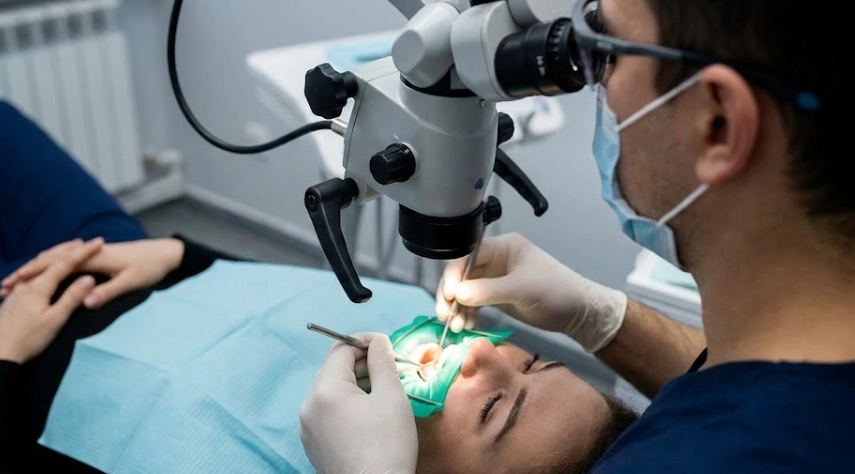
Teeth are not simple pipes; they are complex cave systems. Dentist Polen Akkılıç and her team utilize high-magnification microscopes and 3D imaging because some roots have hidden, curved, or extra channels. If one of these tiny branches is missed, bacteria remain inside, and the throbbing never stops because the infection is still active. This is why we emphasize that root canal therapy is not just about drilling; it is about mapping.
Clinical Answers to Post-Endodontic Pain
In a standard case, the sensitivity peaks between 24 and 48 hours after the anesthesia wears off. By day three or four, it should significantly subside. If you are still feeling a heavy heartbeat in the tooth after a week, that is a red flag that requires a follow-up.
Not usually. Antibiotics kill bacteria; they do not kill pain. If the nerve has been removed and the canals cleaned, the source of the bacteria is gone. The pain is likely inflammation (a bruise), which antibiotics won’t fix. We typically prescribe anti-inflammatory medication unless there is visible swelling or fever.
This is almost always due to the Periodontal Ligament (PDL). Think of the PDL as the shock absorber for your tooth. After a root canal, this shock absorber is swollen. Biting down puts pressure on it. We advise eating soft foods and chewing on the opposite side for at least 3-5 days to let it rest.
It is rare for it to “fail” immediately. Usually, immediate severe pain indicates a “flare-up”—a sudden immune response to the debris pushed out of the root during cleaning. While incredibly painful, it does not mean the tooth is lost; it just means your body is reacting aggressively to the treatment.
Yes. A tooth without a nerve and blood supply becomes brittle over time, like a dry branch. This is why we almost always recommend placing a crown (veneer or full coverage) shortly after the root canal is settled. It acts as a helmet to prevent the tooth from cracking under pressure.
- Siqueira Jr, J. F., & Rôças, I. N. (2021). Clinical Endodontics: Treatment of the Pulp and Apical Tissues. Quintessence Publishing.
- Pak, J. G., & White, S. N. (2011). Pain prevalence and severity before, during, and after root canal treatment: a systematic review. Journal of Endodontics, 37(4), 429-438.
- Nixdorf, D. R., et al. (2016). Frequency of persistent tooth pain after root canal therapy: a systematic review and meta-analysis. Journal of Endodontics, 36(2), 224-230.
- Polycarpou, N., et al. (2005). Prevalence of persistent pain after endodontic treatment and factors affecting its occurrence. Journal of Dentistry, 33(5), 381-388.
- Rosenberg, P. A. (2014). Endodontic Pain: Diagnosis, Causes, Prevention and Treatment. Springer.

