


Wait 24 hours before flossing around a new permanent crown.
The truth is, the process of getting a new dental crown can be an emotional roller coaster. You may be elated, but at the same time anxious. In the end, you are walking out of the dental office with a stunning permanent tooth. The problem starts when you keep asking yourself how to brush your teeth without hurting them. Some people are so terrified of brushing their new tooth that they don’t even get the courage to do it. To them, flossing is a much scarier thought.
Compare the dental adhesive to freshly spread cement under a heavy and costly marble tile. The tile is apparently firm instantly. But the cement needs time to dry and harden thoroughly. If you scrub or tug at the tile edges too soon, you will break the fragile seal.
We at Lema Dental Clinic have witnessed many times how patients ruin their dental treatments by not respecting the healing time, and at the same time, aiming at having perfectly cleaned teeth. If you’re going abroad to Turkey for a dental vacation, the only way to enjoy luxury dental care is by safeguarding your teeth during the first 48 hours.
Professor Doctor Coşkun Yıldız explains that the bonding material choice is the major deciding factor. Temporary crowns alone are fixed with a weak, easily breakable adhesive. In comparison, a permanent crown is cemented with a really strong adhesive, which is supposed to last a lifetime. Hence, in the future, you will be required to manage these two types of crowns in very different ways.
The Waiting Game: Temporary vs. Permanent Crowns
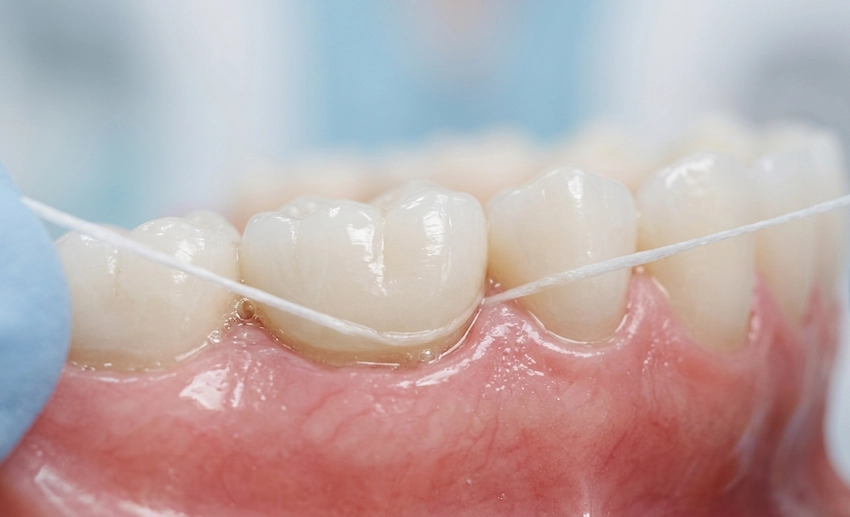
However, we must carefully look at the specific periods of healing that you need to follow for a safe recovery.
Temporary Crowns
If you resort to using a plastic temporary crown, at least the next day after placement, you will have to alter your daily routine. Once it is off, you can sanitize the area once you have the final tooth.
Still, what’s your stance on filling a temporary tooth? Even if temporary, it is crucial to floss so as not to affect the gum adversely. Gums need to be healthy and non-inflamed for the permanent crown. There is a smart trick here: never floss by lifting the string straight up! Instead, slide it down gently for cleaning and then pull the string out from the side. If you do pull the string back up, it will be the temporary tooth that comes off, not the string.
Permanent Crowns
When the polishing of your main gem, your crown, is done and it has been cemented, then the rules might vary. Permanent glue is being done with resin cements, which are generally very strong. But, even then, in your mouth, the glue may still be wet, so that drying completely takes time. The best suggestion that we can make is not to floss at all for 24 hours after the permanent crown installation.
After your first rest day, you can go back to brushing and flossing as usual, and also eat normally. Your replacement tooth can handle chewing and cleaning forces.
The “Slide, Don’t Lift” Rule
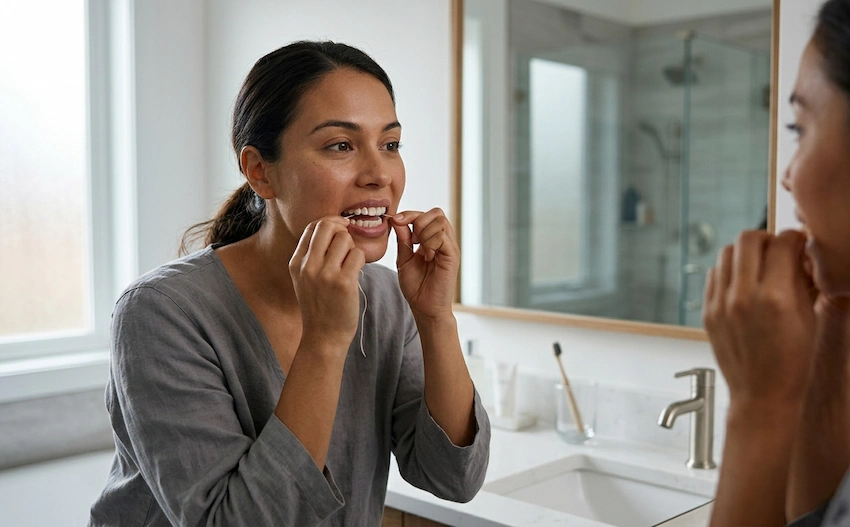
Simply put, here is what is often observed in the clinic: a patient severely pulls the dental floss down, then yanks it back up quickly.
When you have a newly crowned tooth, snapping the floss up will generate a very large force. This force directly targets the edges of your crown. Dentist Polen Akkılıç and her team spend extra time explaining the “Slide, Don’t Lift” safe method of flossing to our international patients before they go back to their home country.
- Slide Down: Gently move the floss back and forth so that you can slide it in between tight teeth.
- Sweep: Give a soft “C” shape around the tooth and wipe the soft gum line.
- Pull Through: Release one end. Pull the floss gently out through the side gap.
Timelines and Risks at a Glance
| Crown Type | Safe Waiting Time | Safe Cleaning Rule | Risk of Early Cleaning |
| Temporary Crown | 12 to 24 hours | Pull the string strictly through the side | The tooth falls off completely |
| Permanent Crown | 24 hours | Normal method (be gentle) | Tiny leaks in the fresh glue |
| Implant Crown | 24 to 48 hours | Water flosser only at first | Sore and bleeding gums |
Frequently Asked Questions
Yes, you may experience a small amount of bleeding for the first couple of days. We were very close to your gums when placing the new tooth. You will see that the swelling will completely disappear if you clean the area gently in order to get rid of the harmful bacteria.
If the crown is well-bonded and the 24-hr waiting period has elapsed, then the floss can’t remove it on its own. However, if your floss keeps snagging on a jagged edge and is shredding, then we suggest you come see us. The edge can be easily polished by our technician.
Sleeping on it and forgetting about it is not the right treatment. Think what will happen if you stop for weeks? Your gums will become very inflamed and painful. By then, gluing your final tooth will be almost impossible. Clean it with care and always pull the floss out only through the side.
The answer is yes. They are excellent at flossing new crowns and bridges. The possibility of your tooth’s edge being caught and pulled off is zero. During your first week of healing, they will be your perfect accessory.
Firstly, do not panic, and most definitely do not jerk the string upwards. With one hand, let go of the floss. Then, slowly pull the entire floss flat and horizontally out through the side of the teeth.
- Rosenstiel, S. F., Land, M. F., & Fujimoto, J. (2015). Contemporary Fixed Prosthodontics (5th ed.). Mosby.
- Hill, E. E., & Lott, J. (2011). A clinically focused discussion of luting materials. Australian Dental Journal, 56(1), 67-76.
- Heintze, S. D. (2007). Crown pull-off test (crown retention test) to evaluate the bonding effectiveness of luting agents. Dental Materials, 23(8), 1052-1065.
- Chapple, I. L., Van der Weijden, F., Doerfer, C., Herrera, D., Shapira, L., Polak, D., … & Graziani, F. (2015). Primary prevention of periodontitis: managing gingivitis. Journal of Clinical Periodontology, 42(S16), S71-S76.
- Ng, E., & Lim, L. P. (2019). An Overview of Different Interdental Cleaning Aids and Their Effectiveness. Dentistry Journal, 7(2), 56.

